
$199 VO mic sounds better than U87 Ai? Warm Audio WA 87jr SE
· Audio · Microphones · 11:03
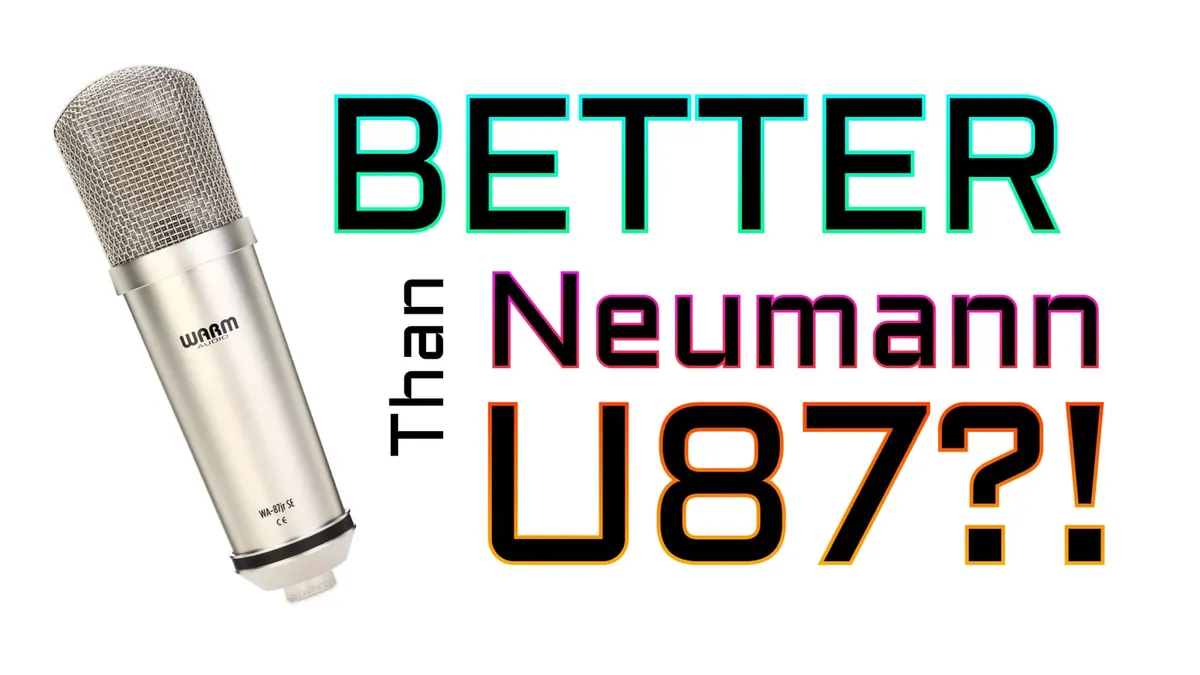
In this week’s episode we take a look at the Warm Audio WA 87jr SE microphone and test it against the classic Neumann U87 as well as the RODE NT-1 5th Generation. How will they measure up to each other? Can this $200 USD microphone hold a flame to the beloved $2,000 Neumann? Which one turns out to be Curtis’ new favorite?! Let’s find out!
Gear used or mentioned
The links below are Amazon, B&H Photo, Sweetwater, or other affiliate links. As an affiliate, I earn from qualifying purchases.
Read the transcript
Full disclosure, Warm Audio sent me the WA-87jr Studio Essential microphone free of charge for this comparison against my own Neumann U87Ai and a Rode NT-1 5th Generation (also sent for review), all recorded into a Sound Devices MixPre-3 II. This is from a voiceover perspective, not music/vocals.
The WA-87jr Studio Essential uses a gold-sputtered large-diaphragm single-backplate K87-style capsule, designed to emulate the vintage original Neumann U87 sound rather than the modern U87Ai. It has a fully discrete signal path (no integrated chips), 9 dB(A) self-noise (very good, matching my own measurements), 100-ohm output impedance (works with any modern preamp), and -37 dBV sensitivity, needing modest gain (43 dB on my MixPre for my relatively quiet voice). It shares its capsule with Warm Audio’s $700 WA-87 R2. Unlike the step-up WA-87jr (which has switchable polar patterns, a -10dB pad, and a high-pass filter), this Studio Essential version is cardioid-only with no switches — fine for voiceover. It’s a FET design (no transformer, unlike the R2), which likely contributes to its lower self-noise, and ships with a hard mount rather than a shock mount.
Testing: strong proximity effect available when wanted, plosives surprisingly well controlled given the open grille, no RF interference detected with a phone moved around the mic, some stand-bump transfer through the hard mount (worse than tapping the mic itself), and reasonably controlled off-axis coloration typical of any cardioid. A practical self-noise test (normalized to -23 LUFS, 80Hz/24dB-per-octave high-pass applied) measured a noise floor of -70 dB — excellent; room noise will be your limiting factor, not this mic. Build is solid all-metal with a 5-year warranty, hand-tested in Austin, Texas (likely assembled elsewhere), priced at $199 USD.
My take: surprisingly open, warm, and pleasant without being woolly, with detailed but not overly sibilant highs — impressive at this price. I’m swapping it in as my primary voiceover mic ahead of both my Rode NT-1 and JZ Microphones V11 (the V11’s dark tonal character gets a bit lost once music is added behind dialogue, whereas the brighter NT-1 and this WA-87jr SE cut through better). The only real con is the lack of an included shock mount — available separately for $89, though at that point you might as well spend $10 more for the full WA-87jr, which adds the shock mount, pad, high-pass filter, and multiple polar patterns. Strong recommendation for an affordable voiceover mic. Get out there and make some great sound, and we’ll talk to you again soon.