
32-bit float recorders & differences in audio quality
· Audio · Recorders · 9:53
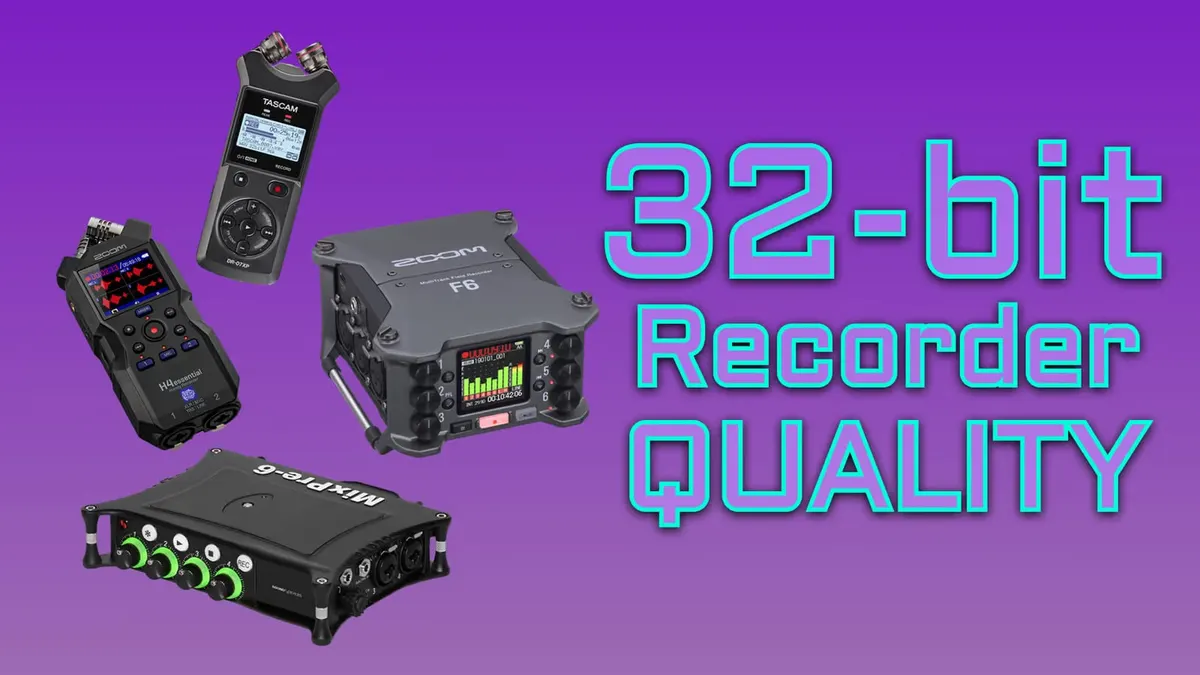
In this week’s episode, we discuss the difference in audio quality between budget and higher priced 32-bit float audio recorders.
Gear used or mentioned
The links below are Amazon, B&H Photo, Sweetwater, or other affiliate links. As an affiliate, I earn from qualifying purchases.
Read the transcript
32-bit float recording is genuinely useful — it removes the need to carefully set gain, freeing you to focus on mic placement and managing room noise. But not all 32-bit float recorders produce equally good audio.
Traditional (16/24-bit) recording: a mic converts sound to an analog signal, a preamp applies gain you set manually, and an A/D converter turns it into digital ones and zeros. If you set gain too high and exceed 0 dB full scale, the result clips and distorts, and that damage generally can’t be undone afterward, even by reducing levels in post.
32-bit float recording instead uses a fixed, deliberately low preamp gain set by the manufacturer, feeding two or more A/D converters simultaneously — one captures louder/higher-amplitude sound, another captures quieter sound, and the two streams are combined into a wider dynamic-range 32-bit float file. The level fader on most 32-bit float recorders doesn’t touch the analog preamp gain at all — it’s just doing math on the already-converted digital samples, boosting or attenuating every sample, which means it also boosts the noise floor along with the signal. High-quality recorders use clean enough preamps that this isn’t very costly.
The apparent “magic”: if your recorded level actually exceeds 0 dB in the file, you can often bring it into post and reduce it, restoring a non-clipped result in most (not all) cases; similarly, very quiet recordings can often be boosted without raising the noise floor as much as with traditional 24/16-bit recording. But this only works well when every part of the signal chain — mic, preamp, converters, and the recombination process — is high quality. Weak links anywhere in that chain degrade the result, just like with traditional recorders.
Two examples: the Zoom H4 Essential ($200, purchased with my own money) does recover clipped-sounding recordings reasonably well when reduced in post, but boosting quiet dialogue tends to raise the noise floor noticeably — likely a preamp quality issue rather than a fundamental flaw of 32-bit float itself (32-bit float recordings are NOT inherently noise-free, despite a common myth). The Tascam DR-07XP, likely using a single A/D converter and lower-quality preamp/mic combination, shows similar noisiness when boosted — detailed samples are linked in reviews of both recorders.
Bottom line: even in the 32-bit float world, you still get what you pay for — the format alone doesn’t guarantee pristine, noise-free audio. For casual hobbyist content, budget recorders may be perfectly adequate. If you’re evaluating a recorder, listen to unprocessed samples (no noise reduction, no heavy compression/loudness normalization, and with YouTube’s “stable volume” feature turned off) across several models before deciding — generally, spending more (Zoom F-series, Sound Devices MixPre) gets you a cleaner-sounding recorder than budget options like the Zoom H4 Essential or DR-07XP. Get out there, make some great sound, and we’ll talk to you again soon.