
Amaran 150c & 300c | RGB Bowens mount lights for video
· Lighting · 11:55
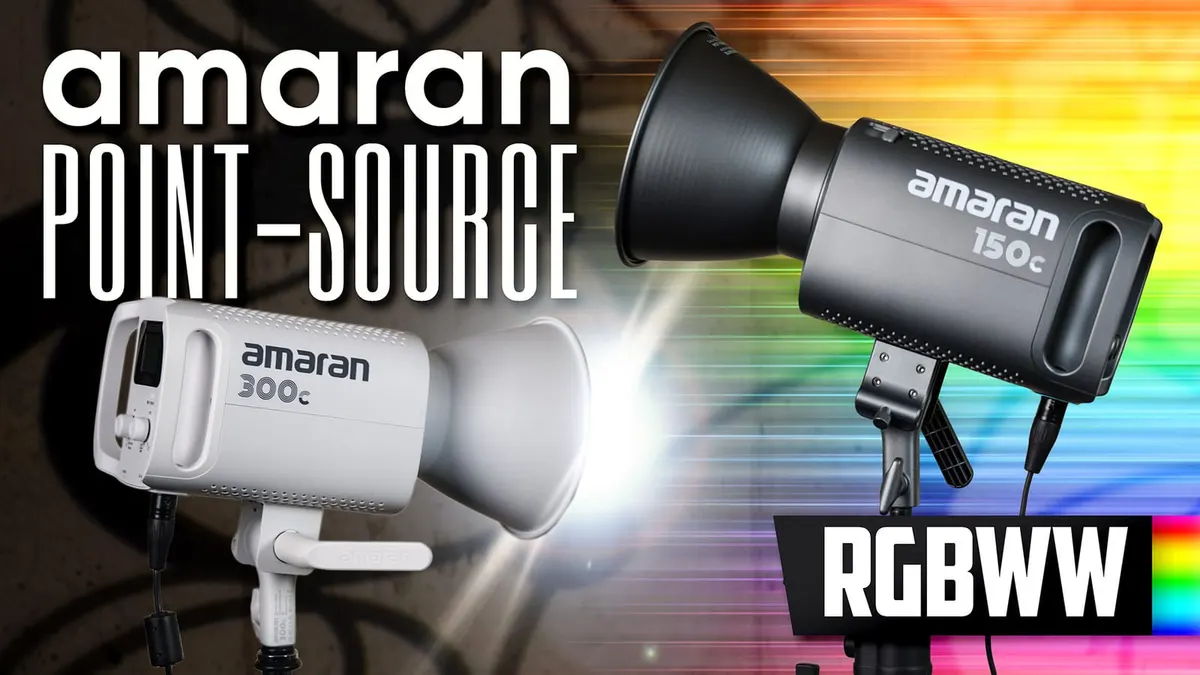
In this week’s episode we try out the new Amaran 150 and 300c fixtures. These single-point RGBWW lights from Aputure’s budget line feature full color plus warm and cool white capabilities. They can be adjusted from tungsten to daylight color temperatures and beyond for great versatility as key lights, and also make great effects fixtures with their preloaded effect library. Let’s take a closer look!
Gear used or mentioned
The links below are Amazon, B&H Photo, Sweetwater, or other affiliate links. As an affiliate, I earn from qualifying purchases.
- Amaran 150c single-point RGBWW LED light - B&H, Amazon
- Amaran 300c single-point RGBWW LED light — B&H, Amazon
- Amaran Pixel Tube Lights — Aputure, B&H, Amazon
- Aputure Spotlight Mount — Aputure, B&H, DVE Store. Amazon
- Aputure light dome II soft box — Aputure, B&H, Amazon
- Rosco Prismatic Glass Gobo in Cool Lavender — B&H
- Aputure power station — B&H, Amazon
- Westcott umbrella — Amazon
- Sennheiser MKH 8050 — B&H, Trew, Amazon
- Sound Devices MixPre audio recorder — B&H, Trew Audio, Sweetwater, DVE Store, Amazon
- Rycote PCS Microphone Quick-Release System — B&H
- Canon C70 cinema camera — B&H
- Canon RF 24-70 f/2.8L lens — B&H, Amazon
- Schneider Radiant Soft 1 diffusion filter — B&H
- Panasonic GH5 camera — B&H, Amazon
- Panasonic 12-35mm f/2.8 II lens — B&H, Amazon
Read the transcript
[Music]
In this episode, we’ll take a look at the Amaran 150c and 300c.
These are single point lights with a Bowens mount, so you can put a variety of different modifiers on them, use them as hard lights or soft lights. In this case, we’re using the 150c right here as my key light.
I have it set to 13%, color temperature is 3200K.
And with that output– again, 13%– the camera is set to 23.976 frames per second,
ISO 800, 180º shutter angle, which is roughly 1/48th of a second, and we’re at f2.8, just so you can get a sense. Plenty of light output if you want to use the 150c as a key light in a situation like this.
And obviously, we have a lot more output we could use, we’re only at 13%. We’re also using the 300c in party light mode on the background here, and we’re using the Aputure spotlight mount.
There is also a new, similar spotlight– less expensive– specifically for the Amaran line, which will be coming out here shortly. I haven’t tested that out yet, but that’s how we’re doing our lighting here.
We also have another light back here, that is our rim. That’s just at 2% percent.
That’s actually a LitePanels
Gemini, but we could also use one of the Amaran pixel tubes or anything like that as well.
So let’s talk about these lights in a little bit more detail.
First of all, I’m going to run through the pros. There are just a few cons I want to talk about as well.
First of all, this is a ‘pro-sumer’ RGB WW LED single point light.
That’s a mouthful– let me explain what all that means.
First of all, it has a Bowens mount as I mentioned, so you can use all sorts of light modifiers.
And the great news is that these lights, unlike some of the others, work very well with a lot of different modifiers that are already on the market, including things like the Aputure Fresnel 2x, so a fresnel lens to make a spotlight; barn doors if you want to cut the light; the F10 barn doors, so the really big barn doors– that also works with these; the F10 fresnel; also works with the spotlight mount.
Obviously, there will be the new, lower cost Spotlight SE– second edition,
I assume– that’ll be coming out. And of course, any sort of soft box, you can bounce it off of all sorts of things.
So the great thing is you can do hard light like we’re doing on the backdrop here or you can do soft light like we’re using for the key here.
So you can do almost anything with these lights.
Now, I say ‘pro-sumer,’ what does that mean? Well, the price, first of all, for the 150c is $359 USD and for the 300c $569 USD.
For a single point RGB WW light, that’s actually very, very good in terms of its pricing.
With the RGB color, you can create more than 90% of the colors that are available in the Rec.2020 color space.
That is to say, you can make almost any color you need to.
From my point of view, these make great effects lights.
So things like we’re doing on the backdrop here, but also in a pinch, you can use them as– not even in a pinch, they’re just good as pretty much everything: key, fill, effects, and pretty much anything else you can imagine you can do with these.
If you’re on a really tight budget, they do also feature an umbrella holder.
So if you just need to diffuse the light really simply and inexpensively, a white photographic umbrella will do the job here as well.
You can get those for $25-$50 USD.
Just like all of the modern Amaran lights, you can control it wirelessly via the Sidus Link app, and that makes it super easy, especially if you’re filming yourself, to go ahead and tune the settings to whatever you need.
So here, for example, is the green-magenta setting.
Watch: green… magenta.
And we can– that’s another nice feature with an RGB light like this, in the way they’ve implemented it,
I can tune the green-magenta balance too, so, I can match pretty much any other light out there.
The color temperature is tunable between 2500K up to 7500K, so, well beyond the typical tungsten to daylight range.
So again, you can match pretty much any existing lighting.
There are a whole variety of effects: party lights, which is what we’re using on the backdrop right now; cop car, paparazzi, fireworks, lightning, faulty bulb, TV, explosion, fire, pulsing, and strobe. So if you need any of those kinds of things, they’re all there. The cooling fans are redesigned from some of the earlier Amaran lights, and I would say they’re quiet enough not to interfere with any sound at a meter and a half and farther away. So for example, here’s the 150c. [Sample silence]
Haven’t done any sort of noise reduction.
And then the 300c is back over here projecting this light onto the background, so… …you can hear my stomach more than you can hear the lights! [laughs]
You can power both the 150 and the 300c with AC power, of course, or it also has a 48 volt input, so you can use the separately available Aputure power station with cinema batteries to power it on batteries if you need to do that as well. People will ask, how long? It depends on the size of the batteries.
So consider: that’s 300 watts for the big one, 150 watts. So you just have to do the math and figure out how long your particular batteries will power.
I’d say on the smaller cinebatteries probably around an hour.
Once you get into the bigger batteries, you can go a couple or three hours, even.
Build quality: we are looking mostly at plastic.
Again, these are the more pro-sumer lights.
So unlike the Aputure LightStorm lights, which are pretty much all metal, these are largely plastic, although I will say it’s a very high density quality-feeling plastic.
There is metal in the two most important parts: number one on the Bowens mount, that is metal.
And then the receiver on the yoke is also metal.
So I haven’t had any of these Amaran single point lights fail yet. I’ve been using them for, what, two and a half or three years or so, whenever the original Amaran single point lights came out.
And we haven’t had any problems with them. I’m pretty careful with my lights.
I also don’t overload them. So I think you can easily handle a soft box the size of the Aputure
LightDome on these without any problems. If you go bigger than that, you’re going to want to probably mount the soft box to your stand and then attach the light to the soft box.
The light itself has two knobs and then also a Bluetooth reset button; very simple. The knobs work nicely.
They also double as buttons so you can make all the selections in the menu you need there.
And then for the really kind of fine-tuned controls, you can always go to your app, the Sidus Link app, and control from there. Now, I should say, the Sidus Link app is the best remote control app for lights and lighting systems that I’ve used. A lot of the others, especially the more consumer oriented lights, tend to be difficult to work with because in some cases, you can only control one light at a time. That’s not very many of them at this point anymore, but reconnecting to them often is a chore.
It takes a bunch of work. So if you have to switch to another app and then come back to your lighting app…
On Sidus Link, it reconnects very quickly and makes it easy.
You can also control up to… I think it’s,
I don’t know, a hundred lights or something wild like that.
It’s more than I need for the work that I’m doing.
But it works really well. It’s a really well designed app, works on both iOS and Android. There are a few cons.
These are pretty persnickety; not anything major here that would say don’t buy these. Let me just run through a couple of things.
The foam cases are fine for storage. Not sure how well they would hold up especially, for example, if you have to fly and check them.
They’d probably be okay, but I wouldn’t want to trust them too long for something like that.
Again, these are pro-sumer lights. I don’t think they’re made for the rigors of set life like the Aputure LightStorms are, so just keep that in mind. Amaran has spoiled me.
So a few weeks ago, we reviewed the Amaran 200x S, which is a bicolor light, single point. In fact, it’s right… …here. This is actually my favorite single point light in terms of color quality that I have used to this point in my video career.
So it produces the best color quality that is the closest actual tungsten light that I have ever seen.
Unfortunately, these new 150c and 300c, they’re good, but not quite as good as this. So for example, the 150– I think the lowest SSI score we got in tungsten mode, 3200K, was an 84 out of 100.
SSI being spectral similarity index, and we’ll put all the specs up here on the screen, so you can pause if you want to look through them in detail.
And then in daylight mode, they were only around 73, which is not nearly as good. On the 200x S, both daylight and tungsten came in at 90 SSI, just for reference there.
So if you’re buying something for a key light,
I would buy, actually, one of these.
And then when it gets time for an effects light or a light that you can use in a pinch for a key light–
I mean, it’s it’s okay, but I mean– you’re seeing what it looks like right now. I’m just spoiled.
This would be my number one choice for a key light and then these would be my… a great choice,
I think, for effects lights and kind of all-arounders.
One last thing: at some angles, it’s a little bit difficult to read the screen.
It’s not a deal breaker, but it’s a little bit difficult, if you’re at a kind of a sharp angle, to read this screen.
Alright: my take. So– these are great, affordable RGB WW lights.
They produce pretty much any color that you need.
Great as effects lights, but they can also double as a key or a rim or a hair light or fill light or anything else that you might need a light to do.
I love the Bowens mount, it works well.
You’ve got a million different options out there, and I’m really happy that on the 150c and the 300c, they’ve put a diffusion… I don’t know if it’s glass or what it is, in front of the LEDs, so it mixes the light. And it does it in a way that you can still use it as a hard light through an ellipsoidal or with barn doors or anything like that.
So it’s great that these work with pretty much all of the existing Aputure light modifiers and modifiers from lots of other manufacturers as well.
As I mentioned, my ideal kit would be the 200x S as a key light, a 150 or a 300c as an effect light like I’m doing here for the background with a spotlight mount– and remember, there is also going to be a new Spotlight second edition, that I believe launches here at the same time, that’s a lot less expensive. So the original was several hundred dollars; the new one, I think, is less than $400, which is actually very, very affordable for an ellipsoidal light that you can put gobos in and make all sorts of interesting patterns for your backgrounds. And then I would also add an Amaran pixel tube as a rim light for producing this kind of thing, or hair light.
The two foot version would probably be plenty, the four foot version could even cover a larger area, but that would kind of be, I think, a really, really nice kit for single person talking head, just like this.
So I hope that was helpful. If you have any questions, go ahead and leave those down below. If you’ve not already subscribed, make sure you do that. And we’ll be sure to get you more great videos on how to improve your lighting and sound for video. Talk to you soon.