
amaran Pano 120c & 60c LED light review
· Lighting · 9:57
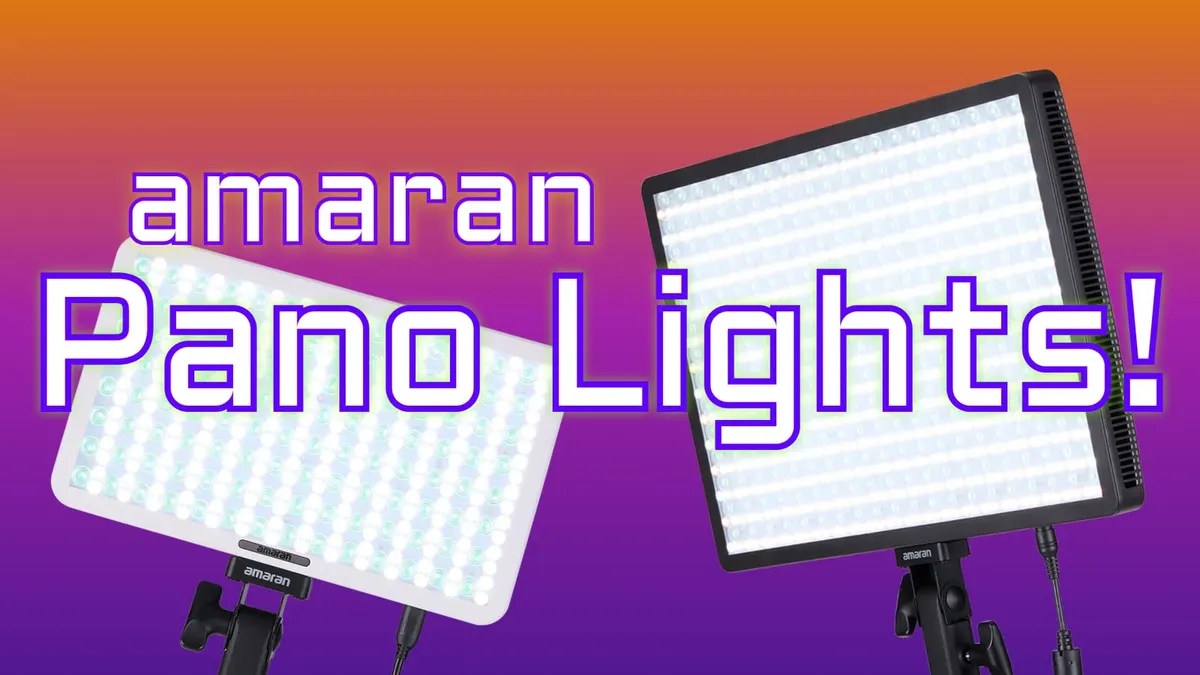
In this review, we have a look at amaran’s new panel lights, the Pano 60c and 120c. These RGBWW LED panel lights are great for content creation, streaming, and home studios. In this episode we briefly cover the Pano lights’ feature sets, show you one possible use case, and compare them to other lights in the amaran lineup. Let’s take a closer look!
Gear used or mentioned
The links below are Amazon, B&H Photo, Sweetwater, or other affiliate links. As an affiliate, I earn from qualifying purchases.
Read the transcript
Amaran sent me the Pano 120C ($289) and 60C ($165) lights free of charge for this review. Amaran and Aputure split into separate brands a while back — Amaran targets creators (mostly plastic build, home/office studio use) while Aputure serves bigger-budget production crews needing rugged, production-truck-durable gear.
Color quality and output are both strong — the 120C bounced off unbleached muslin fully lights this video at just 15% intensity with the fan staying off even in smart mode; even when the fan does kick in, it’s very quiet from a couple meters away. Both lights are full-color (RGB) in addition to white light, so you can do effects lighting too, which is impressive at this price. They have a 45° beam angle — not a flood, not a hard spot, giving flexibility to throw light farther or soften it by bouncing.
They use Amaran’s ACE-E-lock quick-release mount, compatible with an upcoming battery-pack accessory called the Peak for cable-free “Hollywood lighting” handheld use — though the connection does wobble slightly. Fan/thermal management offers a no-fan mode (limits max output) or smart-fan mode (full 100% output, fan only as needed). Both integrate with the Amaran app (which also controls Aputure lights). They can be powered via included AC adapters or USB-C PD — the 60C needs 65W PD, the 120C needs 140W PD, so you’ll need beefier power banks, not tiny ones. Kits include a soft case, softbox, power adapter, grid, and diffusion panel. Build is mostly plastic but decent quality. Flicker testing at 1/785s shutter, 11° shutter angle, dimmed to 10%, showed no flicker for video use.
These are for creators who take reasonable care of their gear rather than throwing lights on a production truck daily, but who still want high color quality — SSI performance is on par with much pricier Aputure lights. For comparison: Amaran’s 300C/150C are point-source lights needing accessories to shape the beam (softbox or hard spotlight/projection), offering more flexibility and output at a higher price; the Verge series are edge-lit LED panels meant for very close-range desk use (like video calls); and the 200XS is the pick if you need the most color-critical output for something like product advertising. The Pano series sits in a nice middle ground — soft when bounced or with the included softbox, or thrown a bit farther when used bare. Hope that was helpful — let me know your questions below, and we’ll talk to you again next week.