
amaran Ray 60c and 120c, Tiny Bright Lights
· Lighting · 13:03
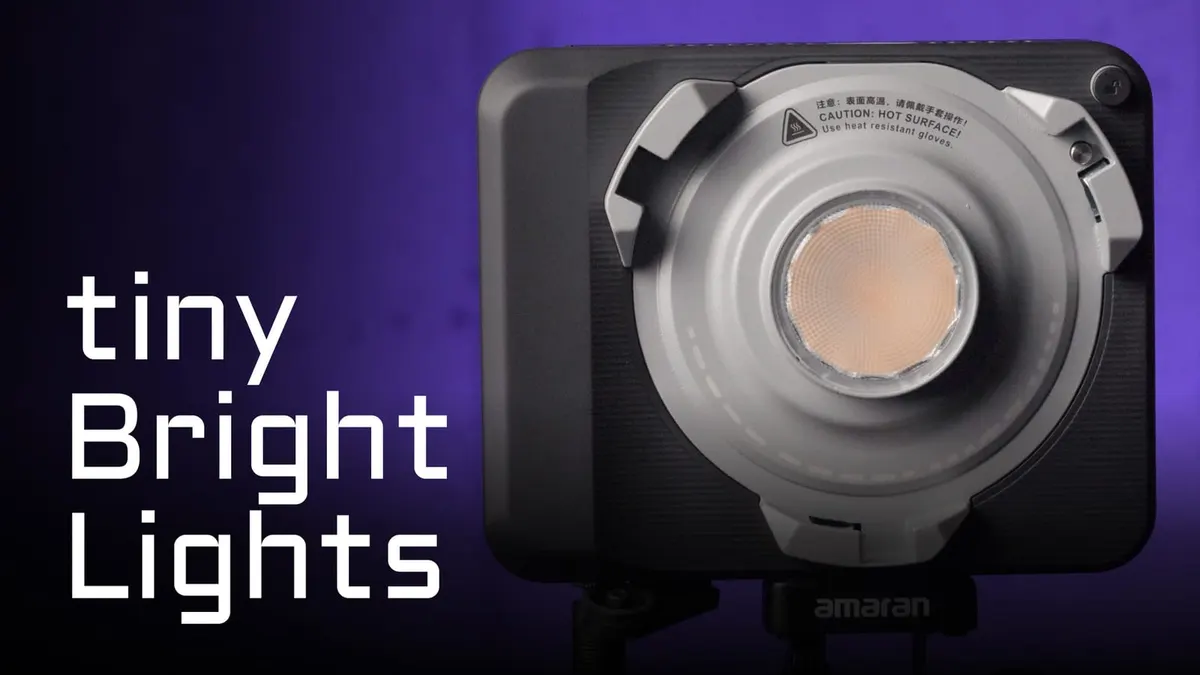
In this week’s video we have a look at the new amaran Ray 60c and 120c lights. These tiny LEDs are just as bright and color-accurate as their bigger siblings, the Ray 360 and 660c, and can be even more versatile thanks to their small sizes. In this review, we test the 60c and 120c’s omni-color engine, compare photometrics to the other lights in the Ray lineup, check fan noise, output, build quality, and real-world usability for creators and small studio operations. We also cover SSI results, Bowens-mount compatibility, IP54 weather resistance, Bluetooth + NFC control via the Amaran app, and how these fixtures might perform best in various video lighting situations.
The Ray 60 and 120c lands in that perfect middle ground of power, color fidelity, and price for those of use working professionally, but in the small budget world — corporate video.
Gear used or mentioned
The links below are Amazon, B&H Photo, Sweetwater, or other affiliate links. As an affiliate, I earn from qualifying purchases.
- amaran 120c — full color video light
- amaran 60c — full color video light
- amaran 660c — full color video light
- amaran 360c — full color video light
- amaran Octadome 120 — large softbox
- amaran Octadome 90 — small softbox
- amaran fresnel lens and barn doors
Read the transcript
Today we’re talking about the Amaran Ray 60C and 120C, tiny lights that pack a lot of output for their size and are highly color accurate. There are four total lights in the Amaran Ray lineup; we reviewed the 660C previously, and now we’re focusing on the smaller, creator-oriented COB lights, the 60C and 120C. Model numbers refer roughly to power draw, though the 120C measured around 140 watts using the Amaran Peak battery. Full disclosure, Amaran sent all of these lights to me free of charge and hasn’t told me what to say.
Color accuracy is a highlight: SSI is 84 at 3200K and 82 at 5500K, much better than most LED lights on the market thanks to the Omnicolor light engine, which mixes multiple LED colors (two reds, a green, two blues, an indigo, and a soft white) for better color quality than similarly priced competitors, at a lower cost than the high-end Aperture Blaze lights. Even dimmed down to 1%, the SSI stays around 82. They’re IP54 rated — splash and dust resistant, not waterproof. Bluetooth control via the Amaran app is excellent, plus NFC pairing even while the lights are off. The fans are quiet and rarely kick on below about 60% intensity. There’s also a “flow” turn knob for fast large adjustments, surprisingly useful once you get used to it.
These have a Bowens mount with a new line of Ray-specific modifiers optimized for their 70° beam angle — for example, the included Ophoto 30cm softbox with inner and outer diffusers. Build quality is a composite Bowens mount (likely with an internal metal frame) with an all-metal yoke; heavier Aperture modifiers aren’t recommended, but the Ray-designed modifiers work great. One yoke limitation: with bigger modifiers you can’t tilt it down as far as you might want, so you may need a grip head and baby pin to angle it properly.
The included Octodome 30 softbox is good as a hair or fill light but isn’t quite large enough to be a comfortable key light unless used very close to the face. You can power these via USB-C with the included AC/DC adapter or with the Amaran Peak battery (about 86Wh, $130 US), which is nice for handheld or walk-and-talk use. The included IEC cable is 4 meters, a bit short for set work but fine for most creator setups. Like the bigger Ray lights, these support a high frame rate mode for 1/1000th shutter speeds or 240fps video (locking dimmer to a minimum of 50%). We ran a flicker test at 10% intensity, 11° shutter angle, 23.976fps, with no visible flicker.
On the narrower 70° beam angle some viewers were skeptical about: using modifiers designed for the Ray line, I haven’t found it to be a problem, even for simple talking-head lighting at 60% on the smallest light in the line. Pricing is remarkable: $189 US for the 60C, $259 US for the 120C — compare that to the first Aperture Light Storm panels from about a decade ago, which cost around $700 with worse color quality and fewer modifier options. These smaller Rays are ideal for at-home creators, streamers, and vloggers working in tighter spaces without sacrificing modifier compatibility or output; the bigger 360C, 660C, and Aperture lights suit those needing more robustness or output for larger spaces, like corporate and education video work. Overall build quality across the Ray line is better than the price suggests — not a toy, not a tank, right in a nice middle ground. Get out there and make some great lighting designs. Talk to you again soon.