
Aputure Delta Pro powered by EcoFlow — Big generator for LED lights on location
· Lighting · 12:14
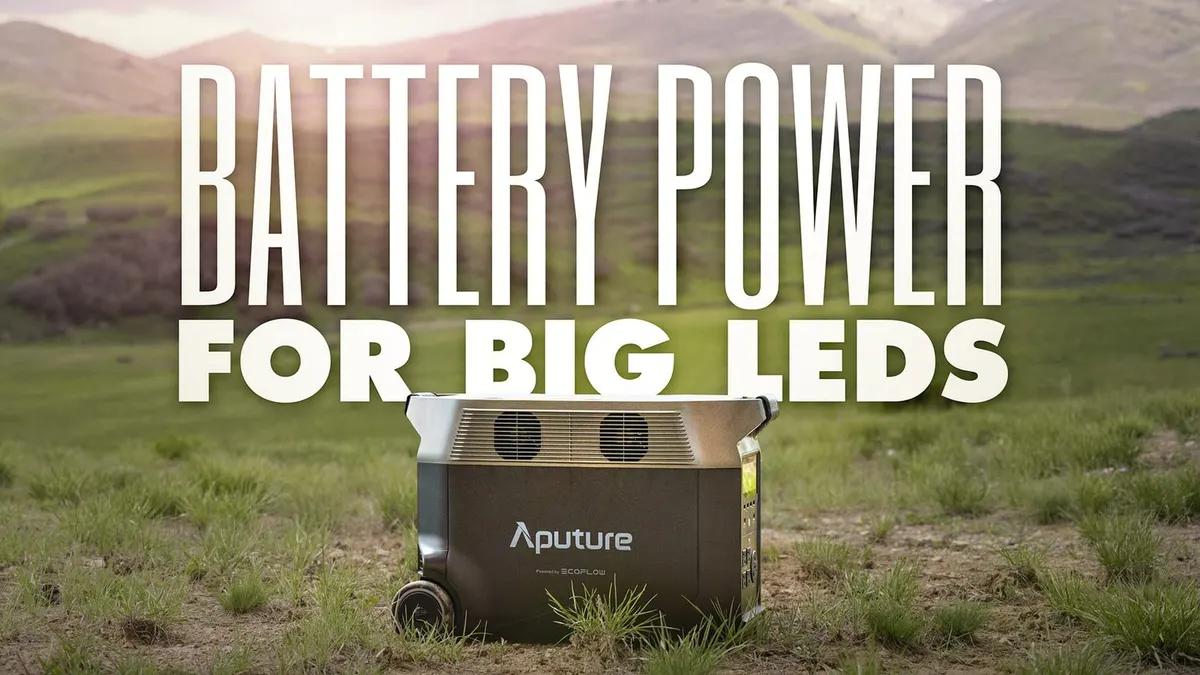
In this week’s episode we try out the Aputure DELTA Pro, a high-wattage power station for powering your lighting kit in the field and on location. With a 3600 watt-hour capacity, 15 different types of power outlets, and luggage-style wheels and handle, this battery is well-equipped to accompany you on your next on-location shoot. In this video we walk through the DELTA Pro’s features and demonstrate how we use it to get the most out of our lighting designs outside the studio. Let’s take a closer look!
Gear used or mentioned
The links below are Amazon, B&H Photo, Sweetwater, or other affiliate links. As an affiliate, I earn from qualifying purchases.
- Aputure DELTA Pro electric generator — Aputure, B&H
- Aputure 600d Pro LED light — Aputure, B&H, Amazon
- Aputure 600x Pro LED Light — Aputure, B&H, Amazon
- Aputure 600c Pro LED Light — Aputure, B&H, Amazon
- Amaran 200x S LED light — B&H, Amazon, Aputure
- Aputure Light Dome II soft box — Aputure, B&H, Amazon
- Aputure Spotlight Mount — Aputure, B&H, DVE Store. Amazon
- Rosco Prismatic Glass Gobo in Cool Lavender — B&H
- Canon C70 Cinema Camera — B&H
- Panasonic GH5 camera — B&H, Amazon
- Panasonic 12-35mm f/2.8 II lens — B&H, Amazon
Read the transcript
[Music]
In this episode, we talk about the Aputure DELTA Pro, which is a big battery bank for powering your LED lights on location, especially the bigger lights like the 600 and 1200 watt lights from Aputure or many other manufacturer, to be honest. So this is a partnership between Aputure and EcoFlow.
Of course, Aputure knows LED lighting for video and EcoFlow knows how to make solar generators and batteries, and they’ve partnered up to make this. So, what does this include? Feature wise, 3600 watt hour capacity.
So in our particular case, we were able to power 4 big LED lights, all 600 watt lights, for 1 hour and 2 minutes.
These were all at full power, 100% on their dimmers, and we were drawing 2715 watts, sustained. So that’s actually quite a lot.
Now typically when you’re using these fixtures, at least in my work, for talking head type things, you generally don’t have them at 100%, even when you’re working outdoors. Even in daylight, you don’t necessarily have to push them that far.
So in real life, if you were going to do a lighting design with 4 big lights like that, you could probably get at least a couple of hours depending on where you set their dimmers.
I think more realistically for me, again, mostly doing talking head or interviews,
I would generally need 300 watt lights or less, even. You can power these for a long time; here are some estimates for the different Aputure lights and how long you could reasonably expect for the DELTA Pro to be able to power each of them.
It has 4 AC 120 volt outlets and it can supply 3600 watts total and even a surge of 7200 watts.
So it definitely has the juice when you need that.
Also features two USB-A ports at 12 watts, two additional USB-A ports that are fast-charge ports that can supply up to 18 watts, and then 2 USB-C ports each supplying 100 watts.
So definitely got you covered in terms of recharging all the other little batteries for other accessories and things you’re using on location.
So even the little Aputure MC lights or anything like that, you can charge them all up here. In terms of charging the DELTA Pro, you can do that via AC power. You can also charge it up in your car with the supported 12 volt/ 24 volt DC ports that you typically see in most cars.
Of course, you can charge it via solar panel, if you invest in those as well.
And then in terms of overall battery life, like the lifetime viability of this product over a period of years, at 6500 cycles, total battery recharge cycles– that’s a complete drain down to 1% and then charge back up, you’ll still have 50% capacity on this, which is pretty interesting. We’ll talk about why that’s important and how other battery technologies and chemistries relate to that.
After 3500 full recharge cycles, you’ll still have 80% capacity.
So that’s actually… that doesn’t sound that great in some respects, but it’s actually very, very good for lithium ion battery chemistry.
Now, what makes this thing special and why would you choose this over a regular gas or propane power generator, which is typically what you see on location sets when you’re needing to power things? First of all, there are no fumes. This doesn’t generate any fumes, so you can use it indoors. It’s a little bit quieter than some generators that I’ve worked with.
But it is about the same, even, as some of the quietest gas powered generators.
So it’s not perfectly silent. It’s important to understand that when you’re running it, especially when you’re drawing, like we were, 2700 watts, the fans in the unit kick in to condition the batteries, keep them in good operating form to optimize the overall performance of the battery.
So– not perfectly silent. It’s important to understand that.
As I mentioned before, you can recharge via AC mains, car, solar panels, and it does have a very strong fast charging controller, so you can charge the entire thing up from AC power mains in as fast as 2.7 hours.
So that’s actually quite fast for the capacity of the battery.
What’s more is that if you’re working with a circuit that doesn’t have– that’s not rated for 15 amps, for example… and that assumes, that 2.7 hours, assumes fifteen amps; if you’re working with a smaller circuit in a household, for example, it’s maybe a ten amp circuit, you can configure how much this draws so that you don’t trip that circuit, which is a really nice feature as well. What that means in practical terms is when you’re charging, you can charge it with a max of 1800 watts via AC.
And then when you’re charging via solar, you can charge for a max of 1600 watts and that’s rated between 11 and 150 volts, 15 amps max. So if you’ve got a pretty sizable set of solar panels, you can definitely charge it up pretty quickly that way as well, which is nice if you’re going be in a very remote location, that’s a way to get this recharged. There’s also an app that allows you to remotely control and keep track of the charge level, which is nice. You can change some of the settings there as well.
For example, configure what level of current you want it to draw from AC power when you’re charging it up. It is expandable, so you can buy additional batteries that can plug into this and you can power for even longer if you need to do that.
In relation to gas and propane power generators, this is, I would say, possibly safer to transport than those others.
Like, if you put a generator in your vehicle plus all of the fuel to power it for however long you need, there’s some– there’s some safety concerns with that.
Obviously, batteries are not perfectly safe either, but it does use a particular chemistry called lithium iron phosphate and it is a little bit more stable than other lithium ion batteries and a little bit safer from that standpoint.
So that’s another plus here as well.
So let’s talk about that battery chemistry. There are different lithium ion battery chemistries, and this particular one is lithium iron phosphate.
So what are the advantages of that chemistry versus something like cobalt or nickel based lithium batteries? And first of all, this is slightly less expensive than nickel or cobalt based batteries.
But iron and phosphates are actually much more abundant in the earth, so they’re a little easier to come by. So there’s some advantages there.
That’s part of why they’re less expensive. It has much better aging characteristics.
That is to say, you can charge it and drain it more times than cobalt or nickel based lithium batteries.
And still maintain its capacity, which is a huge, huge advantage for longevity.
So originally when EcoFlow developed this particular battery, before they partnered with Aputure, I think the idea was that this would be something that would be charged and drained on a pretty consistent basis, maybe on a daily basis as part of a solar system.
So the advantage, again, of this is that you can– you’re going to get a much longer product life out of this, which is a good thing. Also, from a thermal and chemical standpoint, this is a little bit more stable than other lithium ion chemistry.
So again, nothing is perfectly safe, but when it comes to batteries, you know, you’ve heard of Teslas, the early Teslas catching on fire and stuff like that.
They are actually using lithium cobalt based batteries in them.
But overall, evidently, the iron phosphate lithium batteries are a little bit more stable and less likely to catch on fire.
Now, there is one disadvantage of lithium iron phosphate batteries versus other lithium chemistries, and that is lower energy density. And what that means is that for the same volume of battery, you can’t they can’t hold quite as much power, so that is one thing, but they’ve done a pretty nice job here in this unit.
Now let’s run through the pros. First of all, I mentioned a lot of these already, so I’m not going to spend too much time on them.
But overall, you can power a lot of LED light for a pretty sizable amount of time.
Again, we have this chart here where you can see all of those estimates.
You can pause and take a look at the details if you’d like.
Now, I actually purchased with my own money a Goal Zero 3000 watt hour battery before Aputure came out with this one.
And the problem with that one is it only has– its inverter, which is what converts the power to AC, which you need for a lot of lights and other things, is it only has two outlets and it can’t support as much wattage at the same time.
So the DELTA Pro is better suited for, you know, making a lighting design with 4 lights or more.
So you can power the 4 lights on the inverter on the DELTA Pro without a problem and, again, 3600 watt max.
Now, when you have something this sizable, it’s going to be kind of heavy. And in fact, this is 99 pounds or 45 kilograms.
So that’s a pretty sizable thing.
I can lift it, but I wouldn’t want to carry it far.
And for example, going up stairs is a little bit of a challenge just because it’s large and a little bit bulky.
So I would say that when you are planning to use something like this for a shoot, if you do rent one of these units, for example, plan on having a couple people there if you do have to tote it up and down stairs for example and things like that.
Even if you have someone who’s pretty strong and can lift it themselves, getting up and down stairs or going over rough terrain can be a little bit of a challenge.
On the other hand, it does have built in wheels, so where you can use the wheels and then also an extension handle.
That makes it actually really easy to tote around on flatter surfaces, and even on dirt and stuff like that, you can take it out there without a problem. But if you do have to do, like, you know, if you’re climbing up rocks or up a staircase or something like that, it’s gonna be a little bit more of a challenge. Again, as I mentioned, you can charge it quickly. If you do have access to a full 15 amp AC main circuit, you can charge it in 2 hours and 42 minutes all the way up to a 100% if you’re all the way down at 1%.
So that’s nice and also again, charging from your car; it’s not going to charge nearly as fast from a DC port on your car, 12 volt or 24 volt.
So you need to be aware of that, but you can at least continue to get some additional power in there.
A lot of times, these also traditionally have been used in RVs as well.
So if you have a solar panel on top of the RV, you can plug it in there and keep it charging as well. So if you’re working on a production where you have access to something like that, the solar panels on top of an RV, you can plug it in there.
As I mentioned before, there are also expansion batteries.
So EcoFlow makes some where you can actually connect those right in the back of the DELTA Pro.
And that can double or triple your capacity overall.
One thing I should mention, and let’s just go ahead and demonstrate this here for you, but it’s not silent. [Sample audio] Alright. So just to get a sense of how loud this is,
I’m actually– I’m talking directly in the microphone.
We’re peaking around -12. Here’s next to the DELTA Pro, the Aputure DELTA Pro. [Sample audio]
Not super quiet. Actually we’re– we’re drawing 2660 watts roughly right now.
We’re powering 6– 4, sorry, 4 different lights, each of which are rated at 600 watts but some of them actually draw more than that.
And that’s what it sounds like to keep everything cool and running like it should. [Sample audio]
What this means in practical terms is you can’t necessarily have the battery right up next to your microphone on set.
You’re going to need to move it a little distance away.
So bring extension cables so that you can reach everything that you need to reach and not have those fans running right up next to your set.
One other note, you cannot check this onto a commercial flight.
So if you’re planning on flying, this is where you would rent this in the location closest to where you’re going to be in transporting it via land vehicle as opposed to airplane.
So overall, this is a really interesting unit for those that are filming out where you don’t have AC power and you need to film for longer than you can power with smaller cinema batteries, especially for the bigger lights. It’s probably going be available at most of the rental houses; pretty interesting product! Hope you found that helpful; if you have questions, go ahead and leave those down below. And if you’ve not already subscribed, make sure you do that. And we’ll be sure to get you more great videos on how to improve your lighting and sound for video.
Talk to you soon.