
Austrian Audio OC18 a Worthy Career Voice Over Microphone
· Audio · Microphones · 12:38
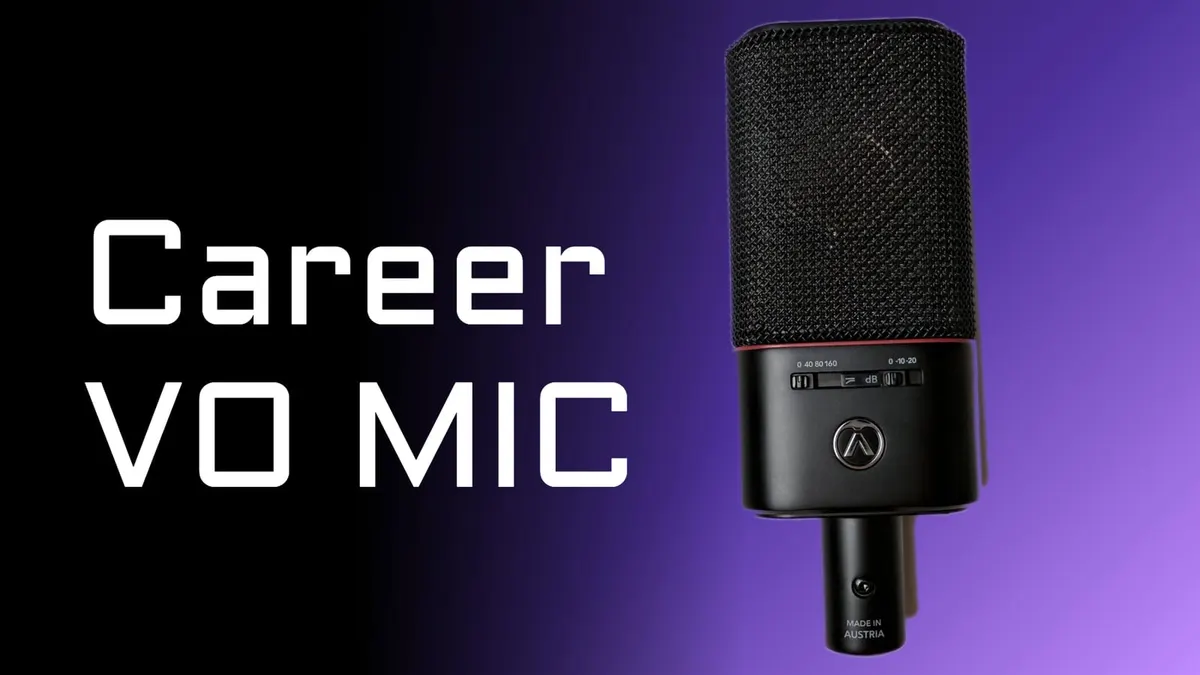
In this week’s episode we review the Austrian Audio OC18 large diaphragm condenser microphone. My main use case for microphones like this is for recording voice over, so we’ll evaluate it from that perspective. Now, the OC18 is NOT a budget microphone. It is the type of microphone upon which you could build a voice acting career! Let’s have a closer look and a listen compared to the AKG C414 XLR and the Neumann U87 Ai.
Gear used or mentioned
The links below are Amazon, B&H Photo, Sweetwater, or other affiliate links. As an affiliate, I earn from qualifying purchases.
- Austrian Audio OC18
- Austrian Audio OC818 — (the bigger sibling)
- Austrian Audio OC16 — (the little sibling)
- Sound Devices MixPre — audio field recorder
Read the transcript
If you’re looking for the mic to help you through your voiceover career, the Austrian Audio OC18 could be a great choice. Let’s go ahead and do a few things. First of all, full disclosure, Austrian Audio sent me the OC18. You’re hearing it right now. I do have the foam cover on. I do have a lot of sibilance in my voice. This attenuates that a little bit, as well as some of the other higher frequencies. They’re not paying me to make this video. The other microphones we’re going to compare it to, the AKG C414 XLS and the Neumann U87 I bought with my own money. All right, what else? Austrian Audio did not review this before posting the video. First up, let’s get you some audio samples compared to those other two mics.
It was easier to know it than to explain why I know it. If you were asked to prove that two and two made four, you might find some difficulty and yet you’re quite sure of the fact. It was easier to know it than to explain why I know it. If you were asked to prove that two and two made four, you might find some difficulty and yet you’re quite sure of the fact. It was easier to know it than to explain why I know it. If you were asked to prove that two and two made four, you might find some difficulty and yet you’re quite sure of the fact.
All right, a few things to know about this microphone. Let’s go ahead and put the specs up on the screen. You can read these obviously, but kind of the things that stood out to me. Number one, there’s a three-way high-pass filter and they have steeper slopes as you get to lower frequencies. So at first I said, why would you ever need a 160 hertz high-pass filter? Well, if you’re doing a lot of proximity work right up on the microphone. So here, for example, I’m working up right on the microphone and I have the 160 hertz high-pass filter turned on so that we don’t get that really boomy sound. Here, I’ll turn it back off. And this is what it sounds like when you have it off when you’re working up very close on the mic. So you’ve got a lot of versatility here. If you do need to get that very up close kind of sound, that really good signal to noise ratio, then you can work up very close on this mic and you won’t be affected by as much of the room in the ambient sound. But you’ll also be able to manage that proximity effect. Pretty cool.
Number two, has the equivalent noise of 9 dB weighted. So it’s a quiet microphone. You’re not going to need to worry about this microphone making noise in your recording. It has a max sound pressure level of 148 dB SPL. So you can record very loud sound sources. Not as much of a matter for voiceover, which is what we’re really kind of focused on here. But if you do need to record some loud stuff as well, you can do that. Or even if you’re going to be shouting, you can manage that pretty nicely with this microphone. There is also a pad if you’re going to be recording really, really loud sounds. Again, not really so much something you do for voiceover, but there’s a minus 10 dB and a minus 20 dB pad. There’s a two-year warranty and the price of the microphone comes in at $899 US at the time of this review.
Let’s test a few things. Let’s first of all take a look at plosives. So plosives are when you talk directly into the mic, pronounce certain consonants in particular, and other letters that create this sort of puff of wind that comes out of your mouth. If that goes directly into the capsule, you get sort of a kind of a low-frequency “boo” kind of sound. So let’s take this off. Peter Piper picked a peck of purple pickled peppers. We’re definitely getting some there. Of course, if I just manage my where I have the microphone, and if I talk a little bit past it here, Peter Piper picked a peck of purple pickled peppers. And then with the foam cover that comes with the microphone. Peter Piper picked a peck of purple pickled peppers. So there’s a sense for that.
Sibilance. Here is a sample here. She sells seashells by the seashore. By the seashore, she sells seashells. I’ve got the foam cover on. Let’s take that off. Of course, what you’re listening for here is that kind of sizzling sound that comes with the “S”s. She sells seashells by the seashore. By the seashore, she sells seashells.
All right, let’s get some RF going here. Phones are probably the biggest source of RF these days. Okay, so we’ve got Wi-Fi. Okay, let’s turn the Wi-Fi off. So we’ll be on cellular instead. Okay, there’s our RF immunity test. From what I could hear, it seems to be working just fine. No RF interference with this microphone.
All right, let’s check the off-axis coloration. And I’m going to talk into the front of the microphone here with dialogue. And then I’m going to go ahead and turn it to the side to try and maintain the same distance. We are turning it off slightly off-axis. And now I am at 90 degrees off-axis on the microphone. And I’m going to keep moving around. This is a little awkward, but coming to the back of the microphone. Now I’m speaking into the back of the microphone. Back of the microphone coming around to 90 degrees. Here we are at 90 degrees. And here I am talking back into the front of the microphone. Obviously, this is a cardioid microphone. Here is the polar graph. So what that means is it’s sensitive on the front. Sensitivity starts to fall off at the sides. And then at the back, it is at least sensitive. So there’s our off-axis coloration.
Now, there are some history to this company, Austrian Audio. In 2017, well, prior to that, AKG closed their offices in Vienna, Austria. And in July 2017, 22 former AKG employees formed Austrian Audio. Reopened in Vienna. Didn’t reopen. They opened in Vienna. They developed the CK-R12 ceramic capsule using many of the things learned from the original CK-12 capsule, which was what was used in the original AKG C414 studio microphone and renowned microphone. And in fact, I have the C414xLS for voiceover work. I specifically bought that in 2017, early 2018 for voiceover work. And I have used it for that. Lovely microphone. It’s a more modern one. So I don’t think it’s using that same original capsule, but that’s what they modeled this one after. Similar dimensions, similar hole patterns on the capsule, and edge termination. They designed and manufactured this microphone, the OC-18, in Vienna, Austria. So if that’s important to you.
And in this particular microphone, they’re using the CK-R6, which is a cardioid-only variant of the CK-R12. Now, CK-R12 is actually two capsules in one. That’s in the OC-818 microphone. The bigger sibling of this, it has multiple polar patterns. It can be figure of eight, omnidirectional, and it needs two capsules to achieve that. This is the single capsule version, which for voiceover is pretty much all we need. We’re in front of cardioid microphones all day long. So this is less expensive, but you still get the same quality as the CK-R12 capsule.
Okay. Ceramic capsule. That’s something that’s unique to Austrian audio. The ceramic capsule has a similar density to brass capsules, traditional brass capsules, but it’s better able to handle changes in moisture, humidity, and temperature. So overall, you should get more consistent sound capture with the ceramic capsule in the OC-818 and the OC-18, which is what we’re reviewing here today. It has an elastic three-point suspension to reduce transfer of mechanical bumps and movement. Bumping the desk here. I actually bumped the cable there. That’s not fair. Well, that’s different. And then here’s me typing on a Mac keyboard. Okay. So that’s the story of Austrian audio.
Now, how is this different than the OC-818 from Austrian audio? And there’s also an OC-16 from Austrian audio. We’re on the Austrian audio OC-18. So this is the middle tier microphone of those three. I have not used those other two, but I’ve listened to a lot of samples from various people, voiceover. And let me talk about the specs and kind of my impressions of the differences. So the OC-818 is sort of a studio workhorse that can do anything. It’s not just for vocals. It is for instruments. It has multiple polar patterns. It has two capsules. You can actually get a separate feed of each capsule out directly if you want to do that. It has Bluetooth control if you get this little add-on for it. It has an app called the Polar Pattern Designer, so you can really fine tune the polar pattern. And that’s priced at $1,400 US at the time of this review. So that’s essentially the same microphone with two capsules in it. And that’s the main difference there. Sounds in all the samples I’ve heard, they sound pretty much identical. The OC-818 and this the OC-18.
Now there’s also the OC-16. This does not have a pad. It does have a high-pass filter, but not the pad. It has different electronics in it, meaning that it has a slightly higher noise floor. Still very acceptable, by the way. And it is also slightly less sensitive, so your microphone preamp will need to supply a little bit more gain to kind of essentially get the same levels. The frequency response, if you look at the frequency response charts, looks pretty much the same. Not exactly the same, but close. But in the samples I’ve heard, the OC-16 doesn’t sound quite as warm as the OC-18. It doesn’t have as much of that low-end warmth to it. So it is a little bit different. It is priced at $450, and again in comparison the OC-18 is $899.
All right, so my thoughts on using this as a voiceover microphone. The OC-18, in my mind, hits the right balance between quality of sound, just the features that you need for voiceover, and price. So this is the type of microphone that could easily take you through an entire voiceover career. It’s a fantastic microphone. How does it compare in my mind? It sounds almost exactly the same to me as the C414xls on my voice. Everybody’s voice is going to be a little bit different. Or it sounds very similar, I would say. I actually prefer the OC-18 on my voice more than the Neumann U87, but that’s my voice. I’m not saying the Neumann is a bad microphone. It obviously isn’t. It’s four times the price, something like that. And it is a multipolar pattern. The microphone has some other features that this doesn’t have. But it’s a studio classic. A lot of people are familiar with that microphone that work in studios.
So in any case, I do find that this microphone can be EQ’d throughout, except for the samples where we didn’t apply any sort of processing. This entire episode has been recorded with the OC-18 into a Rupert Neve Shelford channel with the blue silk turned on. And the slightest, tiniest amount of EQ. A little bit of a cut at 8kHz to manage the sibilance, and a tiny cut around 1.5kHz, because I have a kind of a resonance in my voice there. So those are my thoughts. Hope this was helpful. Again, this is not a definitive review. This is more of a here’s a data point. If you’re thinking about using this for voiceover, here’s some samples with my voice compared to some other common microphones that you might use for voiceover. Hope that helps get out there and make some great voice recordings.