
Big light output, budget price — Nanlite FC-720B
· Lighting · 6:59
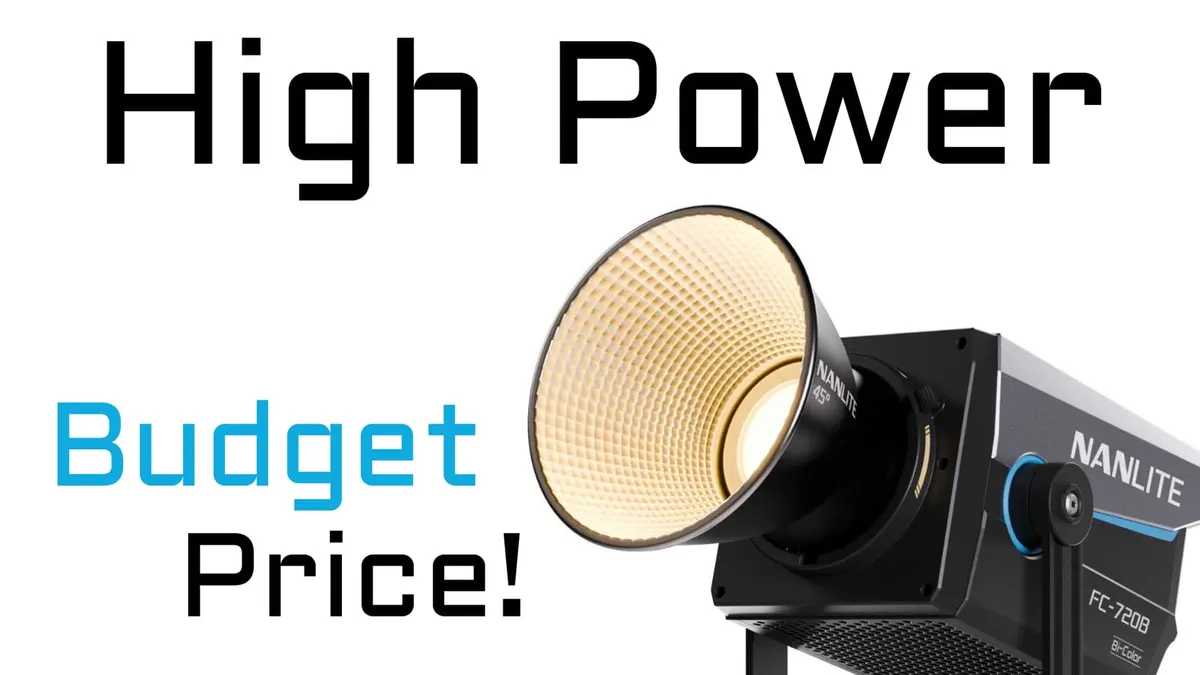
In this week’s video we check out the Nanlite FC-720B, a high-output bi-color LED spotlight available for a really reasonable price point. We dig into the feature set, some practical photometric measurements, and compare it to the Amaran Ray 660C for context. Let’s take a closer look!
Gear used or mentioned
The links below are Amazon, B&H Photo, Sweetwater, or other affiliate links. As an affiliate, I earn from qualifying purchases.
- Nanlite FC-720B — Bicolor LED video light with Bowens mount
- Amaran 660c — Full Color LED video light
- Godox ML150Bi — Bicolor LED video light
Read the transcript
Do you need a big light for corporate work, maybe low-budget indie filmmaking? The Nanlite FC720B might be a good choice. Full disclosure, a Nanlite/Godox/Amaran reseller sent this light to me to make this video, and this video is sponsored by Learn Light and Sound.
We’re using the FC720B as our key light, dimmer set to 8.5%. It’s a 750W bicolor light for $650 US (on sale for $520 at the time of this video), which is a really low price for that much output — be careful, that’s probably enough light to damage retinas. It also makes this light super versatile: bounce it, use it in a softbox, a fresnel, or light a big space. The color range adjusts between 2700 and 6500 Kelvin. It’s dimmable in 0.1% increments from 0 to 100%. There are 12 onboard effects and fan modes of smart, full, low, or off (off limits you to 10% output). You can NFC pair it to the Nanlite app, it has a Bowens mount for modifiers, and it’s DMX capable.
We measured the photometrics with our Sekonic C800 compared to the Amaran Ray 660C. Color quality is good, though the Ray 660C is a bit closer to perfect at 5500K. We did a flicker test with no problems dimmed to 5% at an 11.25° shutter angle, 23.976fps. The fans aren’t super loud but not the quietest either, and the fan in the power adapter always runs when plugged into AC. The beam angle spec says 75° but practically seems closer to 30° without the reflector, which is actually great for softboxes since you don’t need dual diffusers.
Comparing to the Amaran Ray 660C: the Ray is a full-color light so it has less raw output because its color engine has to sacrifice power for color effects, while the Nanlite produces more output if that’s what you need. Build quality slightly favors the Ray, and it doesn’t need a separate power box. The Ray is more expensive at $700 US. Color quality is similar at 3200K, but the Ray edges out at 5500K, especially on SSI. For most talking-head purposes the Nanlite is good enough. If you need lots of light on a budget of $650 or less, the Nanlite is a great option; if you want the versatility of full color and don’t need quite as much output, the Amaran Ray 660C is the pick. Get out there and make some great lighting designs, and we’ll talk to you again next week.