
DEITY THEOS Wireless Microphone System Review
· Audio · Wireless systems · 23:32
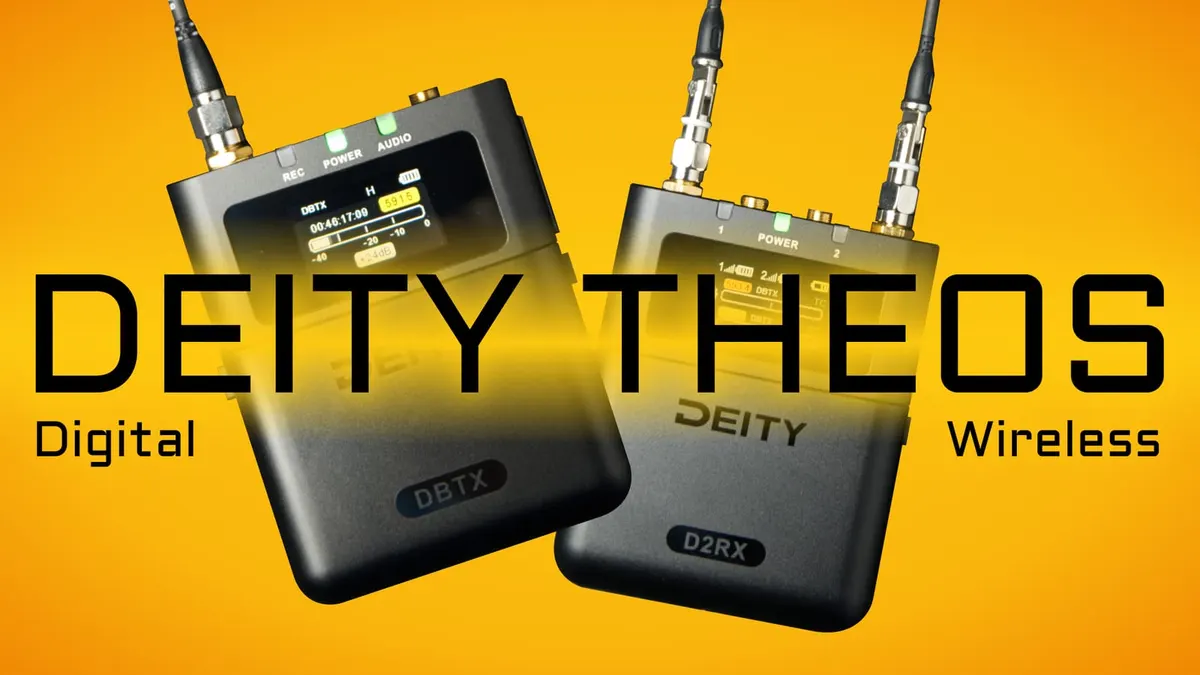
In this episode we finally get to take a look at DEITY’s long-awaited THEOS wireless microphone system! This brand-new prosumer wireless microphone system includes a well-rounded set of features to the market, including Global OneBand technology, simultaneous transmitting and 32-bit float recording (outside the USA, in the USA, you can record or transmit, but not both at the same time), and wireless timecode syncing when used with the DEITY TC-1 timecode generator or the DEITY SL-1 digital timecode slate. In this episode we go over the THEOS system’s most important features, compare it to its closest competitors, and answer your questions. Let’s take a closer look!
Gear used or mentioned
The links below are Amazon, B&H Photo, Sweetwater, or other affiliate links. As an affiliate, I earn from qualifying purchases.
- Deity Theos Wireless Microphone System — B&H
- Deity W.Lav Pro Lavalier Microphone — B&H, Amazon
- Deity TC-1 Timecode Generator — B&H, Amazon
- DEITY SL-1 timecode slate — B&H, Amazon
- Sennheiser MKH 8050 Supercardioid Condenser Mic — B&H, Amazon
- Sound Devices MixPre Series II Recoders — B&H, Sweetwater, Amazon
- Sound Devices 888 Field Recorder/Mixer — B&H, Sweetwater
- Impact Turtle-Base C-Stands — B&H, Amazon
- Aputure LS 600x Pro Bicolor LED Light — Aputure, B&H, Amazon
- Aputure Light Dome III Softbox — Aputure, B&H
- Amaran 300c RGBWW Single-Point LED Light
- Amaran Spotlight SE — Aputure, B&H, Amazon
- Rosco Prismatic Glass Gobo in Cool Lavender — B&H
- Canon C70 Cinema Camera — B&H
- Canon RF 24-70 f/2.8 lens — B&H, Amazon
- Panasonic GH5 camera — B&H, Amazon
- Panasonic 12-35mm f/2.8 II lens — B&H, Amazon
Read the transcript
A review of the Deity Theos, a new digital UHF prosumer wireless microphone system, purchased with the reviewer’s own money. This entire episode is recorded through the Theos in a cold, unheated basement, with raw comparison samples against a Sanken COS-11D lavalier.
The kit includes two transmitters and a single dual-channel receiver, transmitting in the UHF band (550MHz-960MHz, region-dependent) rather than the 2.4GHz band used by consumer systems like Rode Wireless Go/Pro, DJI Mic, or Hollyland Lark — those work great for simple talking-head setups but can fall apart in Wi-Fi-dense environments like stadiums or offices, with no ability to retune around interference the way UHF allows. It records 24-bit/48kHz or 32-bit float on the transmitters, with no irreparable clipping found when boosted in post. Everything can be controlled via physical buttons or the Deity Sidus Audio app, including remote Bluetooth-triggered recording start.
Build quality is strong, primarily aluminum with only minor battery-door wobble. The kit includes two W.Lav Pro lavalier mics, a hard case, three sets of frequency-optimized whip antennas, XLR and 3.5mm output cables, a USB-C cable/adapter, alligator clips, and foam covers, priced at $1,090 US — about $550 per channel, competitive with something like a Sennheiser G4 channel. Antennas attach via swappable SMA connectors, allowing larger shark-fin/LPDA antennas on the receiver for extended range.
Outdoor range testing (not in direct line of sight, transmitter on the back) got 50-60 meters before dropout; in direct line of sight, a full 100 meters with no issue — outperforming many comparable 2.4GHz and even some UHF systems. Indoor testing through a two-story house and two closed doors produced zero dropouts, a clear UHF advantage over 2.4GHz for penetrating walls.
Battery life: over 12 hours on transmitters and 9 hours on the receiver using included Deity lithium disposables; roughly 7 and 6 hours respectively using Ikea Ladda NiMH rechargeables (varying with transmit power settings). Both units also support USB-C power banks. Transmitters include temperature-compensated crystal oscillators (built-in timecode), jam-syncable wirelessly via the app with Deity’s TC1 generators and timecode slate — jam-syncing without the app wasn’t found to be possible. A timecode drift test after 8h17m of continuous jam-sync showed the units still frame-accurate.
A practical self-noise test (boosted to -23 LUFS) measured -63.5 dB RMS max, a clear improvement over Deity’s earlier, noisier Connect and BP-TX systems (transmitter self-noise spec’d at -130 dBu(A) at the preamp level, independent of mic). Control buttons are conveniently hidden under the battery door to prevent accidental bumps. The Sidus Audio app is genuinely excellent — probably the best wireless-control app the reviewer has used, including one-tap remote re-jamming of the entire Deity timecode ecosystem, though a Bluetooth connection range test found it required getting within a few meters in some obstructed indoor scenarios, shorter than the 250-foot claim.
Cons: this kit only tunes down to 550MHz, missing the fully unlicensed 470-550MHz range available in the US, more of a constraint in dense urban RF environments than rural ones; no limiter (analog or digital) on the transmitters, risking clipping on wireless transmission if gain isn’t set carefully (a clipping incident happened during the outdoor test); meter ballistics on both units felt a bit unintuitive; the transmitter’s headphone-monitoring output has a notable 48ms of latency (fine for just checking for clothing rustle, not full monitoring, and separate from the very usable 6ms measured overall system latency from mic input to receiver output); and the receiver’s screen faces forward, awkward to read once slotted into a sound bag unless propped up.
Overall verdict: a genuinely strong step up from Deity’s earlier, noisier generations, and a strong first choice among prosumer wireless options at this price point — preferred over comparable Sennheiser or Sony offerings. One significant US-specific limitation: a patent held by Zaxcom prevents any other manufacturer’s transmitters from recording and transmitting simultaneously in the US (transmit-only or record-only, pick one); this restriction doesn’t apply outside the US. Get out there and make some great sound, we’ll talk to you again soon.