
Earthworks ETHOS broadcast microphone vs SHURE SM7b and Electrovoice RE20
· Audio · Microphones · 14:01
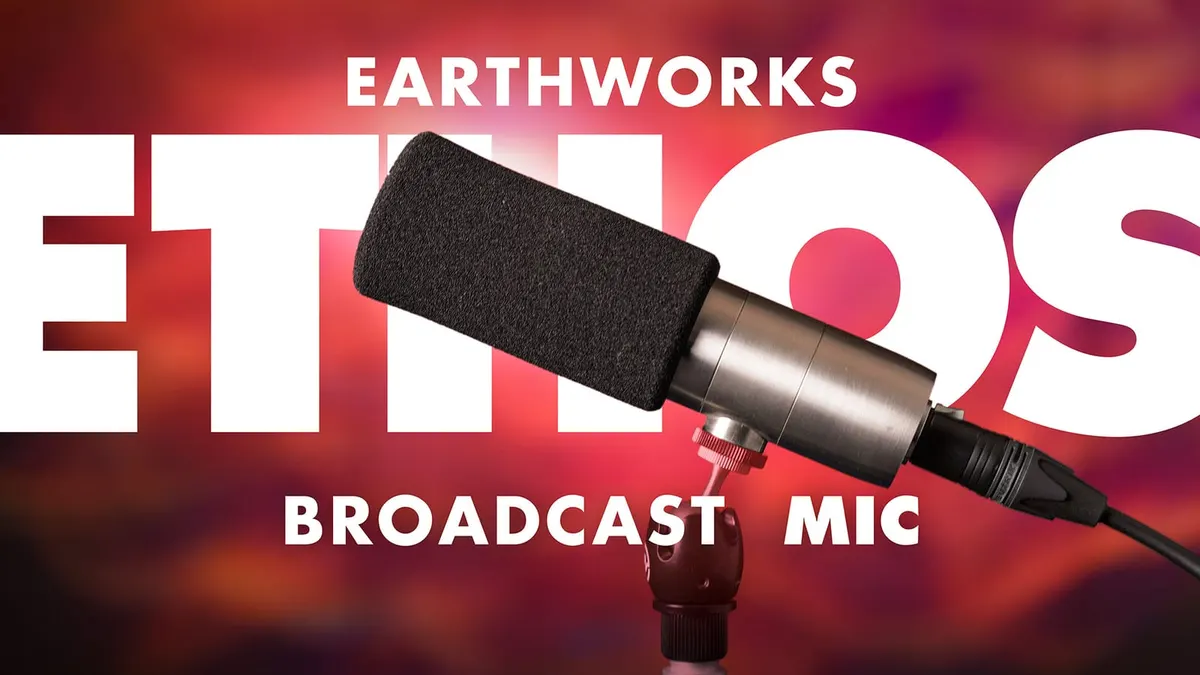
In this week’s episode we have a look at and listen to the Earthworks ETHOS broadcast microphone. This compact, good-looking supercardioid microphone is useful for podcasts, livestreams, and other broadcast-style content creation. In this video we listen to some sound samples, walk through the ETHOS’ feature set, conduct our usual microphone tests, and compare it to some other broadcasts mics of similar quality at similar price points, namely the SHURE SM7B and Electrovoice RE20. Let’s take a closer look and listen!
If you’d like to learn more about processing audio for your video and film projects in DaVinci Resolve Fairlight, you can find our complete course at https://school.learnlightandsound.com…
Gear used or mentioned
The links below are Amazon, B&H Photo, Sweetwater, or other affiliate links. As an affiliate, I earn from qualifying purchases.
- Earthworks ETHOS microphone — B&H, Sweetwater, Amazon
- SHURE SM7B Cardioid Dynamic Microphone — B&H, Sweetwater, Perfect Circuit, Amazon
- ElectroVoice RE20 Dynamic Cardioid Microphone — B&H, Sweetwater, Amazon
- Sound Devices MixPre audio recorder — B&H, Trew Audio, Sweetwater, DVE Store, Amazon
- Rycote PCS Microphone Quick-Release System — B&H
- Aputure LS 300X used for background light — Aputure, B&H, Amazon
- Aputure Spotlight Mount — Aputure, B&H, DVE Store. Amazon
- Rosco Gobo creates the pattern on the back wall — B&H
- Canon C70 cinema camera — B&H
- Canon RF 24-70 f/2.8L lens — B&H, Amazon
- Schneider Radiant Soft 1 diffusion filter — B&H
- Panasonic GH5 camera — B&H, Amazon
- Panasonic 12-35mm f/2.8 II lens — B&H, Amazon
Read the transcript
In this episode, we’re going to talk about the Earthworks ethos, which is a broadcast microphone. What does that mean?
Broadcast microphone is most often used well, it could be used for radio. It could be used for things like that, traditional media. But in our case, we’re talking about it from the perspective of live streaming and podcasting. All of this was bought with my own money, the Earthworks ETHOS.
Also, the other two microphones we’re comparing it to, which are also broadcast microphones, the Sure SM7B and the Electrovoice.
RE20. Let’s get you some audio samples that are completely unprocessed all recorded into a sound devices MixPre-3.
It is an old maximum of mine that when you have excluded the impossible, whatever remains, however improbable, must be the truth.
It is an old maximum of mine that when you’ve excluded the impossible, whatever remains, however improbable, must be the truth.
It is an old maximum of mine that when you have excluded the impossible, whatever remains, however improbable, must be the truth.
It is an old maximum of mine that when you have excluded the impossible, whatever remains, however improbable must be the truth.
It is an old maximum of mine that when you have excluded the impossible, whatever remains, however improbable must be the truth.
It is an old maximum of mine that when you have excluded the impossible, whatever remains, however improbable must be the truth.
With those sound samples, I’m going to let you use your ears.
Use the best possible playback system you can, best headphones or speakers that you can, and make your own decision, your own conclusions about which of those you prefer the most.
That’s only two voices granted but hopefully that gives you a sense for how those three different microphones sound a little bit different.
Interesting thing: To get the same levels, we had to use very different gain levels, different input gain settings.
For the Earthworks ETHOS, which requires phantom power, so it’s a condenser microphone, we needed 47 decibels of gain, which almost any preamplifier can supply whether that’s a field recorder, a very inexpensive USB audio interface.
Not a problem there for most. For the SHURE SM7B now note here, we’re we’re marking about six inches from the front of the microphone.
For the SHURE SM7B, I had to turn the game to 68 dB of gain.
And then for the Electrovoice RE20, 63 dB of gain to get in the same area peaking right around minus twelve dB.
So I think that the important takeaway here is that you do not need a Fethead or anything like it for the Earthworks ETHOS with pretty much any pre amplifier, so that’s a very important difference between this versus the other two dynamic microphones.
In those three samples, one thing I did notice is that the
Earthworks ETHOS has a different kind of polar pattern, a different kind of directionality. So it is, of course, more sensitive on the front, but it also picks up a little bit from the back.
Whereas the other two, the SM7B and the RE20 have a cardioid polar pattern.
So they’re basically rejecting everything at the exact back of the microphone and they have kind of a wider sensitive part on the front.
What that resulted in is I did feel like I was picking up just the tiniest bit of audio reflected off of my desk or computer monitor and those samples, but nothing that was problematic, just something to be aware of, and that had to do with how I had it positioned where the back of the microphone was facing right at the desk. So you can have a position in lots of different ways.
I like to have it down there so that it’s not imposing on the frame when I’m doing my live stream.
But, you know, do whatever works for you. Just be aware, this does have a little sensitivity node on the back versus the other two.
Directional microphones do sound a little bit different when comes from the side or from the back.
Here’s a sample of how it sounds on the ETHOS.
Let’s give you a little sample here of how the sound changes when it comes from off axis.
So a directional microphone with a supercardioid polar pattern.
Here we are directly on access to zero degrees.
Now here I am off axis at ninety degrees.
So talking to the side of the microphone right now, so you can hear how that sounds.
And here I am talking into the back of the microphone at one hundred and eighty degrees off axis.
Overall, relatively even, not super colored at any of the different angles.
So overall, I don’t see that as a problem with the ETHOS.
Next up plosives. When you work up very close on a microphone, such as this, you can start to pick up plosives.
Here’s a sample. Peter Piper picked a peck of purple pickled peppers.
If I get up closer on the mic, Peter Piper picked a peck of purple pickled peppers.
And then even if I’m up close, but I’m just turned away from it just a little bit,
Peter Piper picked a peck of purple pickled peppers.
Overall with the included foam, the Earthworks Ethos does very, very well. I didn’t find plosives to be an issue at all.
So really good news there. We talked about sibilance a little earlier.
Sibilance is a sizzling sound you get when someone says the letter S or C especially.
Some microphones have a tendency to really emphasize that and it can be really grating for voices that have a lot of sibilance.
Mine has a good bit of sibilance in it.
Here’s a sample. She sells seashells by the seashore.
By the seashore, she sells seashells.
From my point of view, the ethos really handles sibilant voices quite nicely,
In fact, if you look at the frequency response graph, it does have a little bit of a, I guess, a scoop or whatever you wanna call that.
In the sibilance range, which typically occurs somewhere between five thousand and ten thousand hertz. So it handles those bright voices with lots of sibilance quite nicely.
Directional microphones have what is called proximity effect.
That is when you get up very close on them, they pick up a lot more bass. Here’s a sample of that.
If I get up right on the front of the microphone, you’re definitely going to hear more bass. And then as I back off here now,
I’m about six inches from the front of the microphone, which is typically where I usually have this microphone as I’m using it for my live streams.
You can hear the difference here. Again, right up on the microphone. And at about six inches from the front of the microphone.
There is definitely plenty of proximity effect available here with the Earthworks ETHOS you want that broadcast sound and you work a little bit closer up on the microphone, you’ll get it. The nice thing is that the foam also prevents plosives from happening at the same time.
I would recommend if you’re going to do it, keep it maybe angled at a little bit like a forty five degree angle and talk just past the edge of it here.
Have it aimed at the corner of your mouth, and I think you’ll get some good results.
I would be careful about moving up too close on the microphone and getting a lot of that really bassy sound that could be fatiguing for people to listen to.
But you have some options here. How well a microphone handles bumps to your stand and things like that is pretty important as well.
Here are some samples on that. We’re using an OC White low profile arm here.
And I’m gonna bump all the way up here on the microphones mount and even on the microphone.
Overall, for a condenser microphone, the ETHOS did very very well on that.
So, yes, it does pick some of that up, but it didn’t seem as prominent as it is on some other microphones that I’ve used.
So again, ETHOS is in a good spot there.
Next up, self noise. A lot of people kind of really fixate on this and The specification for the Earthworks ETHOS according to
Earthworks is a self noise of 16 dB A weighted.
That’s not anywhere near the quietest microphone spec out there.
For example, the RODE NT1 comes in I think at 4.5 dB A weighted.
So, do you have to worry about that here?
We did a little bit of work on that. So what I did is my practical noise floor sample.
The way that works is here in this space here, I turn off all the lights I have my microphone.
I turn off everything that’s making any semblance of noise.
And I record a little bit of dialogue and then I leave a few moments of silence.
Then in post, we bring that in and boost it all up to minus twenty three LUFS, including the silent portion. And then what I do is I measure the silent portion.
And What I found here is that the silent portion sat at minus sixty three dB RMS max, and that’s with no sort of low cut filter whatsoever.
If I add a low cut filter at 65 hertz with a 24 dB per octave slope, that came out at -73 dB RMS max, which is an excellent excellent result.
So I think you just use a high pass filter or a low cut filter.
Same thing. Different names. And you’re going to be in a really good spot.
I think it’s going to be your space. that’s going to make more noise than the microphone itself, so I’m not at all concerned about that.
Now, I have been guilty of maybe passing on this advice to a lot of people, and that is if you’re going to be recording in a room that’s not acoustically treated and perhaps has a little bit of ambient noise, maybe it’s a computer fan running or air conditioning or whatever it is,
I generally recommend a dynamic microphone, and I actually wanted to test that. And so what I did is I set up the Earthworks ETHOS, also the SM7B and the RE20.
And the the other two microphones, the SM7B and the RE20 are dynamic microphones, they require a lot more gain. They tend to be a lot less sensitive.
And what I found is if I’m at the same distance six inches away from the microphone, they’re all about the same in terms of how much fan noise they pick up.
If I and I intentionally turned on this fan, here’s a sample. This is a condenser microphone, the ETHOS. So it tends to be more sensitive than dynamic microphones.
And oftentimes, you might operate from that as a little bit more of a distance.
So when you do that, it may pick up a little bit more of the sound in your noise, in your environment where you’re recording or streaming.
In this case, we have a fan in this filter that’s running right back here behind me.
And this is what it sounds like on the ETHOS.
Now in this case, we have the same setup except I’m using SHURE SM7B, a dynamic microphone, not nearly as sensitive, although I did have to bump the gain up quite a bit to get to an equal level here and I’m at about the same distance as I was from the Earthworks ETHOS.
This is what that fan over here and the background sounds like at this point.
Alright. Here’s another sample this time with the Electrovoice RE20.
Again, we have the fan running in the background.
This is what it sounds like. So here’s the nuance I think to that advice.
If you do have those, you know, more noise in your space and you’re going to try and record in that space without, you know, maybe there’s something you can’t turn off. You can’t turn off your computer for whatever reason.
Okay. Fine. The advice I have is if you’re going to work up very, very, very close on the microphone and I’m talking here two inches or less, then maybe one of those other dynamic microphones, the SM7B or RE20 may be a better choice.
That’s going to increase your signal to noise ratio.
That is to say, you’re not going to need to gain up as much because you’re right on top of the microphone.
And therefore, it’s going to pick up less of the noise in the room, the fan, for example, in our case. So It’s not that if if you use them at equal distances, they’re about the same. They didn’t… there wasn’t tremendously better performance from one of the other microphones.
So that’s where that kind of nuance comes in.
So just keep that in mind if you are trying to choose a microphone and you do have some ambient noise that you’re trying to deal with while you’re recording.
The build is actually pretty impressive the first time you encounter this microphone.
It is solid stainless steel. And that’s going to hold up really really well.
The only thing I’d be worried about if you are really tough on microphones, if you’d have a tendency to drop things, if you’re not going to leave it on a stand for your live stream setup or whatever.
The thin metal kind of tube underneath the foam that’s there to hold the foam in place.
If you dropped it on that, you could you could probably dent it.
So just be careful. But overall, I think the build is just really excellent.
Probably one of my favorite features of the physical part of this microphone is the ball mount.
And this is made by a company called Triad Orbit.
And it allows you to position the microphone any way you need to.
It’s super, super durable and solid.
I’ve been using some triad orbit gear for a few years now.
Excellent excellent stuff and holds up really well.
This is so much better than the SHURE SM7B’s yoke, which with respect to SHURE, is not my favorite feature of the SHURE SM7B and can be a little wonky and difficult to work with at times.
This one’s a dream to work with in comparison.
Okay. If you could only choose one, and I’m talking to myself here.
If I could only choose one, which of those three microphones that we talked about here would you choose.
And I would choose the Earthworks ETHOS. And in fact,
I’ve owned Earthworks ETHOS now for just over a year. I bought it when it was brand new, when it was first released. Back in that time, by the way, it was seven hundred dollars US, and now it’s four hundred dollars US.
So that’s a really nice thing as well.
And that incidentally is about the same price as the SHURE SM7B, which is four hundred dollars. And the Electrovoice RE20, which usually retails around four hundred and fifty dollars US.
So Why would I choose this? It’s just a great fit for my voice.
It’s a really beautiful sounding mic from my point of view.
I would suggest you choose whichever one sounds best to your ears.
And also, you’re going to have to kind of tailor it to your voice if you’re looking for one for your own voice. I think you can get great results with any of these three microphones.
I just find that Earthworks ETHOS complements my voice more than the other two, and that’s why I would choose this one.
So hope that was helpful for you. If you have any questions, go ahead and leave those down below. If you’ve not already subscribed, make sure you do that. And we’ll be sure to get you more great videos on how to improve your lighting and sound. For video. Talk to you soon.