
Lavalier mic on your ear? Point Source Audio Embrace
· Audio · Microphones · 8:07
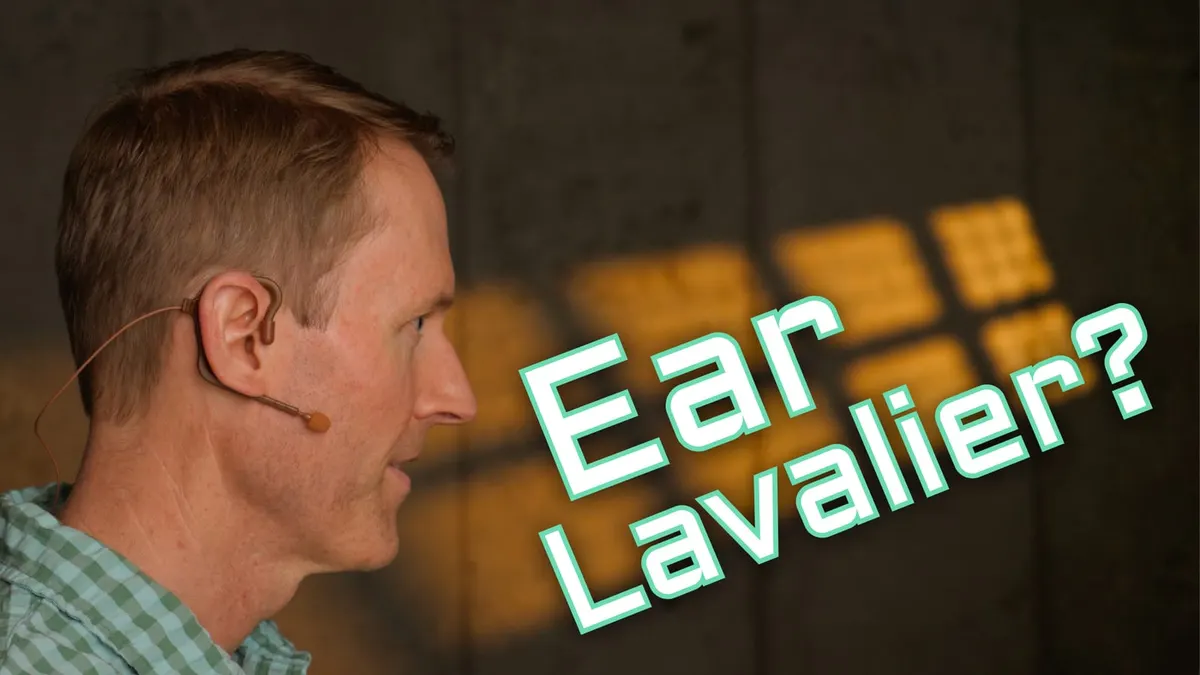
In this week’s episode, we have a look at and listen to Point Source Audio’s Embrace lav mic system- specifically the Embrace EO-8WLh. This ear-worn lav system is super easy to use and specified for high-sensitivity use cases, like interviews, demonstrations, and other dialogue-based recording scenarios. Let’s take a closer look and find out if the Embrace would be a good lav solution for your workflow!
Gear used or mentioned
The links below are Amazon, B&H Photo, Sweetwater, or other affiliate links. As an affiliate, I earn from qualifying purchases.
- Point Source Audio Embrace — EO-8WLh Ear-Mount Lavalier Mic Kit
- Shure SLXD Wireless — System
- Sound Devices MixPre-3 II — 32-bit float audio recorder
Read the transcript
Do you need the freedom to be able to move around with a wireless microphone pack, but you don’t really have time to position or hide a lavalier microphone, or maybe you want to avoid the whole issue of clothing rustle altogether, which is something that happens even when you’re placing the microphone potentially on the outside of the clothing, not even when you’re hiding it, or avoid the drop-offs when person turns their head away from the lavalier microphone? You want to avoid all that?
Point Source Audio’s Embrace microphones could be a good option. Again, this is what we’re recording with right here.
Point Source Audio sent this to me free of charge. This is the Embrace mic. They not paid me further. They have not told me what to say. They’ve not reviewed this video prior to posting, so all the opinions you hear are my own. The one we’re using today is the EO8WLH.
Uh it’ll make sense a little bit what some of those letters and numbers mean in just a moment. This particular configuration is with our Shure wireless
SLXD system, so I’m using the transmitter on my back here. The receiver is just sitting right here for the SLXD system from Shure. That’s going into Sound Devices MixPre, and that’s the whole signal chain that you’re hearing here today. Incidentally, the this version of the microphone with a 3.5 mm locking connector for Sennheiser costs $429 US, just to put this in context. This is not a consumer creator level mic. This is more of a professional mic. All right. So, that’s what we’re looking at. The only thing we’ve done to the audio, we have not done any processing except to normalize the loudness to minus 23 LUFS, sort of a standard level, and that’s what you’re hearing here.
Let’s go ahead and play you two samples really quickly. This is with the microphone right here up next to my ear. It was easier to know it than to explain why I know it. If you were asked to prove that two and two made four, you might find some difficulty, and yet you’re quite sure of the fact. All right, this is the longer boom. It gets a little bit closer to my mouth, so let’s see how this sounds different. It was easier to know it than to explain why I know it. If you were asked to prove that two and two made four, you might find some difficulty and yet you are quite sure of the fact.
Okay, what are these microphones? They attach to your ear. They have this kind of rubberized connector that you can actually tweak. You can bend it and it will stay to some extent in that position. And it it holds it close to the sound source, in this case your mouth, so that as you turn, it follows you. You’re not going to get the fall off that you would get with a lavalier microphone necessarily. Now, obviously, not something you could generally use in narrative films unless you’re hiding it somewhere.
Um but you could definitely use it for interviews. Even if I am doing kind of an interview setup, there are different configurations. I’m using the one with the longer arm right now. There’s one that’s even shorter that places the microphone up closer to your ear here.
But even in an interview setting a setup, if I were looking off camera doing that type of interview, you could use the shorter one and the microphone will be completely concealed if you put it on the far side of the the face.
So, common applications here, of course, include TV, theater, corporate video, so on and so forth, even live sound production. The H in this particular model stands for high sensitivity, so that’s going to be for talking, spoken word type things, not necessarily for operatic singing. So, keep that in mind.
Um but this works really, really well for that. So, if you’re going to go with the really loud vocals, you’ll want to use the low sensitivity version, which is the version that ends with L at the end of the name instead of H for high sensitivity.
All right, what makes these unique? Of course, as I mentioned before, the pre-shaped ear mount allows you to quickly put it on. There is very little time. The only thing I’ve done here is just to keep the cable kind of contained cuz I’m running it down the back of my shirt to the wireless pack is I just put one piece of tape to hold the wire in place right there. That’s all I had to do. Very quick setup. So, there’s a reason why they use mics like this for live presentations. Classic example is TED Talks. You’ll see they almost always have the ear hung mics, ear worn mics. Similar type thing here.
Built-in cable channel on that little holder and which makes it very easy to route the cable through it and hold it in place, which is nice. You can still use this mic in traditional setups as a lavalier if you wanted to, but it does come with the the ear hanger and which is really nice. You can easily match this to the skin color of the talent that is using it. This one is not a perfect match for my skin. I have very light skin, but it comes in a variety of different colors, so you can have a variety of them on hand depending on the the color of the skin of the person that you’re working with.
The kit includes an X connector in your selected termination. So, you’ll see here we can actually change out terminations, which is really helpful.
So, you don’t have to go pay the hundred and whatever dollars to get it reterminated for a different wireless system if you’re switching wireless systems. Uh it’s just a screw connector, which is fantastic. It comes with that.
It comes with your selected termination.
It comes with a over ear mount, two under ear mounts, a small foam windscreen, and a traditional cable clip to help relieve strain and manage the cable between your ear and the transmitter. Are they noisy? Here is a practical noise sample. I’m just going to be quiet.
Relatively quiet room here, but uh that gives you a sense. So, we’ve normalized this again to minus 23. That’s where the noise floor sits in this particular case. Now, that’s measuring a lot of things. This is not a scientific self noise test because we have sound in the room that it was picking up. We have the Shure SLXD wireless system it’s going through and then we have the Sound Devices MixPre that it’s going into plus all the cables between them.
So, that’s the total measurement of all that. From my point of view, that’s that’s definitely acceptable and something great to work with. To me, these sound quite good. Uh definitely better than most lavalier microphones, especially when you’re wearing them down here. And I could see this is a really helpful thing to use if I’m going to be doing a demonstration and then I can walk around with complete freedom and show you my lighting setup. Here’s one of the lights that we’re not currently using in the background or here’s a soft box that we have stored right here or something you also can’t see off screen, but we have a little rim light that’s uh sitting over here just off screen, so uh really helpful to be able to move around and demonstrate things. And now, of course,
I have messed up my lighting setup.
There we go. Back on track there.
Okay, you can get it in again beige, black. It is also IP57 in terms of its water resistance, so that’s helpful.
Again, you’re probably not going to dunk want to dunk it and leave it under water for a long period of time, but if it does get some sweat on it, it’s going to be just fine. Possible connector types for different wireless systems include
TA3F, TA4F, TA5F, locking 3.5 mm,
Hirose, Lemo, and uh 3.5 mm TRRS. So, if you were going to even use, for example, a mobile phone, you could do that or a or a laptop. So, that makes it compatible with a lot of different wireless systems, Audio-Technica, AKG, Beyerdynamic,
Shure, Sennheiser, Lectrosonics, Sony,
Zaxcom, Wisycom, and probably others as well. So, that is that’s really nice. Again, as we mentioned, the X connectors are nice because you can switch between those different terminations.
The different termina- terminations cost different amounts, so that $429 is for the 3.5 mm. Some of the others are more expensive because of the connector.
All right, I think that’s everything on this one. I think this is a useful option for people that are doing demonstrations on video, potentially corporate video, in which case I would probably use the over ear ear connector. So, guess is that what you call it? I’m not sure. Um but good job, Point Source Audio. Thanks for sharing this with us.
For everyone else out there, get out there and make some great sounds, and we’ll talk to you again soon.