
Microphone Specifications - What do They Mean?
· Audio · Microphones · 19:48
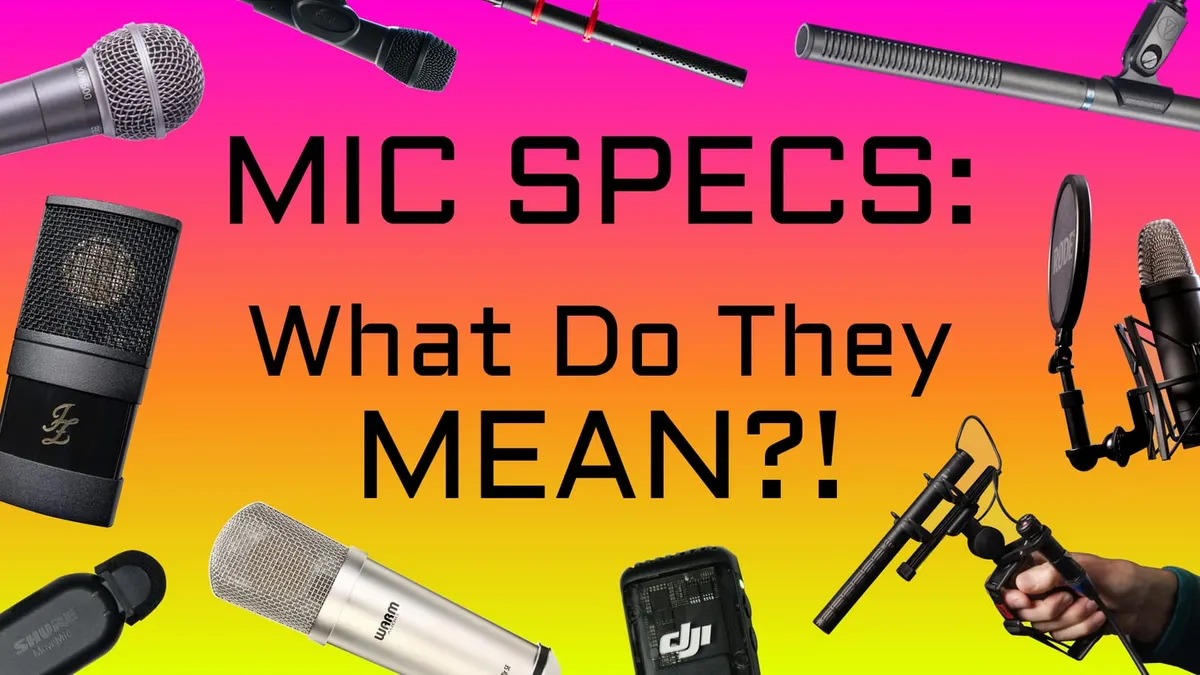
In this week’s episode, we explain what the various microphone specifications mean — things like element type, sensitivity, impedance, self-noise, power requirements, frequency response, and more.
Gear used or mentioned
The links below are Amazon, B&H Photo, Sweetwater, or other affiliate links. As an affiliate, I earn from qualifying purchases.
- Sound Devices MixPre-3 II — audio recorder
- Sennheiser MKH50 — microphone
Common questions
What does microphone self-noise actually tell me?
It's noise from the mic's own electronics, separate from room noise. The best mics measure around 4 dB(A), and I consider 16 dB(A) or less generally acceptable. Worth remembering that a "noisy" recording is usually a noisy room, not a noisy microphone.
Can I trust a microphone's published frequency response chart?
Treat it as a general guide, not gospel. Those charts are often heavily averaged and smoothed, and apart from some high-end mics they're not measured from your specific unit. Watch for a bump around 5-10 kHz, which can emphasize sibilance.
What max SPL do I need in a microphone?
Around 120 dB is usually enough for dialogue or singing. For very loud sources like air shows or jet engines, look for 130 dB SPL or higher. Lavalier mics often spec lower, so check carefully if you need to capture everything from whispers to screams.
Read the transcript
This episode covers common microphone specifications, what they mean, and their practical impact on dialogue recording. First, element type or acoustic principle: is it a dynamic or condenser microphone? Dynamic mics tend to sound more “broadcasty” when used up close, with emphasized bass response. Many believe dynamics reject room noise better, but that’s really because they’re typically used very close to the mouth, improving signal-to-noise ratio, not an inherent property of the dynamic design itself. They’re a solid choice for untreated rooms when used close. Condenser microphones (RF-bias, DC-bias, JFET types) almost always need 48V phantom power, and tend to have an extended, brighter high-frequency response. I prefer condensers when I can use them, but reach for a dynamic for something like an interview on a noisy show floor.
Next, polar pattern (pickup pattern): directionality that reduces sensitivity to off-axis noise. Cardioid is most sensitive to the front, less to the sides, least to the rear — good for dialogue mics used reasonably close. Supercardioid, common on boom mics, is even more focused on the front with slightly more rear sensitivity as a tradeoff, which suits the greater working distance typical of boom recording.
Frequency response describes how evenly a mic captures each frequency across the spectrum — most mics fall off at the low and high ends, and dynamics generally roll off high frequencies sooner than condensers. Watch for a bump around 5-10 kHz, which can emphasize sibilance for voices with a lot of “s” and “c” energy. Published frequency response charts are often heavily averaged/smoothed and not measured from your specific unit (except on some high-end mics), so treat them as a general guide rather than gospel. If you have a bassy voice, avoid mics with heavy emphasis in the 40-200 Hz range, which can sound muddy and fatiguing.
Output impedance on XLR mics is typically 50-200 ohms. As a rule of thumb, your preamp’s input impedance should be roughly 10x your mic’s output impedance (a “bridging” relationship) for optimal performance; mismatches won’t damage anything or cause a fire, but may slightly color the sound.
Sensitivity (or output level) indicates how much gain your preamp needs to supply for a healthy recording level — condensers are typically more sensitive (numbers closer to 0 dBV/Pa) and need less gain; dynamics need more, sometimes requiring an in-line booster like a Cloud Lifter for very insensitive mics like the Shure SM7B (look for at least 60-65 dB of clean gain on your preamp for that mic).
Max SPL is the loudest sound level a mic can capture before distorting — for very loud sources (air shows, jet engines) look for 130 dB SPL or higher; for dialogue or singing, around 120 dB is usually enough, though lavalier mics often have lower max SPL specs, so check carefully if you need to capture whispers-to-screams for something like a horror film.
Self-noise (usually dB-A weighted) is noise generated by the mic’s own electronics, separate from room noise — the best mics measure around 4 dB(A); I consider 16 dB(A) or less generally acceptable, and remember a “noisy” recording is often actually a noisy room, not a noisy microphone.
Power requirements: condensers typically need 48V phantom power (occasionally 24V or 12V); modern dynamic mics are safe to use even with phantom power switched on for other channels. Lavalier mics typically need 3-5V of plug-in power, and many consumer wireless transmitters or pocket recorders don’t supply enough voltage for professional-grade lavaliers, which can limit performance (though usually won’t damage the mic).
Finally, high-pass (low-cut) filters vary widely — from around 60 Hz up to 250-300 Hz. On my Sennheiser MKH50, the built-in high-pass filter is centered at 250 Hz, aggressive enough to counteract heavy proximity-effect bass buildup when used as a close mic, but it would make my voice sound too thin when I’m using it properly positioned as a boom mic at 35-40cm. An 80 Hz high-pass on a large-diaphragm condenser, by contrast, is a good general-purpose setting for voice that removes rumble without thinning out the sound. Get out there and make some great sound, and we’ll talk to you again soon.