
Neumann NDH 30 reference headphones — and immersive audio
· Audio · Headphones & monitors · 12:42
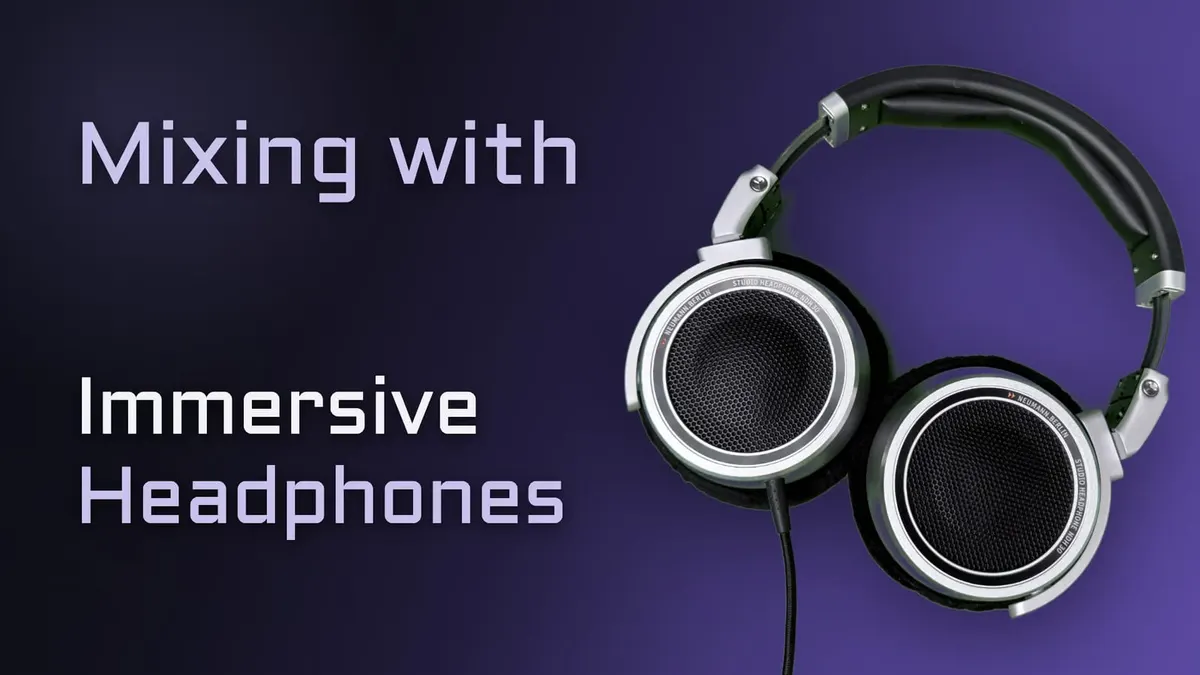
In this week’s episode we have a look at the Neumann NDH 30 reference headphones. These premium headphones inspire confidence when it comes to mixing sound for video on open-back headphones. But the unique value is in the add-on plugin/app called RIME which turns these headphones into immersive headphones, allowing you to playback up to 7.1.4 Dolby Atmos immersive sound. Let’s have a look and a listen!
Gear used or mentioned
The links below are Amazon, B&H Photo, Sweetwater, or other affiliate links. As an affiliate, I earn from qualifying purchases.
- Neumann NDH 30 — open back reference headphones
- Neumann NDH 20 — closed back reference headphones
- Neumann U87 Ai — microphone
- Neumann RIME plugin
- Sound Devices MixPre — audio recorder
Read the transcript
Can you playback and even potentially mix immersive audio like Atmos on headphones? Let’s have a look here at the Neumann NDH-30 headphones and the Add-on Rime plugin and app. Now, before we get into it, full disclosure, Guitar Center contacted me several months back and asked if I’d be interested in reviewing some Neumann headphones. And of course, I said yes. I’ve tried a lot of different headphones from companies like Biodynamic, Shure, Odyssey, AKG, lots of others. And I’ve never tried Neumann headphones, so I said absolutely yes. These were provided to me at no cost by Guitar Center. So thank you, Guitar Center for that. And they have not instructed me what to say. So everything you hear here is my own opinion. They haven’t reviewed this video prior to posting.
Now, NDH-30 are not budget headphones. So if that’s what you’re looking for, come back. Future episodes, we will cover more affordable headphones. But this one is really kind of unique from the standpoint that you can do some really, really interesting things with immersive audio with these that you cannot do with a lot of other headphones, at least not like you can with a Neumann NDH-30.
Here’s what I really like about these headphones. I’ve been using them for approximately the last 10 weeks. The build quality is pretty much of the highest quality that I’ve used of any headphones. The ear cups are solid aluminum. The hinges and the joints are just really high quality and premium feeling. Of course, removable replaceable cable. The padding on the ear cups is really, really nice. It’s sort of a velour fabric. Really nice padding on the headband up here, along with this sort of notch to prevent hot spots on the top of your head. Just fantastic in terms of build quality and in terms of comfort. So really love those.
Sound quality, obviously one of the most important headphones I’ve ever used. Now these sound as good and as clear to me across the frequency spectrum as much more expensive headphones, even planar magnetic headphones. And planar magnetic headphones, if you’ve never used them, I think your experience would be pretty similar to mine. They are pretty phenomenal. These are actually dynamic headphones, but in terms of what they’re able to reproduce, they rival what I hear from things like Odyssey headphones, which are planar magnetic.
So again, what I mean by that is that if you’re listening to some music, for example, on lower quality headphones, the instruments sort of smear together and you can’t necessarily pick out the nuances of the different instruments because they’re smeared. With really high quality headphones like this, you can actually hear each of the individual instruments very clearly if the different parts in an arrangement come through very, very clearly. And I can say that’s definitely the case with the NDH30s.
They also translate well when I switch from my near field monitors to these and back and forth, which I need to do sometimes. So when I’m doing dialogue edits, for example, I’ll have these on because I want to hear all the tiniest little mouth clicks and all the nuances. And then I’ll switch over to my near field monitors and they translate pretty well. And Neumann monitors, I’m using focal monitors right now. I’d love to try some Neumann monitors for the record, but they translate really well, which kind of speaks to the quality of the headphones here.
One of the most important things, of course, with headphones is that you need lots of headroom. You need to not have distortion and the distortion spec on these, and it seems to play out in my experience with them, is less than 0.03% at 1 kHz at 100 dB SPL. Now, you shouldn’t be cranking up your headphones at 100 dB SPL regularly, but what that means is you’ve got plenty of headroom. They can reproduce things without distorting beautifully.
Incidentally, they’re designed to sound like to be voiced very much like the Neumann near field monitors. So again, I’d love to try that, but that’s what I’m told here is that their voicing is very similar to those. As I mentioned, before, replaceable cable with a locking connector, that earpads are also replaceable. So that’s fantastic. 120 ohm impedance. What does that mean? You can use them with almost all headphone amplifiers, whether it’s one built into your audio interface or something maybe more premium than that. I found myself on my Universal Audio Apollo X6 audio interface with the volume usually at about 50%. Yeah, somewhere around there for a really good, well mixed, immersive mix. And it was very comfortable there. So plenty of enough power for most headphone amps to drive these.
These are open back headphones, the NDH 30s. There’s also a NDH 20, which are the same, very similar, but closed back. I prefer open back when I’m mixing for a couple of reasons. It sounds less claustrophobic, less, less closed in. So it feels like mixing on near field monitors or speakers to me. And I have the luxury of recording or mixing in a room where there’s not a lot of ambient noise. So I don’t have to worry about that. That’s where close back is when you’re either recording into a microphone and monitoring yourself, or you can’t afford to have sound bleeding out because you’re working around other people, or there’s sound in the environment where you’re mixing, and you need to kind of attenuate that or get some isolation from that. So that’s where the NDH 20 may be a better option for you.
For me, the biggest thing that got me excited about these headphones is that there is also from Neumann an app and a plugin called RIME, R-I-M-E, which stands for, incidentally, Reference Immersive Monitoring Environment. And what this plugin and what this app do is that it allows you to take your NDH 30 or NDH 20 headphones and it turns them into immersive headphones.
What I mean by that specifically is that you can play back an immersive mix up to 7.1.4, like an at most mix, from your DAW or from apps like maybe Apple Music or Apple TV. The app then sort of basically intercepts that 7.1.4 or immersive mix, and it renders it down to binaural for playback on your headphones. Now, there are other things that do that as well. RIME is not the only software that will take an immersive mix and render it down to binaural, but this one is optimized specifically for the nuances of the NDH 30 and the NDH 20.
And the result is, because Neumann made the headphones, they voiced them, they also make the software, they can kind of fine tune it. And this has, with the RIME plugin and the app and the NDH 30s, that’s the most convincing, immersive binaural playback I’ve heard so far.
And I’ve played with the Dolby binaural renderer with Atmos built into various DAWs. And it does okay, but this one is actually kind of what I always struggled with is getting the surround. It doesn’t work very well because a lot of other or at least on the Dolby binaural renderer in DaVinci Resolve that I’ve tried with my Biordynamic headphones. But this one was much more convincing, especially the the rear, the sound coming from the rear, which was very nice. So that’s kind of a very cool feature.
Now, a few notes about the NDH 30s. First of all, a question I’m sure someone’s gonna ask, are they flat? Are can you trust them for mixing? Well, here’s the thing with headphones, they’re not flat. There are tons of places out on the internet, you can go look up various people who have measured these with highly sophisticated measuring devices. And you’ll notice that the frequency response is not flat. And that’s true of any quality headphone.
Most headphones are actually voiced or tuned to sound to meet various targets, target curves, like a Harman curve or a diffuse field curve. And the Harman curve, for example, was is based on a bunch of scientific research where they give lots of people headphones and they play back some things. And they get people’s preferences and they average those and like, in essence, and they create those curves. And so they’re kind of like, it’s a scientific from the standpoint that they used lots of people, both professionals in audio and non professionals and kind of got their preferences and figured out what okay, for most people are going to enjoy listening to this type of curve. And then diffuse field on the other hand is more to represent what playback from high quality speakers or monitors in a good acoustic environment would sound like. So it’s, it has to use these unusual curves to achieve that effect within headphones. That’s the short version, the very dumbed down version.
And again, in my last 10 weeks of monitoring with these headphones, they represent audio across the frequency spectrum in a way that I trust them for mixing, I absolutely feel confident mixing in these. Now, does that mean I will never listen near field monitors again, of course not. But it does mean I feel confident I could do a mix in this, switch over to my near field monitors, double check the mix and go. And I’m excited to try that for immersive mixes now too. Obviously, I don’t I don’t have a 714 setup in my mix room. So I’ll have to check the mix elsewhere. But I feel confident that I could get a good start. And probably a pretty solid mix in these headphones with the RIME plugin.
A couple of other notes, the cable that comes with it is quite long, it’s three meters long, that’s really helpful if you’re working in a place where you need to kind of move around a little bit from your headphone amp. Other people find that annoying because then you’re running over the cable with your chair or walking over it or whatever. You can manage that in a few ways, you can just get some hook and loop tape, of course, and manage it yourself. Or they also from Neumann have shorter cables, a 1.2 meter cable, or a coiled cable if you prefer. And I find that people the whole debate against around straight versus coiled cables is like a religious debate, it just everyone has your preference. And that’s okay. So you have both options.
Now, as I mentioned before, these are open back. And there are some costs using open back open backs not appropriate in every single circumstance, if you’re trying to manage ambient noise, obviously, close back may be a better choice. Or if you’re working in a space with other people, and you don’t want sound leaking out, and interrupting those other people, you might want to consider close back instead. And of course, the ndh 20 closed back headphones, which are a great option as well, I imagine.
So let’s talk about the price $699 us at the time of this review, is that expensive? It’s all relative. For many people with tight budgets. Yes, that’s expensive and probably out of reach. However, if like me, you’re trying to dip your toes into immersive mixing, that’s a whole lot less expensive than a 714 12 speaker setup in your mix room, positioned throughout the room with the associated audio interface that can drive that many speakers, and where there’s acoustic treatment, and the room is calibrated. That’s that’s an expensive proposition, if we’re being honest. This gives people away for less than $1,000 to get into that.
Now I should mention that the RIME app is also an add on it’s a $99 app slash plugin. And that’s still less expensive than doing that whole 714 setup in your mix room. Also, as I mentioned before, RIME is also optimized for the $599 ndh 20 closed back headphones. So that’s an option as well.
How do you set it up if you want to do playback from on a Mac for maybe Apple TV or Apple Music? I have instructions down in the description below just kind of step by step if you want to figure out how to get that set up.
All right, my take on these headphones, I’ve used them every day for the last 10 weeks. They’re probably the best sounding dynamic headphones that I’ve used in terms of reproducing with clarity across the entire frequency spectrum. And I feel confident mixing with them versus much lower quality headphones that I’ve used before.
So build quality is excellent. The comfort is among the best that I’ve tried in headphones. And for someone who wants to dip their toes into immersive mixing, I would say that the Neumann ndh 30s or 20s with the RIME plugin are a really, really good option. So let’s you and I get out there and start making some immersive mixes. Talk to you again soon.