
PART 2 — 32-bit Float Audio Recorder Quality
· Audio · Recorders · 11:41
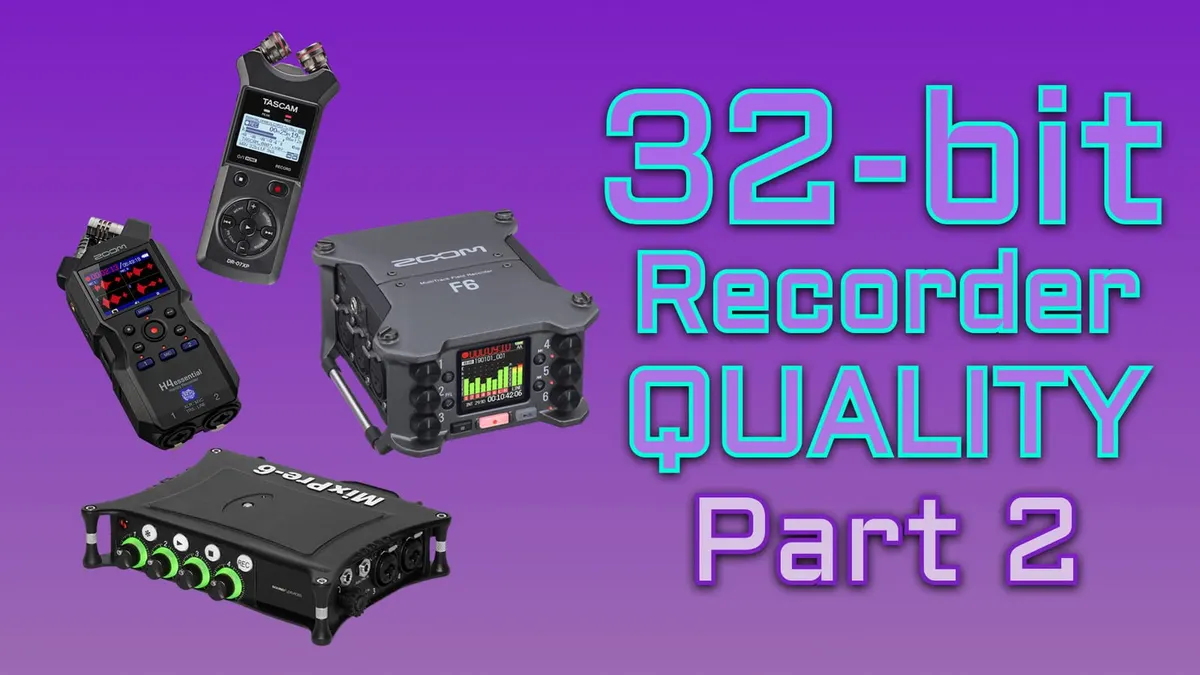
In this week’s episode, in our second part in this series, we discuss in a bit more detail, the difference in audio quality between budget and higher priced 32-bit float audio recorders.
Gear used or mentioned
The links below are Amazon, B&H Photo, Sweetwater, or other affiliate links. As an affiliate, I earn from qualifying purchases.
Read the transcript
Part 2 on 32-bit float recorder audio quality differences. Last week’s summary: every component in a recorder’s signal chain affects the final sound, and a weak link (a low-quality preamp, or just one A/D converter) drags down the whole result. Here’s the ideal 32-bit float signal chain in more detail: a microphone feeds two or more preamplifiers at fixed, manufacturer-set gain levels (one optimized for quiet sounds at higher gain, one for loud sounds at lower gain, each tuned for the best possible self-noise at that setting), each preamp feeds its own A/D converter, and then — critically — the outputs of those converters get recombined into a single 32-bit float stream. That recombination step is genuinely complex engineering, not just averaging or summing the signals; it has to account for phase differences and make real-time decisions about which converter’s output to favor at any given instant, all without introducing weird artifacts, and do it efficiently enough not to drain batteries in a field recorder. This recombination algorithm is a big part of the “secret sauce” that separates good-sounding recorders from mediocre ones.
Where budget recorders skimp: often just a single A/D converter (and therefore effectively a single preamp), meaning that preamp’s fixed gain has to be set low enough to avoid clipping on loud sounds, sacrificing the low-noise headroom you’d get from a dedicated low-gain/high-gain preamp pair. Boosting that quiet audio in post then brings up more noise floor than an ideal design would. So why bother calling it “32-bit float” at all if there’s no real dynamic-range benefit? Partly marketing, but it does offer a genuine benefit for casual users: you never have to set gain, which matters if you’re not confident doing that, even if the noise floor isn’t pristine. These budget recorders also typically pair that single-converter design with cheaper preamps and, if they have built-in mics, less capable microphones — and microphone choice has a big impact on self-noise too.
Even recorders with two preamps and two converters can still sound mediocre if the recombination algorithm itself isn’t well engineered, which often shows up as harsh-sounding audio — that’s a sign the manufacturer may not have invested enough R&D there.
The takeaway: every stage of the signal chain matters, and a few excellent components can’t compensate for one weak one — this has always been true of audio recorder design. Manufacturers hitting an aggressive price point have to make tradeoffs somewhere, and it’s usually in these areas.
Recorders I’ve found sound genuinely good: the Sound Devices MixPre series (which per their patent filings use at least two, possibly three, preamps and converters per input); the Zoom F3, F6, and F8n Pro (confirmed by Zoom’s Samuel Green to use multiple converters per input, though preamp details are less clear); the Tascam FR-AV2 and Portacapture series (decent, though the Portacapture sounded slightly less clean to me than the Sound Devices/Zoom options); and the newer Zoom H5 Studio, which also performed really well in my testing. Links to all these reviews are below — opening several in separate tabs and comparing them back to back is a good way to hear the differences yourself. Let me know your own experiences with 32-bit float recorders in the comments. Get out there and make some great sound.