
RODE NT1 Signature Series?! Great sound, price (and colors, if you're into that)
· Audio · Microphones · 15:36
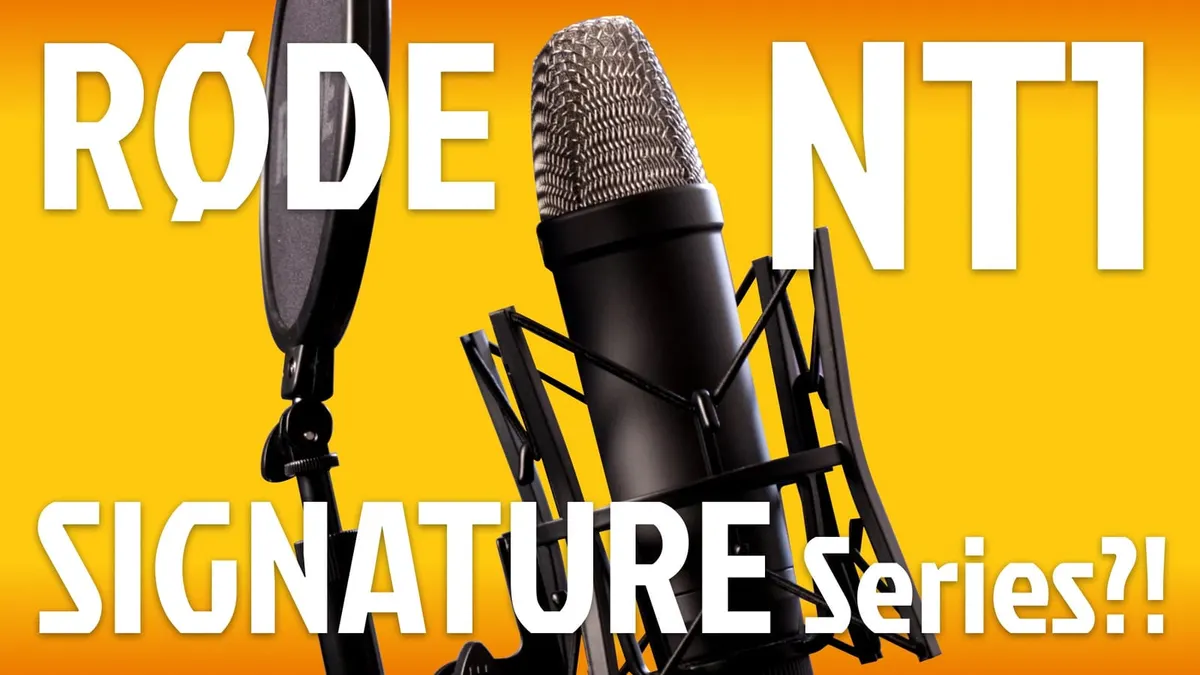
In this episode we take a look at and listen to RODE’s latest studio condenser microphone, the NT1 Signature Series. This is the newest version of RODE’s large diaphragm condenser microphone with an XLR output for the ridiculously tiny price of $159 USD. It includes a shock mount, XLR cable, pop filter, and a dust cover as well as an industry leading 10 year warranty. Let’s take a closer look!
Gear used or mentioned
The links below are Amazon, B&H Photo, Sweetwater, or other affiliate links. As an affiliate, I earn from qualifying purchases.
- RODE NT1 Signature Series microphone — B&H, Sweetwater, Amazon
- RODE NT1 5th Generation microphone — B&H, Sweetwater, Amazon
- Neumann U87 Ai microphone — B&H, Sweetwater, Amazon
- On-stage stands desk stand (you will need to add extra weight to the base to avoid tip-over — B&H, Amazon
- Canon C70 Cinema Camera — B&H
- Canon RF 24-70 f/2.8 lens — B&H, Amazon
- Panasonic GH5 camera — B&H, Amazon
- Panasonic 12-35mm f/2.8 II lens — B&H, Amazon
- Impact Turtle-Base C-Stands — B&H, Amazon
- Amaran 200x S LED light — B&H, Amazon, Aputure
- Aputure Light Dome II soft box — Aputure, B&H, Amazon
- Aputure Spotlight Mount — Aputure, B&H, DVE Store, Amazon
- Rosco Prismatic Glass Gobo in Cool Lavender — B&H
Read the transcript
[Music] What?
Another Rode NT1?
How many of these are they going to make, and why should anyone care?
Let’s talk about that. So this entire episode is recorded with the Rode NT1 Signature Series into a SoundDevices
MixPre3, and I do have a light here with a fan in it and the light that’s putting this on the background also has a fan in it.
It’s over there. You might hear a little bit of that, so don’t blame the microphone for that.
Let’s go ahead and jump in. Let me just tell you a little history. So I bought my first large diaphragm condenser microphone in 2007.
It was the Rode NT1A.
At the time I believe it was $270 USD, and I bought it so I could record podcasts- audio only at that point.
And it was a pretty good microphone.
It actually had a really beautiful low end and kind of rich sound to it, but it also emphasized some of the high end a little bit.
So it emphasized sibilance.
That is to say, when people say the letter S or C, some voices more than others you get this sort of sizzling sound that’s kind of grating to listen to, and I have a good bit of that in my voice. So the NT1A was a great microphone but wasn’t the perfect fit.
Then a few years later Rode released a new version of the Rode NT1- what we can now call the fourth generation, and that microphone, to my ears, pretty much solved that problem.
It was a much more balanced sound.
It didn’t overemphasize the sibilance.
Great microphone. As it turns out, I use that microphone every single day for work- for Zoom calls.
It is my number one choice for that.
Sounds fantastic. Much more balanced sound. Great microphone at $270 US.
I actually like the sound of the Rode NT1 Signature Series better than my voice through the Neumann U87Ai.
Now this is a classic studio microphone.
This is the latest iteration of that, but this is a microphone that costs I believe $3,700 if you buy it in a kit with this shock mount.
This is my copy.
I… unwisely spent that much money on it.
It’s not a bad microphone. I don’t want to make it sound the wrong way but I actually prefer the sound of my voice through the Rode NT1 fourth generation, fifth generation, and Signature Series better than
I like the sound of my voice through the Neumann U87.
Earlier in 2023, Rode released the NT1 fifth generation.
So essentially they took the NT1 fourth generation, they redesigned it while keeping basically the same sonic signature, the same sound to it, but they added some things.
They added a USB output in addition to an XLR output.
They added 32-bit float audio via USB and they also added internal processing.
So things like a compressor, an equalizer, a noise gate into the microphone itself, which is in and of itself an impressive feat, but they also did that and reduced the price down to $250 US, which is really impressive.
And this is for a microphone that’s manufactured in their own facilities in Sydney, Australia.
So they’re not outsourcing it or having it manufactured in some other country.
They’re actually doing it in their own factory in Sydney, Australia.
Pretty impressive.
Now what is the NT1 Signature Series?
It’s basically the NT1 fifth generation but without the USB output, the 32-bit float audio or the internal processing.
And you can also get it in a variety of different colors.
And the biggest feature, I guess I would say, is it is a great sounding microphone.
Sounds exactly to my ears exactly like the NT1 fifth generation and the NT1 fourth generation and it is $159 US.
So let’s go ahead and first let you listen to some raw samples completely unprocessed with no fans in the room.
Here we go. [Sample Audio] So, to my ears it has a kind of nice warm low frequency tone to it, kind of rich, pretty neutral mid-range, and just a very slightly emphasized high frequency response. Overall making a really nice sound. Is it perfectly 100% neutral?
No, but I think overall the sound is pretty balanced and I think works for a lot of lot of voices. It includes a traditional shock mount and pop filter, and you’ll need both of these things to help manage, first of all like table bumps or stand bumps, and the filter helps prevent plosives. Plosives are when you say the letter P or B, a little puff of air comes out of your mouth. If you do that directly into the microphone, it hits the microphone capsule, which is the part that picks up the sound, and it sort of distorts.
You get this low frequency sort of “boom” kind of sound to it, and it’s not really great.
So the pop filter prevents that, so it comes with everything you need.
Here are some examples of the sibilance, which we talked about earlier, to see how well this microphone handles that, how well the pop filter works, how well it prevents those plosives from happening, and also how well the shock mount prevents vibrations from the table, whether you bump the stand or the table itself, from transmitting themselves into the microphone.
So it kind of isolates the microphone from those. [Sample Audio] Now let’s also tap the stand here and see how the shock mount does at managing that. Here’s the base of the stand. Oh, definitely picking that up.
Here’s the base.
Yeah, stand itself outside of the shock mount, and then the microphone itself.
Okay, so definitely need the shock mount.
Here I am tapping the table.
Now I found that with these microphones, typically I like to apply a low cut or a high pass filter- same thing, different names- and all that does is cut off the really low frequencies below the spoken word voice and cleans that up just a little bit.
This is an incredibly clean microphone.
They cite a very, very low self noise; in fact, the cleanest self noise spec I’ve seen on a large diaphragm condenser microphone on the market.
And when I did my practical noise floor samples, what I do is I record in here just a little bit of talking and then leave a silent portion.
I turn all the lights off; the freezer over there, I unplug it so there’s no noise in this room. And I have sound blankets and then I measure the silent portion after I normalize the entire audio clip up to -23 LUFS.
Just a way to kind of gauge what kind of noise floor you’re going to get when making a recording with this microphone in a quiet space.
And it definitely supports Rode’s claim of an incredibly low self noise on this microphone.
So we came in at -74 dB RMS max, one of the cleanest microphones I’ve ever worked with.
Now, this is a directional microphone.
It does have what Rode calls a cardioid polar pattern, meaning it’s most sensitive on the front. The sensitivity starts to fall off at the sides.
It picks up less at the sides and even less at the back.
Now what I’m really proud of Rode for doing is that they are now being more specific when they print their polar graphs.
And this tells you about the sensitivity of the microphone on its different sides.
And what you can see here is it actually is quite cardioid at the lower frequencies, but when you get to the higher frequencies, 8 kilohertz for example, it has a bit more of a super cardioid polar pattern.
So it does pick up a little bit of that in the back and you can hear that in our off-axis sample right here. So here we are talking directly into the front of the microphone at 0 degrees, right on axis.
So this is the most sensitive part of the microphone.
Now we’re going to turn at 90 degrees so that we are talking into the side of the microphone.
And there we go. We’re talking now directly into the side of the microphone.
So we’re off axis 90 degrees.
Now we’ll go ahead and keep turning that around.
And now I’m 180 degrees off axis.
I’m talking into the back of the microphone where it should be least sensitive.
Let’s go ahead and bring it back around to the front.
So here we’re talking, talking, talking as we turn it so that we’re at 90 degrees off axis. And then we will continue to turn until we are directly on axis talking directly into the front of the microphone. Now, the NT1 Signature Series can handle sound pressure levels up to 142 dB SPL.
That’s really loud. And if you’re working in an environment that loud, you had better be wearing ear protection.
So what that means in practical terms is not only can you use it like I typically do for spoken word recordings, but if you wanted to record a screaming guitar amp or bass amp you could do that as well. It can handle that level of sound pressure level.
But if you want to learn more about that, I might recommend you go over and see another channel here on YouTube called Podcastage.
If you go over there, tell Bandrew hello for me and also tell him that I really like his pop punk ditties. They’re a load of fun. Now: is this the right microphone for you?
It’s not the right microphone for everyone. No one microphone is the right microphone for everyone.
But let me tell you a little bit about it and where I think it’s going to shine.
I do spoken word recordings, whether that be for podcast or video.
That’s typically what I’m doing and this is a good fit for that.
What I have found, which is interesting, is that some people who buy their first microphone buy something like this and they get it home and they’re recording in their home and they’re like, “Oh my gosh, this picks up every little sound!”
That’s true. They’re sensitive microphones. That’s what a condenser microphone does.
It’s good at picking up nuance.
Some of those people will tell you, “Don’t buy a condenser microphone like this.
Whatever you do, they just pick up every tiny little thing.”
So the heater comes on. You can hear that. The air conditioner comes on. Noisy pets and children.
Fan in your computer. All those things it’ll pick up.
They’re not wrong. It will pick up those things.
In those cases, what a lot of those people will say, and I don’t think this is necessarily bad advice, is that you might be better off with a dynamic microphone instead of a condenser microphone. Rode makes some of those. There’s the PodMic, for example.
The general thing that works there in those situations where you have a little bit more noise going on is that a dynamic microphone is generally less sensitive, meaning you end up having to work up closer on the microphone.
And when you get closer, by nature, you increase what’s called the signal-to-noise ratio.
Your voice is closer to the capsule of the microphone.
As a result, you don’t have to turn the gain up quite so much to capture your voice at the right level. And what that means in practical terms is that all of the noise in the background is going to be picked up a little bit less as well.
So if you’re working in a very noisy environment, that’s where a dynamic microphone might be a better choice than something like this.
However, if you are looking to make a… especially if you’re doing something like voiceover or an audio-only podcast, I actually think that this can provide a more polished sound.
A lot of those dynamic microphones get this really kind of broadcasty sound, and sometimes, depending on your technique, they can start to sound fatiguing like you’re talking into a pillow after a while.
I’m not saying that it’s a bad sound.
Dynamic microphones don’t automatically result in that sound, but I think a lot of people who are using them for the first time end up getting that kind of sound.
I feel like with a microphone like this you can get a more polished, kind of a classier sound maybe? Something a little bit more natural but still has that rich low end to it, but it does take a little bit of work. And what I mean by that is you do need to control some of the noise in your space.
So for example, I unplug that freezer over there every time I record here.
I have sound blankets here. I have blankets to either side of me hanging from the ceiling.
Now that’s pretty intense. A lot of you are not going to be able to do that in your home necessarily.
I put a blanket on the table in front of me so that the sound of my voice doesn’t bounce off the table and bounce back into the microphone.
You can use any sort of blanket, by the way. It doesn’t have to be a sound blanket, but anything you can do to kind of manage the sound in your space a little bit, manage the reverberation of the sound of your voice, bouncing off of the hard walls and the hard floors perhaps or ceilings, depending on what you have in your space.
If you can control some of that and you can optimize the position of your self, your voice, to the microphone, you can get a fantastic sound with a microphone like the Rode NT1.
And you can do it at a reasonable price. $159 US. You can get the designer color of your choice.
And you can use this with pretty much any USB audio interface with an XLR input, even the budget ones like, say for example, Focusrite Scarlett 2i2.
This works beautifully with those because it doesn’t need a lot of gain.
Here, for example, we’re using 49 dB of gain through this entire thing, which is plenty.
And the budget interfaces can all supply that like the Scarlett 2i2.
And you can make some fantastic spoken word audio recordings.
So I hope that was helpful for you. If you have any questions, go ahead and leave those down below.
If you’ve not already subscribed, make sure you do that, and we’ll be sure to get you more great videos on how to improve your lighting and sound for video.
Talk to you soon.