
Sennheiser EW-DP | Easy-to-Use Digital Wireless System
· Audio · Wireless systems · 15:20
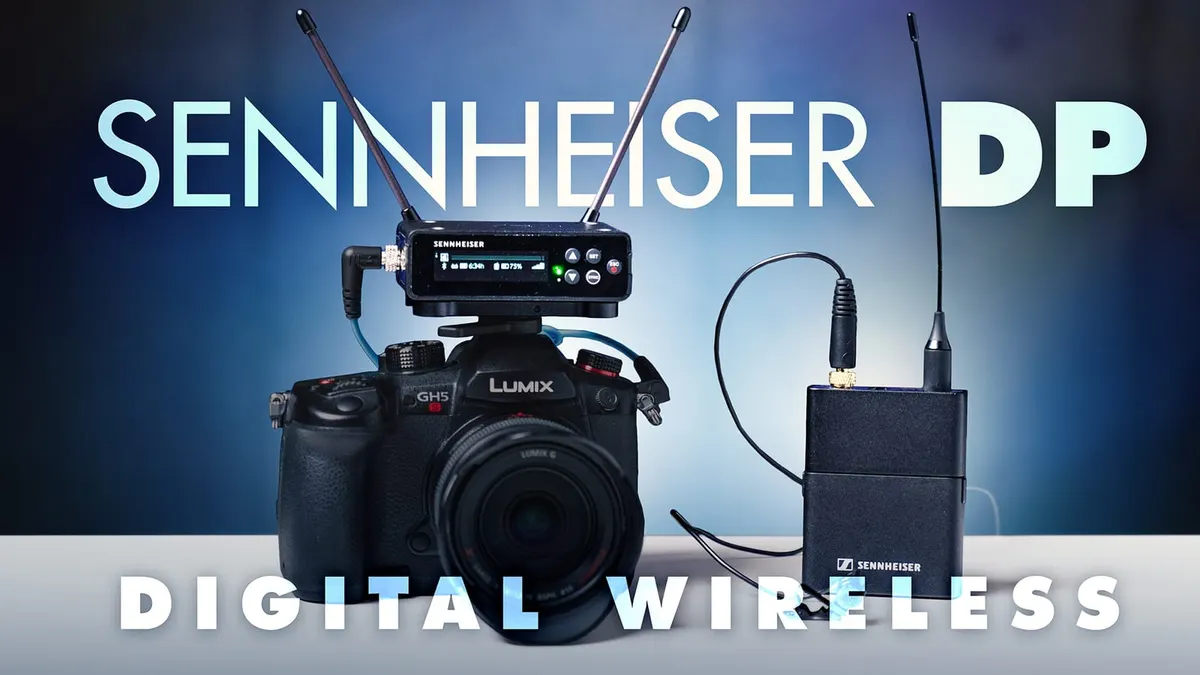
In this week’s episode we get to know Sennheiser’s new EW-DP wireless system. This prosumer UHF system is built for camera-top use to simplify and streamline filmmaking and content creation workflows. System-wide Bluetooth integration and app control make setting up and monitoring during recording easy. In this video we test out the EW-DP’s sound, range, and reliability, and show you how to effectively incorporate it into your workflow. Let’s take a closer look!
Gear used or mentioned
The links below are Amazon, B&H Photo, Sweetwater, or other affiliate links. As an affiliate, I earn from qualifying purchases.
- Sennheiser EW-DP Wireless Microphone System — B&H, Sweetwater, Trew, Amazon
- Sanken COS11-D Omnidirectional Lavalier Microphone — B&H, DVE Store, Amazon
- Sennheiser MKE 2 Lavalier Microphone — B&H, Sweetwater
- RODE Wireless GO II Dual Channel Compact Wireless Mic System — B&H, Sweetwater, DVE Store, Amazon
- DJI Mic Wireless Microphone System — B&H, Sweetwater, Amazon
- Amaran 200x S LED light — B&H, Amazon, Aputure
- Aputure Light Dome II soft box — Aputure, B&H, Amazon
- Aputure Spotlight Mount — Aputure, B&H, DVE Store. Amazon
- Rosco Prismatic Glass Gobo in Cool Lavender — B&H
- Canon C70 Cinema Camera — B&H
- Panasonic GH5 camera — B&H, Amazon
- Panasonic 12-35mm f/2.8 II lens — B&H, Amazon
Read the transcript
[Music]
In today’s episode, we’re using the EW-DP digital wireless microphone system from Sennheiser, and you’re hearing it right here.
This is the included ME 2 lavalier microphone.
I’m wearing the body pack on my back here, on the belt.
That’s transmitting to the receiver, which is sitting on top of my Canon C70 camera, and it’s feeding the audio from the receiver directly into the camera’s microphone input. The microphone input is actually set to line level, and that’s exactly what you’re hearing right now.
In post we’ll boost it -23 LUFS, which is a standard loudness level. We’ll do a little bit of mouth de-clicking and de-breathing, but we won’t do any sort of EQ, noise reduction, or compression.
This light right here does have a fan in it, and there’s a light putting this up on the wall behind us that also has a fan, so you will hear some of that as well. Let’s go.
First up, let’s get you some raw audio samples with the included microphone as well as the Sanken COS-11D. [Sample audio] [Sample audio] [Sample audio] [Sample audio] [Sample audio] [Sample audio] [Sample audio] [Sample audio] [Sample audio] [Sample audio] [Sample audio] [Sample audio] [Sample audio] [Sample audio] [Sample audio] [Sample audio] [Sample audio]
Alright– what makes this system special? First, it is a fully digital wireless system that transmits within the UHF frequency range.
So what does all that mean? It is actually transmitting a digital signal, a signal of audio that’s been converted into digital, and then modulated, sent over the UHF frequencies, received, decoded back into analog, and sent out to whatever you’re recording to.
It’s typically made for recording to a camera.
So that’s one thing that’s really important about this system, for those that are up and coming location or production sound mixers, this is not a sound bag type of wireless system.
The receiver is made so that it’s not really equipped to go inside of a sound bag.
Just so you’re aware, it’s really made to record directly into a camera.
Does this replace the Sennheiser G4?
And the answer is no. The G4 is an analog system and this is a digital system. So this doesn’t replace it.
I would say, though, if I were choosing between this and the G4,
I would choose the system in 2023 and beyond.
Each kit has a 56 megahertz tuning range, so just talk with the dealer where you buy it, make sure you’re getting something that will work in the location where you’re filming and by ‘work’, I mean, is legal to use without a license!
Each individual channel of transmission takes up 400 kilohertz, so it’s fairly narrow, which is actually quite good.
So that means you can pack in a lot more different channels at the same time.
Now, one big change between the G4 and this system is that it uses Bluetooth low energy to do the syncing between the transmitter and the receiver. So with a UHF system, you have to choose a frequency.
Usually what you do is you do a scan to see what’s busy, which frequencies are ‘busy’, if you will; ‘busy’.
And then once you’ve chosen that on the receiver, then you have to sync the transmitter to use that same frequency so they can communicate.
And to do that, it uses Bluetooth low energy.
There’s an app for both iOS and Android that helps facilitate that and makes it very, very simple to set this up. In fact, I would say, quite a bit easier and faster than with the G4.
Another difference is because this is a digital system, it’s not having to do anything like the analog systems had to do, namely companding.
If you don’t understand any of this, just stick with me.
Companding is not necessary on a digital system.
And so what that allows them to do is they can achieve 134 dB of dynamic range with this system.
And the interesting thing about that is you don’t set the gain at the transmitter; you actually set it at the receiver, which is really, really nice. So if you’re operating camera and you’re trying to get the levels dialed in, you don’t have to keep walking up to the person wearing the body pack.
You can do that right from the receiver.
In terms of range, in our tests here in my home, we have about 3,000 square feet, so we walked from one end of the house on the first floor all the way up to the second floor and the other end of the house.
And we did not have any sort of drop outs whatsoever.
So it did really, really well indoors. [Indoor range sample]
Outdoors, it’s important to keep in mind that we got up to 25 meters reliably even with the pack on the back of my belt.
If you went beyond that and the pack is on the back, and I’m facing camera, we started to get dropouts right after 25 meters. [Outdoor range sample]
It’s important to keep that in mind. We do those walking outdoor tests just to understand the limits of the gear.
I don’t usually film 100 meters away from the receiver, but just so you understand what the limits are.
Indoors, though, we had no problems going through two doors, in fact, and so it did really, really well there.
For powering, the kit that I have here came with a lithium ion rechargeable battery.
I used that in the receiver, And with that in the receiver,
I’m able to get just over 7 hours of powering time.
You can also buy an extra battery like that and put it in the transmitter pack as well.
And when you do that, you get 12 hours of powering time, which is fantastic for a transmitter.
You can also use AA batteries in a pinch; you won’t get quite as long there. Here we’re using some alkaline re– actually not rechargeable, it’s just alkaline batteries. And we’re probably trending somewhere more around 8 hours, but still. Fantastic. And if you’re out in the middle of nowhere and you don’t have a rechargeable battery with you or a place to recharge it, using AA batteries will work in a pinch.
Digital microphone systems have latency.
That is to say, when you talk into the microphone, it takes a small period of time to translate that into digital, transmit it, and then the receiver, then, to take that digital signal, translate it back to analog.
That’s called latency. In Sennheiser’s original AVX digital system, the latency was 19 milliseconds, which actually became somewhat problematic.
So if you’re recording a wired boom microphone and wireless lavalier microphone, they wouldn’t be perfectly in sync. And there are other systems like this as well; the DEITY Connect system also had a 19 millisecond latency.
This one has a 1.9 millisecond latency, so those issues disappear. You’re going to be in good shape with that.
Now as I mentioned before, this system is really meant for recording into a camera and it does come with all of the equipment that you need, the rigging equipment you need to attach it to pretty much any camera.
It comes with this really nice cheese plate that has four magnets at the corners and what you do is you can actually attach that directly to your camera cage or if you have a shoe mount, you can attach the included shoe mount.
It comes with the allen wrench and everything, and that works really, really nicely.
Then you can just put the receiver on top of that– it attaches with the magnets– and if you’re going to add another receiver, so you’re gonna have two channels of audio, you literally just stack the second receiver on top of the first so they connect via magnets, and that works so beautifully.
The kit also comes with the ME 2 lavalier microphone, which, again, is what you’re hearing right now. Not my favorite lavalier microphone in the world.
It doesn’t sound amazing, but it’s less expensive than their MKE 2, which is their much better sounding, professional lavalier microphone. Just so you’re aware, the mic it comes with is just okay.
Also, it comes with a 3.5 millimeter locking cable to get the audio from the receiver into your camera.
It also comes with a 3.5 millimeter locking to XLR cable if your camera has XLR inputs instead.
Now with the included microphone, we did our practical noise floor sample.
And again, not a scientific test. What we do is we come in here, turn off all the lights, and we record a portion of me talking and then record me not talking for about 10 seconds.
We take that audio clip into post, boost it all up until it’s at -23 LUFS, and then measure the silent portion.
And this came in at -61.5 dB RMS max.
That’s acceptable. It’s not stellar, but it is acceptable. And that’s largely a measurement of the quality of the microphone and not so much the wireless transmission system itself.
One change from the G4 system, their analog wireless microphone system to the DP, is that the receiver does have two antennas, and you can adjust them, you can orient them in different ways. That’ll ensure that you get the best connectivity.
There is also a headphone jack on the receiver.
So if your camera for some reason does not have a headphone jack, you’ve got one here on the receiver. Now, if you’re using multiple channels, what I would probably do is feed the audio into your camera and then monitor from your camera’s headphone jack.
But either way, you’ve got a backup here if you need it.
The build quality is also a step up from the G4 system.
There’s far less plastic on this system; it’s almost entirely metal on the body pack transmitter and the receiver, versus the G4 and even the G3 before that, which was partly metal and then a bunch of plastic on top of that.
So it should stand up pretty well over time.
Now, as I mentioned before, the way that the system works is it auto scans, finds a frequency that’s not being used by anything else.
It sets that on the receiver and then it communicates with the transmitter to make sure that they’re both talking on that same frequency.
And it does all that via Bluetooth low energy, and you can use the app on your phone to also help facilitate that, as well as to change some of the other settings. For example, one thing that’s very nice is that if you, say, for example, you’re at a conference and you send someone up on stage with the body pack transmitter, they put the mute switch on and then they go to talk and then there’s no sound.
You can actually override the mute from the app, which is really nice, as well as set the gain on the transmitter and the output level on the receiver.
So you can control all of that from the app or you can control it from the receiver.
Now, one thing that the system does not have yet but is supposed to be coming later in 2023 is a plug-on transmitter.
That is, like, an XLR plug-on transmitter.
And that would allow you, for example, to connect it to a boom microphone and transmit that wirelessly.
In addition, it’s supposed to supply phantom power; fantastic.
And secondly, it also is supposed to have a recorder built into it so that you can record on the transmitter as well.
The system comes with a 2 year warranty and, at the time of this review, comes in at $699 USD for a kit that includes the body pack transmitter, the receiver, the lavalier and then all of the mounting hardware and cables.
So, overall, pretty good price for what you’re getting here.
Now again, this sits in the kind of consumer… between the consumer and the pro realm.
So for example, all of the consumer wireless that you have on one end, that’s going to be things like the RODE Wireless GO II, the DJI mic, those I would consider consumer wireless. This is a step above that.
And the big differentiator here from my point of view is that this has tuneable frequencies.
With those consumer systems, it all operates at 2.4 gigahertz, which is the same frequency that WiFi and lots of other consumer devices work at.
If you’re recording in a space and you’re getting all sorts of interference or drop outs on your consumer wireless system, there’s nothing you can do, except for turn off as much WiFi around you as you can or as many devices that are using that frequency.
In this case, you can actually find a different frequency and move to that.
Huge, huge benefit, especially if you’re working professionally and recording for clients.
There are a few cons, or at least things you need to know about.
Number one, the antennae are on the wrong side of the receiver to make it a bag receiver.
So it is not for location sound mixers, at least not right out of the box. So, evidently, according to Tobias at Sennheiser, who did an interview with Gotham Sound at NAB… they are working on a version for soundbags, so. Didn’t give any details beyond that.
Don’t know when it’s coming. Don’t know exactly what it’s going to look like.
Don’t know how much it’s going to cost, any of that; but evidently, they are working on a bag version of the receiver.
As I mentioned before, the antennae on the receiver and, actually, the transmitter, are not removable.
So on the receiver, what that means is you cannot connect an external antenna, like, for example, a shark fin log periodic dipole array antenna.
Which usually will allow you to get much greater range; can’t do that with this particular receiver. Hopefully, the bag receiver will allow that. And I guess it’s important to say; if this is important to you,
I don’t know who films this way, but maybe there are circumstances.
If you need to record with the transmitter more than 25 meters away, it has to be direct line of sight or you’re going to drop your signal, at least in my experience outdoors with nothing else around for the signals to reflect off of.
So something important to keep in mind.
One note, a question that I think a lot of people will ask is, does this have a line level output?
So if you’re using a camera that has a switchable input, you can switch from microphone to line level.
This is not a true professional line level output on this particular thing.
So you can you can crank up the output to 0 dB, and then you might have to increase the gain on your camera’s line input a little bit to get it where it needs to be.
And that’s exactly what we’re doing here with the Canon C70.
Okay– overall, my take. I think, for those that are wanting something that can be a little bit more reliable than a lot of the consumer wireless systems out there, this is a very good choice for that.
Now, I’ve also used some of the… some other companies have made UHF systems that are less expensive than this, but I find this one to be far more reliable in my experience and the quality of the build is better.
Just the engineering that went into it seems better to me.
So from my point of view, if you’re looking for a good prosumer wireless microphone system, this is one to strongly consider. So I hope that was helpful for you; if you have any questions, go ahead and leave those down below. And if you’ve not already subscribed, make sure you do that. And we’ll be sure to get you more great videos on how to improve your lighting and sound for video. Talk to you soon.