
Sennheiser MKH 50 Boom Microphone for indoor dialogue recording
· Audio · Microphones · 13:41
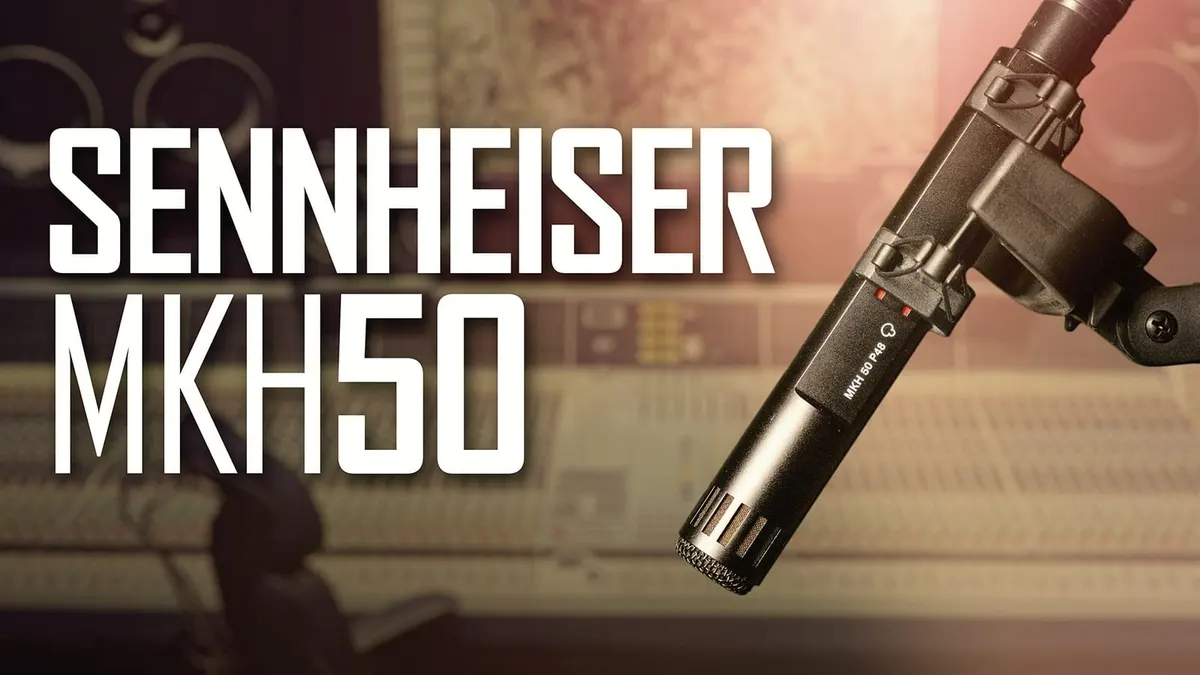
In this week’s episode, we have a look at and listen to the Sennheiser MKH 50 supercardioid boom microphone. The film and TV industry has generally considered the MKH 50 as a staple boom microphone for many years. This microphone has the unique characteristic that it captures bass frequencies, even when used at at distance of 2 or even 3 meters. This makes it useful for wide shots in addition to more traditional booming distances of less than 50 cm. In my experience, the MKH 50 is a rich sounding mic which is well suited for indoor booming. Its RF bias design and overall build make it incredibly reliable. Its gentle roll-off filter and -10dB pad also make it useful for closer mic (10 - 40 cm) or really loud situations. The MKH 50 also holds up really well when compared to the much newer MKH 8050 and Schoeps CMC641 boom microphones which we compare it to in this episdoe. The $1200 USD price seems very fair for the quality offered by the MKH 50.
Gear used or mentioned
The links below are Amazon, B&H Photo, Sweetwater, or other affiliate links. As an affiliate, I earn from qualifying purchases.
- Sennheiser MKH 50 boom microphone — B&H, Trew Audio, Sweetwater, Amazon
- Sennheiser MKH 8050 boom microphone — B&H, Sweetwater, Amazon
- Schoeps CMC641 boom microphone — B&H, Trew Audio, Sweetwater
- Sound Devices MixPre audio recorder — B&H, Trew Audio, Sweetwater, DVE Store, Amazon
- Rycote PCS Microphone Quick-Release System — B&H
- Aputure LS 300X used for background light — Aputure, B&H, Amazon
- Aputure Spotlight Mount — Aputure, B&H, DVE Store. Amazon
- Rosco Gobo creates the pattern on the back wall — B&H
- Canon C70 cinema camera — B&H
- Canon RF 24-70 f/2.8L lens — B&H, Amazon
- Schneider Radiant Soft 1 diffusion filter — B&H
- Panasonic GH5 camera — B&H, Amazon
- Panasonic 12-35mm f/2.8 II lens — B&H, Amazon
Read the transcript
[Music]
In this episode, we’ll take a look at the Sennheiser MKH50, give you some raw audio samples compared to some other mics; in fact, let’s start with that. It was easier to know it than to explain why I know it. If you were asked to prove that 2 and 2 made 4, you might find some difficulty, and yet you are quite sure of the fact. It was easier to know it than to explain why I know it. If you were asked to prove that 2 and 2 made 4, you might find some difficulty,and yet you are quite sure of the fact.
It was easier to know it than to explain why I know it. If you were asked to prove that 2 and 2 made 4, you might find some difficulty, and yet you are quite sure of the fact.
It was easier to know it than to explain why I know it. If you were asked to prove that two and two made four, you might find some difficulty, and yet you are quite sure of the fact.
It was easier to know it than to explain why I know it. If you were asked to prove that two and two made four, you might find some difficulty, and yet you are quite sure of the fact. It was easier to know it than to explain why I know it. If you were asked to prove that two and two made four, you might find some difficulty, and yet you are quite sure of the fact. A couple notes about those– number one, in terms of gain the MKH50 needed 50 dB of gain to make it so that when we were each talking we would hit at about -12 dB full scale on the meters and then the other two microphones, the 8050 and the Schoeps CMC 641, needed 53 dB of gain. So the output signal on the 50 is a little bit hotter. In terms of overall sound, what occurs to me is that I could use those any of those mics on Dani’s voice pretty effectively. On my voice, I definitely preferred my voice on the Sennheisers versus the Schoeps but I think all of them are capturing across the frequency spectrum evenly enough that we could definitely EQ and get a good sound in post. One thing that’s interesting about the MKH50, and I actually found this with the 8050 as well, is that at distance it still picks up a good bit of bass; here’s a sample. Now I’m going to demonstrate the microphone at different distances; here this is about 30 to 40 centimeters from my mouth, I’m going to go ahead and move farther back…
Okay, here’s about a meter from the microphone, checking our levels and especially the bass response about a meter from the microphone.
Now I’m approximately two meters from the microphone; that’s about two meters from the microphone just to give you a sense… I can crawl down into the back wall over here,
That’s about three meters from the microphone and clearly I’m out of the frame now. Coming back in, moving up until we are about 30 centimeters from the microphone and there we are about 30 to 40 centimeters– I’d say 30 centimeters from the microphone. Now some people say that the 50 picks up bass at greater distance relative to the 8050. I found them to be about the same, here’s a graph here; the two lower lines represent two meters distance and the orange one is the 50. So I didn’t hear a huge difference and the spectrum doesn’t show a huge difference; I think they both actually do pretty well at picking up bass from somewhat of a distance. What does that mean in practical terms? I think the 50 and the 8050 could be used at a little bit more distance for wide shots effectively without losing all of the bass response. Here’s a proximity sample, I’m using the microphone up very, very close. Here’s what the microphone sounds like if I’m right up on it, literally within about an inch of my mouth. And as you can hear, that’s a horrible idea. This is not a mic that’s meant for being used up very, very close unless you use the roll-off filter and we’ll demonstrate that here. In any case, this is what it sounds like with that turned off; the filter is off at this point, and this is with the roll off filter turned on so you can have that as a comparison point to see how it changes the overall sound. We’re boomed about 30 centimeters in both cases here. This roll-off filter, often called a high pass or a low cut on other microphones, is actually very, very gentle. It starts all the way up at 400 Hertz and gently, gently, gently rolls off as you get into the lower frequencies; can be very useful if you are going to be working up closer on the microphone, so if you are planning to use this for something like a podcast, I would probably turn the roll-off switch on. Now microphones start to sound different as the sound source comes from either the side or the back. I’m talking about directional microphones here, and it especially is evident with shotgun microphones– microphones that have an interference tube design, not the MK, none of these three here are shotgun style microphones. One of the reasons that production sound mixers like to use things like the MKH50 is that the off-axis sound is not nearly as colored; in other words, for example, if you were standing by a road and traffic was driving by, with a shotgun microphone a lot of times the traffic driving by, maybe a car driving by, sounds sort of like shhh, which in real life is not necessarily what we hear and so it seems a little otherworldly. That can be fine if that’s what you’re going for, but if you want the those off axis sounds to sound a little bit more like the real world, that’s where a mic like this makes sense. Here’s a sample where I talk into the various sides of the microphone. Once it’s off axis, so here’s directly on axis and then here is 90 degrees; here is 90 degrees off axis so that you can hear what that sounds like and then…
Here is 180 degrees off axis as a comparison. The microphone comes with a mic stand clip and also a shock mount. Let’s go ahead and use the shock mount and do some queuing back and forth like we would if we were operating a boom pole to hear how that does.
Overall I think that shock mount worked surprisingly well and the only thing I’m really hearing is air moving past the microphone capsule. That’s a reality of queuing so overall really good performance from the shock mount. Sibilance is a sound that people’s mouths make when they say the letter S or C. Some voices have a lot more sibilance, some have less. My voice has a good bit; here is a sample for you. Here’s a sample: she sells seashells by the seashore; by the seashore she sells seashells. Now overall, the MKH50 does have a little bit of a presence boost between three kilohertz and eight kilohertz, tops out at about plus 2 dB in the middle of that, so I didn’t find that it over emphasized sibilance. I mean, if you have a sibilant voice you’re going to hear sibilance, naturally, but it didn’t really, really overemphasize it like I’ve heard on some other microphones. So if you’re working with someone with a sibilant voice, you may have to use a de-esser in post. We did record a practical noise floor sample and what I do is I come into this space here, turn off all the lights, turn off anything that could make noise; I’ve got sound blankets on either side, one on the table in front of me, one back by the camera, one on the floor, and I speak for probably 10 seconds, then I leave a gap of about five to ten seconds and bring that into post, normalize the audio to -23 LUFS which will actually just basically look at the dialog part and boost everything up, and then we measure the silent portion and that came in at minus 69 dB RMS max, which is an excellent performance. If you add a high pass filter in post at about 65 hertz and with a -24 dB per octave slope, you can actually reclaim an additional 4 dB, so it goes down to -73 dB RMS max which is very, very clean. You’re not going to have to worry about this microphone creating the noise, you’re gonna have to worry about the actual sound– the ambient sound in the space where you’re recording. So excellent results from the MKH50. Radio frequency interference: how does this microphone do? We brought in our cell phone set to LTE mode and streaming a video; we then switched it over to Wi-Fi and streamed a video and we also used a microphone transmitter at 494 megahertz, put those all right up next to the microphone and we didn’t detect any sort of radio frequency interference. So the microphone seems to be very nicely shielded. The Sennheiser MKH series are all RF bias microphones versus more traditional condenser microphones, which typically use a DC bias design so the practical value of that is that the MKH series, including the 50 and the 8050, tend to be a little bit more immune and tend to continue to work well if you’re in a situation where there’s a lot of humidity and some of that humidity condenses on the microphone capsule itself. Now obviously you want to do everything you can to protect your microphone so that it is not affected by humidity and condensing on the capsule itself, but the RF bias microphones tend to do better. For example, the Schoeps CMC 641– a lot of people complain when they first get that,
Oh, I was having– I filmed in this place, it was humid, and it just basically started crackling and popping and creating all sorts of weird sound that I couldn’t use when we were in this humid spot. And there are just a couple things to keep in mind there, the actually the CMC 641 comes with a little airtight container that you’re supposed to put the capsule in if you are going to be in those situations. So the idea is if you go from an air conditioned space to humid space, you put it in that airtight container for that transition, let it kind of settle for a while and then maybe 20 minutes, 30 minutes, take it out of that, put it on the mic, and then you should be okay.
The nice thing about the Sennheiser MKH series is that they don’t tend to have as much problem with that. I would still do that if you have the chance, still put the microphone maybe in a Ziploc bag or something, let it acclimate in a humid area if you’ve come from an air-conditioned area for a few minutes, and it should do fine but overall the MKH series generally do better in those circumstances.
One last thing, I didn’t discover this myself but I have seen some people out there complaining, so
I tested it, that if there is moving air near the switches on the body of the microphone, that can actually make its way into the microphone and hit the capsule and create distortion; here’s a sample.
And as I said– simple solution– put tape over the switches. So– next question I think a lot of people are going to ask is, ‘Well, which of these microphones should I buy?’ Now I think you need to use your ears and determine which of those sounded better in the raw samples earlier on that we didn’t do any processing on. Here’s some thoughts that I have as well: I think if you’re going to be doing a lot of wide shots, I actually prefer the Sennheiser MKH50 or 8050. I think the polar pattern on the 50 is a little bit tighter so that’s probably would be my preference for wider shots. The nice thing about the 8050 is that it’s tiny, so much smaller than the 50, so if you are going to be booming all day long there’s a huge advantage there. The 50 also has a roll-off filter so if you are getting any sort of proximity effect working up close on it, you can roll that off a little bit and it also has a minus 10 DB pad if you’re recording very, very loud sound sources. The 8050 doesn’t come with that although you can add an additional module that will give you those; the problem is it costs another $470 USD so… and as a start the 50 comes in at $1200 USD at the time of this review and the 8050 comes in basically at $1300 USD, so if you do need that roll off and you do need the -10 dB pad, I’d probably go with the 50 instead. Now what about the 50 or the 8050 versus the Schoeps? The Schoeps has a very different sound and in fact, on my voice,
I felt like it really emphasized some nasal qualities in my voice. I do have some nasally qualities in my voice, but it seemed to emphasize them quite a bit. I think a lot of people consider the Schoeps to be more honest; I think it– it’s definitely voiced differently than the Sennheiser microphones– less bassy but if you like that sound I think that’s fine. If that’s your preference, do that. A lot of production sound mixers have the philosophy, ‘I want something as true as possible,’ and so they choose the Schoeps and that’s I think a fine choice as well. If it were up to me I would probably go with the Sennheisers and in fact I own all three of these microphones, I paid for all three of them with my own money, and my preference is almost always to use the 8050, to be honest.
So– and that’s that’s mostly for corporate or educational type videos at work. Where I work we use the 50s in our studio and they work great. I’m very happy with the results on a consistent basis and those are some of my thoughts. I hope that was helpful for you; if you have any questions go ahead and leave those down below, if you’ve not already subscribed make sure you do that, and we’ll be sure to get you more great videos on how to improve your lighting and sound for video. Talk to you soon. [Music]