
Sennheiser Profile USB Microphone for Zoom and Teams calls, podcasts, live streams
· Audio · Microphones · 12:03
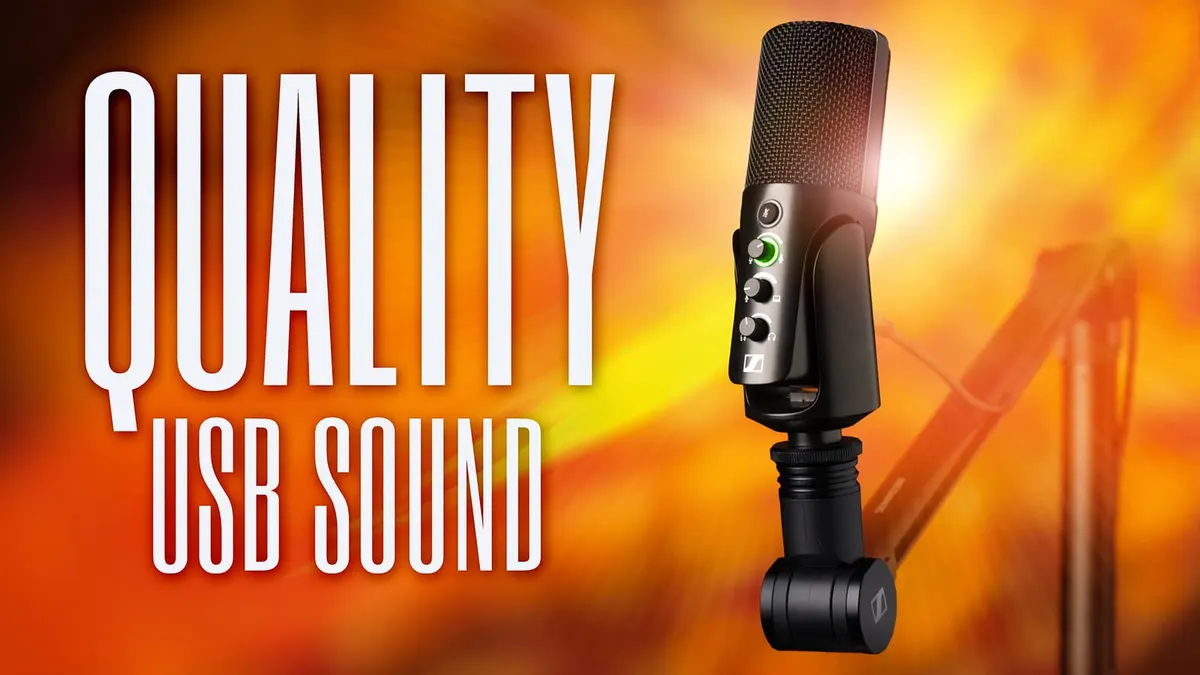
In this week’s episode we have a look at and listen to Sennheiser’s Profile USB microphone. This cardioid condenser mic is made for easily capturing quality stream and podcast audio via a simple USB-C connection. This sleek USB mic is ready to stream and record right out of the box. In this video we test out the Profile’s sound quality, walk through its feature set, and determine the workflows in which it might be most useful. Let’s take a closer look!
Gear used or mentioned
The links below are Amazon, B&H Photo, Sweetwater, or other affiliate links. As an affiliate, I earn from qualifying purchases.
- Sennheiser Profile USB Cardioid Condenser Microphone — B&H, Sweetwater, Amazon
- RODE NT USB Mini Microphone — B&H, Sweetwater, DVE Store, Amazon
- RODE NT USB Microphone — B&H, Sweetwater, DVE Store, Amazon
- SHURE MV7 Podcast Microphone — B&H, Sweetwater, Amazon
- RODE NT1 5th Generation Microphone — B&H, Sweetwater
- Amaran 200x S LED light — B&H, Amazon, Aputure
- Aputure Light Dome II soft box — Aputure, B&H, Amazon
- Aputure Spotlight Mount — Aputure, B&H, DVE Store. Amazon
- Rosco Prismatic Glass Gobo in Cool Lavender — B&H
- Canon C70 Cinema Camera — B&H
- Panasonic GH5 camera — B&H, Amazon
- Panasonic 12-35mm f/2.8 II lens — B&H, Amazon
Read the transcript
In this episode, we take a look and a listen to the Sennheiser profile USB microphone.
In this particular case, we’re using the kit that comes with the boom arm.
And you can also buy it without the boom arm. I’ll get into this later, but I would recommend the one with the boom arm. It’s worth the extra money from my point of view. You’ll see why. Let’s start with some raw audio samples comparing this microphone to several other USB microphones.
It was easier to know it than to explain why I know it.
If you were asked to prove that two and two made four, you might find some difficulty and yet you were quite sure of the fact.
It was easier to know it than to explain why I know it.
If you were asked to prove that two and two made four, you might find some difficulty and yet you are quite sure of the fact.
It was easier to know it than to explain why
I know it. If you’re asked to prove that two and two made four, you might find some difficulty and yet you’re quite sure of the fact. It was easier to know it than to explain why
I know it If you were asked to prove that two and two made four, you might find some difficulty and yet you’re quite sure of the fact.
So I’m talking right now into the very front of the mic.
It’s a direct directional microphone with a cardioid polar pattern.
That means it’s most sensitive on the front, starts to fall off at the sides, and it should be least sensitive on the back. So I’m talking into the front. Let’s turn it ninety degrees. Now, I’m talking into the side of the microphone.
At ninety degrees off axis and this is what that sounds like.
I’m now talking into the back of the microphone hundred and eighty degrees off axis and this is what this sounds like.
So you can hear there’s a little bit of coloration.
Is that a problem? For spoken word audio? Probably not a huge problem. Next up, we’ll have a listen to the proximity effect. Proximity effect is that when you get really really close to the microphone, not only does it get louder, it also gets a lot bassier. Now, Sennheiser recommends that we position ourselves between five and fifteen centimeters from the front of the microphone. So for best results, that’s where you’ll want to be. If you’re farther than that, you’re going to pick up a lot more room ambient sound. So just be aware of that. If you absolutely do not tolerate having the microphone in the frame being visible.
And I think this is fairly unimposing if you put it like this.
It’s not covering my face. You can see that it’s here, but it’s black and so it’s not particularly not flamboyant.
It’s not screaming for attention, but you also get the benefit of having it very close so that it improves the sound quality. That’s something important to understand.
Again, if you do not want the microphone in frame, it’s not gonna sound as great. In fact, let’s do this.
Let me just give you a distance test here. So right now,
I’m right up on the microphone. That’s where you’re gonna get the proximity effect.
Now I’m within the ten to fifteen centimeters range.
Right here, that’s probably the ideal range. This is about one meter from the microphone just so you can hear how that sounds.
And now I’m approximately two meters from the microphone, so you can hear how that sounds. Not only is it quieter, but I think even with this treated acoustical space.
You’re hearing some of the reflections off the wall.
Sibilance. Sibilance is the sound that you hear in some voices more than others when you say the letter s or c and some other letters in some cases as well.
Here’s a little sample. She sells seashells by the seashore.
By the seashore, she sells, seashells. Now I have quite a lot of sibilance in my voice, so that’s gonna come through here. This microphone is sensitive in that area where sibilance happens.
It isn’t overwhelmingly sensitive in that area relative to a lot of other modern microphones, but it definitely picks that up. So if you have a very sibilant voice, this is not going to mask that for you. Now plosives are the effect you get when you say the letter p or b up close to a microphone and you get this sort of really low frequency “BOO” kind of sound.
And usually on some other mics, you you put on pop filters or pop shields like this to prevent that from happening. This microphone does not come with that or you might put a foam cover on in some cases depending on the microphone.
Let’s see how this microphone does. So if I say Peter Piper picked a peck purple pickled peppers at the recommended distance of I’m at about ten to twelve centimeters. I’m probably at twelve centimeters right now.
That’s the effect you’ll get. Microphones are sensitive devices. They pick up vibrations. So if you bump their stand, whatever’s holding them or bump the microphone itself, oftentimes, you’ll get a very low frequency sort of “boom” sound.
And in some cases, microphones also have resonances where if you tap them, they will kind of ring in some respect. So let’s go ahead and tap this stand here. [very faint tapping sounds] We are getting some but it is not overwhelming.
It is actually handling it better than most other microphones, especially USB microphones that I’ve used. So sounding pretty good there.
Next up, what about typing? So I am on the same desk here.
I have my Apple wireless keyboard just underneath the microphone here.
Keyboard is on the same desk. It’s actually on a tray just down below the desk that is connected to the desk as the microphone is attached to the desk with the clamp here. Here is me typing on my wireless keyboard. [faint typing sound] So through all those tests, I would say that the profile performs really, really well relative to other USB microphones in a couple of areas particularly. First of all, in terms of plosives, it does a really good job. Whatever they’ve done for the the actual grill itself. You don’t need a foam cover. You don’t need a separate pop shield. It manages that really, really nicely.
Even if you get right up on the mic. It also did really well with stand bumps and the boom arm that it comes with. You can move it around and you’re not going to pick up a whole ton of vibration noise, which you do typically on a lot of other microphones, so this is really good on that standpoint. Also, there are a couple of areas where it’s not it depends on the microphone. So if you have a lot of sibilance in your voice, this doesn’t mask that, you definitely pick it up. I would say, for example, the SHURE MV7 didn’t pick as much of that up.
So if you have a really simple voice, that MV7 might be a better option for you.
But I think the important thing is you really have to be up close to this microphone.
If you were expecting to put it out of the frame, so you couldn’t see it on your Zoom calls or Teams calls or any videos that you’re filming,
I think you really need to to keep it within about fifteen centimeters or closer, five to fifteen centimeters as Sennheiser recommends.
Otherwise, it’s just going to sound a little bit thin and not so great.
So I don’t want you to go spend the money and then be disappointed when you put the microphone so that it’s out of the frame and it doesn’t sound that much better than your laptop’s microphone.
Now there’s one other area that we did a measurement on.
We do what I call my practical noise floor sample.
It’s not a scientific test, but it’s a fair playing field for all different mics.
And what I do is I go out into my studio where we have a bunch of sound blankets.
I record some dialogue, some spoken word. And then I record some silence in the same clip. Come back in, loudness normalize up to the same level and all the microphone tests we do for all the different microphones that I’ve tested to -23 LUFS, which is just a standard way of normalizing that.
And then we measure the silent portion. And this came in at -69.6 dB RMS Max.
What does that mean? If you don’t have any idea what I’m talking about, means you’re not going to get a lot of self noise, a lot of hiss that the mic is making itself. It’s a clean mic and you’re not going to have to worry about that. That’s really good performance especially for a USB microphone, so Sennheiser has done a really nice job designing this. There are a couple of cons. First up, there is no built-in processing like some of the other newer USB microphones have the MV7, for example, the RODE NT USB mini, the RODE NT USB plus also has in-built processing.
That includes things like compressors or de-essers, and that just can make your audio sound a little bit better. So for example, people with sibilant voices, might benefit quite a bit from a de-esser. On the other hand, those things are a little bit challenging to kind of tune them in exactly right.
So if you don’t have any experience with those. That’s a little bit of a mixed bag because sometimes I’ve heard people that don’t really know how to set those up.
They get those microphones, they turn on the compressor, and then it sounds [muffled talking] just doesn’t sound great.
So it’s not always the best thing. But in any case, this doesn’t have that.
I think if you position yourself right and If you’re considering that you can move this boom arm around quite a bit without picking up a ton of low end rumble, then I think this can be a really, really good option. Secondly, as I mentioned before, this can be a bit harsh on voices that have a lot of sibilance.
I I have a fair bit of sibilance. Some people like that crisper sound. You have to decide for yourself. We have some samples earlier in the video for you to make that decision. At least with a data point of my voice going through it. So overall, I would say that the profile, especially with the included boom arm, is a really good value for the money. Now here’s the thing. All of those other microphones, none of them come with a boom arm. And most of them have challenges with plosives.
So that’s that’s where the profile has the edge.
So I think for the price, $199 US with the boom arm, really, really good deal. Now You can also buy it with just a desk stand, a really low desk stand for $129. The problem with that is that unless you sit really close to the surface of your desk, it’s not the right position, and it won’t sound as good because you’re gonna be right next to the desk.
And you’re probably gonna pick up more of the reflected sound from the desk into your microphone, so it just doesn’t seem optimal to me.
It’s just it’s a cheaper way for them to sell the mic.
And people that don’t know better will buy it. So I would I’d recommend staying away from that and going for the boom arm if you’re going to invest the money. I love that you don’t need a big substantial pop filter or a foam cover. You can use this without either of those without any risk really of getting plosives, the little this sort of “boom” Sound you get when you talk directly into the microphone and a puff of air comes out of your mouth, hits the microphone capsule and makes that low frequency rumble.
This really doesn’t suffer from that, which is fantastic relative to some of those other mics you saw. For example, I really love the sound of the
RODE NT1 5th generation. It’s a bit more expensive than this, but it has this massive shock mount. And even with that shock mount, it doesn’t do as well as stand bumps. And then it also has this big huge pop shield.
So it’s like there’s no way to position it so that it’s not in front of your mouth and still be at the optimal distance and still be able to see the camera without blocking your…anyway. It’s just this is a really good mic for that purpose. So for Microsoft Teams calls or Zoom calls or even if you just want to keep things really simple with a podcast,
I think this is a really good choice. Relative to some of the others.
So you have to decide if it’s sound it’ll sound best on your voice relative to some of those other microphones. Overall, I hope that was helpful for you if you have any questions. And leave those down below. If you’ve not already subscribed, make sure you do that. And we’ll be sure to get you more great videos on how to improve your lighting and sound for video. Talk to you soon.