
SHURE MoveMic Tiny Dual Transmitter Microphone Direct to Mobile Phone
· Audio · Wireless systems · 19:06
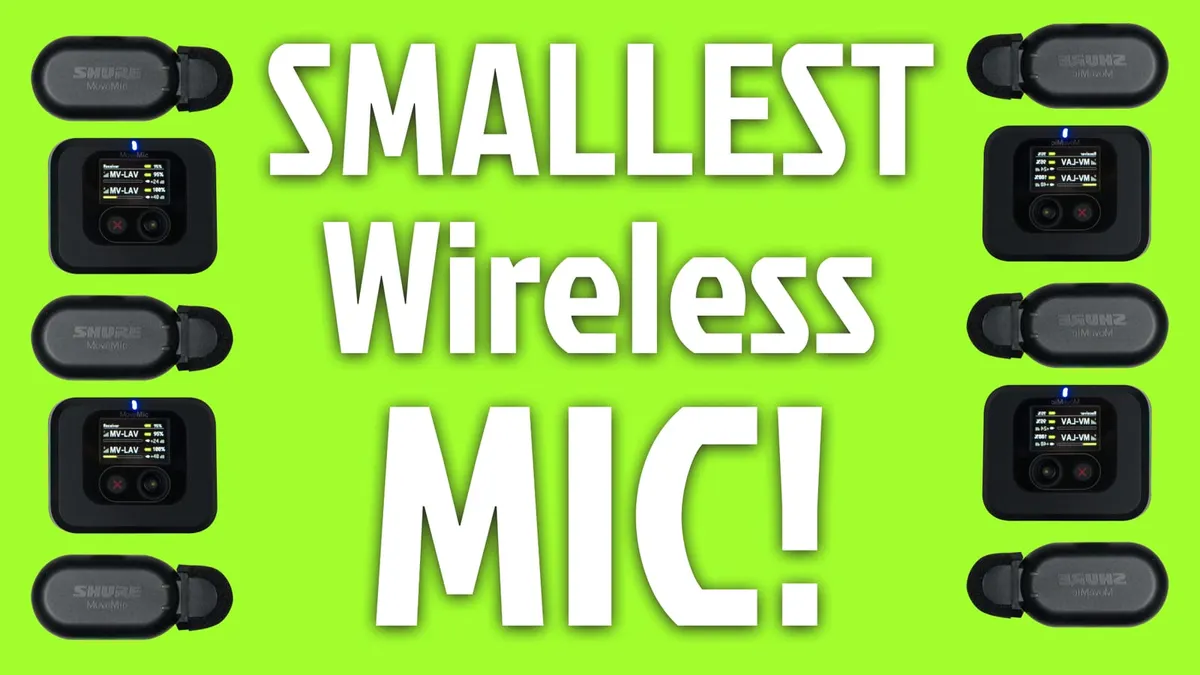
In this episode we have a look at and listen to the new MoveMic wireless microphone system from SHURE. This consumer wireless microphone system easily records 24-bit/48 kilohertz audio to your phone, tablet, computer, or camera, and is a great addition to any videographer, content creator, or journalist’s audio kit. Noteworthy features include direct-to-mobile (no need for a receiver), a charging case with 24-hour battery capacity, and up to 100 meters of transmission range. Let’s take a closer look and listen!
Some of my other studio gear:
Gear used or mentioned
The links below are Amazon, B&H Photo, Sweetwater, or other affiliate links. As an affiliate, I earn from qualifying purchases.
- SHURE MoveMic Lineup — Sweetwater, Amazon
- Sennheiser MKH50 microphone — B&H, Sweetwater, Amazon
- Sound Devices MixPre audio recorder — B&H, Sweetwater, Amazon
- Impact Turtle-Base C-Stands — B&H, Amazon
- Aputure LS 600x Pro Bicolor LED Light — Aputure, B&H, Amazon
- Aputure Light Dome III Softbox — Aputure, B&H
- Amaran 300c RGBWW Single-Point LED Light
- Amaran Spotlight SE — Aputure, B&H, Amazon
- Rosco Prismatic Glass Gobo in Cool Lavender — B&H
- Canon C70 Cinema Camera — B&H
- Canon RF 24-70 f/2.8 lens — B&H, Amazon
- Panasonic GH5 camera — B&H, Amazon
- Panasonic 12-35mm f/2.8 II lens — B&H, Amazon
Read the transcript
A review of the Shure MoveMic consumer wireless microphone system (on loan), compared throughout against the Rode Wireless Pro and DJI Mic 2 with raw audio samples.
MoveMic’s strengths: it’s the smallest, least intrusive transmitter of the three with the longest single-charge runtime (10 hours 5 minutes in testing); you can connect two transmitters directly to a phone (iOS or Android) via the Shure Motiv app; it has strong built-in effects — compressor, EQ, and noise reduction that’s noticeably better than the DJI Mic 2’s (good for steady noise like AC hum, less effective on loud discontinuous noise like honking); arguably the best overall sound of the three, and the best receiver UI.
Its biggest tradeoff: it does not record onboard or in 32-bit float, unlike the Rode Wireless Pro and DJI Mic 2. That’s a real limitation for workflows that rely on fixing levels in post, but an advantage for workflows wanting quick, no-post-production turnaround, since MoveMic’s onboard compressor/EQ/noise-reduction handle a lot of that live. The Rode Wireless Pro counters with a 3.5mm input for external mics, built-in timecode (a unique feature among these three), and the lowest latency (all three are within one video frame at 30fps regardless, generally imperceptible), though it has the worst, fussiest receiver UI of the three. The DJI Mic 2 also has 32-bit float and a 3.5mm input with a good touchscreen receiver, but is the worst-sounding of the three, its phone-connected sound is mediocre (unlike MoveMic’s, which sounds great connected directly to a phone), and its noise reduction introduces more audible artifacts.
No single winner — MoveMic is the clear choice for live streaming/vlogging directly into a phone or for workflows wanting no post-production; Rode Wireless Pro wins if you need timecode or a 3.5mm external mic input (tied with DJI Mic 2 on the latter).
MoveMic details: modes for Speech, Singing, or Flat (no filtering); adjustable input gain; LED indicators can be disabled; Normal or High Power transmission modes; a compressor, high-pass filter, and adjustable-strength noise reduction (demonstrated across its 5 settings against an electric fan); an EQ; and lockable controls. A practical self-noise test (boosted to -23 LUFS) measured -67 dB RMS max — no hiss issues. Live streaming directly from the Shure Motiv app to any RTMP service (YouTube, etc.) is supported, recording at 48kHz/24-bit WAV, Apple Lossless, or AAC (a better modern alternative to MP3 at similar file sizes). Two transmitters must go through the Motiv app (not plain Bluetooth) to sound their best and to connect simultaneously.
Range testing: zero dropouts throughout a two-story house through multiple walls; outdoors, 100 meters with direct line of sight, first dropout at about 29 meters when turned away from the camera in high-power mode. Both transmitter and receiver are IPX4 (splash) rated. The charging case (holding and recharging two transmitters, good for two extra full charges) includes an LED-status legend printed inside the lid. The receiver’s cold shoe mount is metal with adjustable viewing angle and a bright, easy-to-read color screen even outdoors.
Pricing ranges from $175 (single transmitter) to $500 (dual transmitter kit with charging case, receiver, cables, and neoprene pouch).
Cons: the Motiv app is required for full functionality and, at least on iOS, can’t switch between front/back camera mid-recording (likely an iOS platform limitation); no onboard/32-bit float recording, though the built-in processing is a reasonable tradeoff for many workflows; non-user-replaceable batteries (Shure will service/replace them for a fee, though many units will likely be discarded instead when batteries degrade); the included foam windscreen only handles winds up to about 5mph, with no fur cover option included (unlike the Wireless Pro and Mic 2); and no 3.5mm input for external lavalier mics, a tradeoff for its very compact size.
Overall take: probably the best-sounding consumer wireless system tested, with excellent battery life in a tiny transmitter, and its built-in compressor/EQ/noise-reduction genuinely reduces or eliminates the need for post-production — 32-bit float isn’t a universal requirement, and for some workflows, onboard processing solves the same problem more conveniently. Get out there and make some great sound, and we’ll talk to you again soon.