
SHURE SLX-D Wireless Mic Receiver & XLR Plug-On Transmitter
· Audio · Wireless systems · 17:49
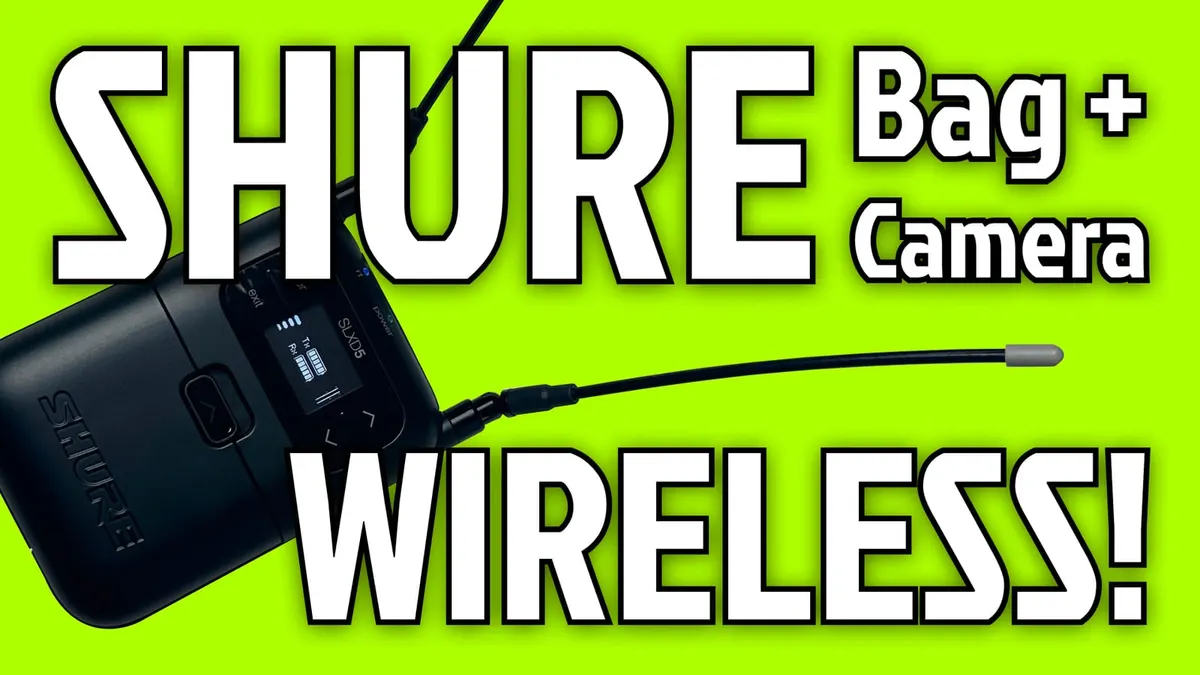
In this episode we have a look at and listen to SHURE’s SLXD5 portable receiver and the SLXD3 plug-on transmitter to make any XLR microphone a wireless microphone. This new addition to the SLX-D wireless ecosystem represents SHURE’s jump into the pro-sumer UHF wireless space; it’s their first camera-top and/or sound bag receiver in this price range. Noteworthy features include digital predictive frequency switching, 118 dB of dynamic range, and a multi-source monitoring mode. Let’s take a closer look and listen!
Some of my other studio gear:
Gear used or mentioned
The links below are Amazon, B&H Photo, Sweetwater, or other affiliate links. As an affiliate, I earn from qualifying purchases.
- SHURE SLX-D ecosystem — B&H, Amazon
- Sennheiser MKH50 microphone — B&H, Sweetwater, Amazon
- Sound Devices MixPre audio recorder — B&H, Sweetwater, Amazon
- Impact Turtle-Base C-Stands — B&H, Amazon
- Aputure LS 600x Pro Bicolor LED Light — Aputure, B&H, Amazon
- Aputure Light Dome III Softbox — Aputure, B&H
- Amaran 300c RGBWW Single-Point LED Light
- Amaran Spotlight SE — Aputure, B&H, Amazon
- Rosco Prismatic Glass Gobo in Cool Lavender — B&H
- Canon C70 Cinema Camera — B&H
- Canon RF 24-70 f/2.8 lens — B&H, Amazon
- Panasonic GH5 camera — B&H, Amazon
- Panasonic 12-35mm f/2.8 II lens — B&H, Amazon
Read the transcript
Shure is a highly experienced wireless microphone maker, though its products historically haven’t fit indie filmmaking well — that changes somewhat with the new SLX-D5 portable camera/sound-bag receiver and SLX-D3 XLR plug-on transmitter (this whole episode is recorded through the SLX-D3 with a Sennheiser MKH50; sample audio from the SLX-D1 body-pack transmitter with a Unipoint lavalier is also included).
Pros: it’s a digital UHF system with what Shure describes as digital predictive diversity (likely antenna diversity, switching to whichever antenna has better signal), up to 118dB of dynamic range at 24-bit, and very low, consistent latency (spec’d and measured identically at 3.2ms via a clap test) — no practical sync issues. It’s part of a broad Shure ecosystem (body-pack transmitters, chargers, proprietary rechargeable batteries, multi-unit charging docks, rack-mount and half-rack receivers in single/dual channel configurations).
Note: the SLX-D5 receiver used here is single-channel only, a disappointment next to newer dual-channel competitors. Outdoor range testing in open terrain got a first dropout at 50 meters out of line-of-sight (70m in line-of-sight) — excellent for this class of digital system; indoor testing through an entire two-story house with multiple doors produced zero dropouts. This is the core advantage of UHF over 2.4GHz consumer systems (Rode Wireless Go/Pro, DJI Mic), which struggle with dropouts once you exceed a couple of channels; UHF systems like this can scale to 32 channels per band. The receiver outputs true line level (or mic level for consumer cameras), avoiding double-gain-staging issues when feeding directly into a line-level input like a Sound Devices MixPre.
For larger channel counts, it’s compatible with Shure’s Wireless Workbench software for frequency coordination, which becomes important once you exceed about three simultaneous wireless channels and start dealing with intermodulation (phantom RF spikes from crowded spectrum). Build quality is excellent — fully metal receiver and plug-on transmitter, hard plastic (well made) body-pack transmitter. Battery life: 5h21m worst-case on the receiver with alkaline AAs (longer with NiMH or Shure’s lithium-ion), and 10h47m on the body-pack transmitter using Ikea Ladda NiMH rechargeables; both can also run via USB-C. A multi-mic scanning mode lets one receiver find and infrared-sync multiple other receivers/transmitters for coordination without Wireless Workbench.
A practical self-noise test (plug-on transmitter plus Sennheiser MKH50, boosted to -23 LUFS) measured -68 dB RMS max — very quiet, though this largely reflects the boom mic’s own self-noise rather than the wireless system itself; the bundled Unipoint lavalier was noticeably noisier (-58 dB RMS max in the same test). Comes with a 2-year warranty; pricing ranges from $599 (receiver + transmitter, no mic) to $899 (with the Unipoint cardioid lavalier — cardioid lavaliers are relatively rare and helpful for live-sound feedback rejection) to $729 (receiver + plug-on transmitter for a wireless boom/handheld setup).
Cons: no SMA antenna connectors on the portable receiver or transmitter (no swappable/external antennas, though rack-mount receivers do support this); the bundled Unipoint lavalier is not the cleanest mic available (a Twinplex lavalier is a cleaner alternative); no wideband receiver option, so you must buy region-specific frequency-band kits (authorized dealers like B&H, Gotham Sound, or Trew Audio can help pick the right one); and no limiter built into the transmitters, though headroom is generous enough that this is rarely an issue with clean mics.
Other notes: US max power output is just 10mW (1mW on low), surprisingly modest on paper but performs very well in practice and helps battery life significantly; the portable receiver has analog output only (no digital output — look at Shure’s ULX line for that).
Where the SLX-D system makes sense: sound bags, studios, venues, and houses of worship needing a thoughtfully engineered, reliable, durable entry-level pro system backed by a rich ecosystem. Where it doesn’t: needing two channels feeding directly into a consumer camera’s single 3.5mm input, or if you’re purely spec-sheet shopping rather than valuing engineering maturity.
Versus the Sennheiser EW-DP: SLX-D clearly wins on outdoor transmission distance; Shure’s Wireless Workbench is a big plus for multi-channel setups; but the EW-DP is easier to expand to dual-channel via stackable receivers for cameras with a single 3.5mm input. Versus the Deity Theos: Shure brings far more field-proven maturity (in production since 2020) and a richer transmitter ecosystem, but the Theos counters with a dual-channel receiver, onboard 32-bit float recording, wideband reception (no region-specific receiver needed), and a transmitter limiter that the SLX-D lacks. Versus the Sony UWP-D: Sony isn’t a digital system and has some resulting limitations, though it still sounds decent and offers a proprietary shoe-mount for direct camera attachment on compatible Sony bodies; it’s best suited to camera operators running just a couple of channels, lacking anything comparable to Wireless Workbench for larger setups. Get out there, make some great sound, and we will talk to you again soon.