
SHURE SM57 vs SM58 vs SM7B for podcast, livestream, or zoom calls
· Audio · Microphones · 23:46
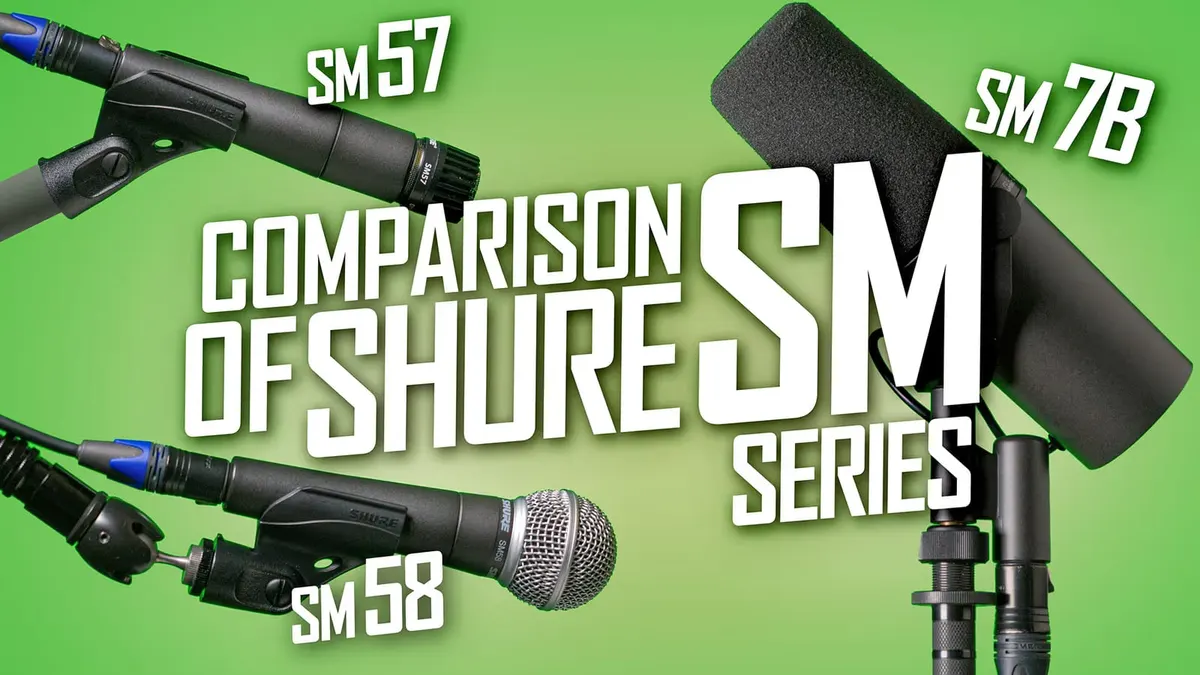
In this week’s episode, we compare three microphones from SHURE: the SM57, SM58, and SM7B. These noteworthy installations of the SM (‘Studio Microphone’) series include two of the bestselling mics in the world— the 57 and 58— as well as a favorite of podcasters and streamers, the 7B. In this video we walk through the SM57’s feature set, compare it to the SM58 and 7B, and discuss how, when, and where you might use each of these three great microphones. Let’s take a closer look and listen!
Gear used or mentioned
The links below are Amazon, B&H Photo, Sweetwater, or other affiliate links. As an affiliate, I earn from qualifying purchases.
- SHURE SM57 microphone — B&H, Sweetwater, Amazon
- SHURE SM58 microphone — B&H, Sweetwater, Trew Audio, Amazon
- SHURE SM7B microphone — B&H, Sweetwater, Perfect Circuit, Amazon
Read the transcript
In this episode we’ll take a look at the Shure SM57 versus the SM58 and the SM7B for spoken word applications like podcasting or live streaming. (Music)
This entire episode is recorded with the SM57 which you see right here and we’re using a windshield. This is the Shure A81WS. It’s a windshield that’s made actually primarily for outdoors but we’ll talk about why I’m using it later and that’s exactly what you’re hearing here. We have normalized the audio to minus 23 LUFS just to get it up to a reasonable level and at the same time getting it to that level doesn’t generally require any sort of compression so I wanted you to hear what this sounds like pretty much straight out of the recorder. Now let’s get you a few audio samples so you can hear what this sounds like compared to those other two microphones.
It was easier to know it than to explain why I know it. If you were asked to prove that two and two made four you might find some difficulty and yet you are quite sure of the fact. It was easier to know it than to explain why I know it. If you were asked to prove that two and two made four you might find some difficulty and yet you are quite sure of the fact. It was easier to know it than to explain why I know it. If you were asked to prove that two and two made four you might find some difficulty and yet you are quite sure of the fact. It was easier to know it than to explain why I know it. If you were asked to prove that two and two made four, you might find some difficulty, and yet you are quite sure of the fact it was easier to know it than to explain why I know it. If you were asked to prove that two and two made four, you might find some difficulty, and yet you are quite sure of the fact. it was easier to know it than to explain why I know it. If you were asked to prove that two and two made four, you might find some difficulty, and yet you are are quite sure of the fact. Student “It was easier to know it than to explain why I know it. If you were asked to prove that two and 2 made 4, you might find some difficulty and yet you’re quite sure of the fact. It was easier to know it than to explain why I know it. If you were asked to prove that two and two made four, you might find some difficulty, and yet you were quite sure of the fact. It was easier to know it than to explain why I know it. If you were asked to prove that two and two make four, you might find some difficulty and yet you’re quite
We also did a practical noise floor sample. The way I do that, I have a space here. I had a sound blanket on the table in front of me. Sound blankets to either side, one backed by the camera, blanket on the floor behind me, fairly quiet room, and then I record some dialogue. Once I recorded that dialogue, I normalized that to minus 23 LUFS and then measured the silent portion. And in this case, it came in at minus, pretty much minus 70 dB RMS max. That is very good. In other words, this is not a noisy microphone. It really is going to come down to how clean the preamplifiers are that you plug this microphone into. That is your recorder, your audio interface, or whatever you’re plugging it into to record. So very clean microphone. I’d worry more about your preamplifier than the mic itself when it comes to self noise.
The SM57, along with the other two, have what is called a cardioid polar pattern. What does that mean? It means they’re most sensitive on the front and they pick up a lot less on the back. It’s a directional microphone. And this is really helpful in terms of picking up what you want and not picking up the sounds you don’t want. So here’s a sample of how this microphone sounds different when you get off axis from the front of it. Usually you’ll get a little bit of coloration and you’ll see in this case, it’s not too bad. First of all, here is directly on axis, which is not how you should talk into this mic for best results. To minimize mouth noises, you are better off talking right here at about 45 degrees off axis.
Here is 90 degrees off axis. Here is 90 plus 45 degrees off axis. And here is a full 180 degrees off axis.
Plosives, here’s a sample. Peter Piper picked a peck of purple pickled peppers. Peter Piper picked a peck of purple pickled peppers. Peter Piper picked a peck of purple pickled peppers. Now this is a microphone that can be handheld, although it wasn’t necessarily originally designed for that, but it does have a little bit of a shock mount system inside of it. Nevertheless, you still pick up resonances when the stand is bumped or the microphone is bumped. Here’s what that sounds like.
Let’s jump into the fascinating, at least for me it’s fascinating, I’m kind of a microphone nerd, history of the SM57 along with the 58 and the 7B. So first up in 1939, Schor introduced the UNIDINE microphone capsule and along with that the 55 model microphone. This is such a classic microphone. It is what you think of when you think of as a vintage microphone, it has the big grill on it. It was designed by an engineer, Ben Bauer. And the thing that was unique about this microphone is that it was the first microphone with a single microphone capsule that had a cardioid polar pattern. It wasn’t the first microphone with a directional polar pattern, but it was the first with a single capsule. There were previous directional microphones, but they were really hard to implement and they didn’t work all that well. So the way they would do it typically is they would have an omnidirectional capsule along with a figure eight polar pattern capsule in the same microphone. They would cancel part of the signal from one of the capsules to come up with a directional pattern, but it was really hard to implement and didn’t work all that well. The UNIDINE-1 microphone capsule from Shure in 1939 was groundbreaking.
And variations of that microphone, the 55, exist even today. It’s been carried on that long, over 50 years. And it’s been used in all sorts of situations by all sorts of people you’ve heard of, like Elvis Presley, Frank Sinatra, Ella Fitzgerald, and many, many, many others. So this is a microphone that is a classic in pretty much every sense of the word. Over the course of time, the UNIDINE capsule evolved. There was a UNIDINE-2, and the big advantage of the UNIDINE-2 is it wasn’t quite so big. So the 55 was a big microphone. And the UNIDINE-2 allowed them to make that a smaller microphone. So we saw that happen.
And then in 1959, an engineer by the name of Ernie Seeler joined Shure, and he created the UNIDINE-3 capsule. And the big advantages of the UNIDINE-3 capsule, number one, it was massively smaller, way, way smaller than the UNIDINE-1 or 2. And it was also better at picking up bass frequencies. So it sounded a little fuller than the older microphones, which some might describe as having more of an AM radio kind of sound in the past, but the UNIDINE-3 sounded much fuller. And so it was a huge step forward. And with that, in 1965, Shure released the Shure SM57. That’s this microphone right here. So this microphone has been in production longer than I’ve been alive, and longer than many of those watching have been alive. Initially, this microphone was aimed at the TV studio market. In fact, SM stands for studio microphone. So just to give you a little history on where that comes from. When you hear about the SM57, the SM58, the SM7B, those were all intended as studio microphones originally, although they’ve been used in all sorts of live applications for a long, long time as well. So their original intentions weren’t necessarily where it ended up.
And in fact, today, I think most people think of this microphone as an instrument microphone. They use it a lot on drums, for example, especially on a snare drum. And in fact, what’s interesting is that Ernie Seeler was an enthusiast of orchestral music and wasn’t a really big fan of rock music at the time. And so it was very hopeful that it would be used as an orchestral microphone. Perhaps ironically, it has used a ton in rock music to record guitar amplifiers, to record snare drums, all those kinds of things. But it’s a really versatile mic that can be used for a ton of different things.
It was adopted right in 1965 when it was introduced as the microphone that was used for most of the presidential speeches for the United States president and has been used by every president since then as well. So it’s another reason why you might call this a classic. The SM57 and the 58 are the best selling microphones in the world since they were introduced. So there are more copies of these microphones in the world than any other microphone. The SM57 is unique from the other two in just a minute in that it has the brightest sound. So it has a high frequency kind of presence boost that can sound on the one hand rather sparkly and have kind of a nice high end to it. But it can also on the flip side, depending on the voice that’s going through it can sound a little bit sibilant. And sibilance is the sound you get when you say the letter S or C. Some people’s voices produce more energy in those frequency ranges. And if that’s the case, and you’re talking through this microphone, it can start to sound kind of harsh and grating. And in fact, my voice has quite a bit of sibilance in it. And that’s why I’m using this particular foam cover, the A81WS.
She sells seashells by the seashore. By the seashore, she sells seashells. Ooh. A foam cover like this will reduce some of those higher frequencies before they get through to the microphone capsule. And so this tends to sort of mellow it out a little bit for my particular voice. Now, if you have a voice that’s not quite as sibilant, smaller windshield like this, this is the A1WS, no, A2WS. This is another one you can use. Not nearly as much foam, but it does help with plosives. That’s the kind of bassy sound you hear, boo. When someone says the letter P or B directly into a microphone capsule, get this really low frequency kind of rumbly sound. This will help prevent that, as will this. There is in, at least in the more recent versions of the SM57 and what they call a pneumatic shock mounting system internally to the mic. So you can hand hold it, but as you saw in the microphone stand bump test, I’d be pretty careful about that. That will transfer to the microphone capsule and create kind of a low frequency rumble sound.
Now, despite the fact that nowadays most people use the SM57 as an instrument mic, or I think it’s really well known as an instrument mic, obviously the microphone police are not going to show up at your place and issue you a citation for using it as a spoken word microphone. So let’s bring in the other two microphones, the SM58 and the SM7B, and talk about how they’re similar and how they’re different. Now, all three of these microphones use the UNIDINE 3 microphone capsule. There might be very slight variations, but it’s all UNIDINE 3. All are dynamic microphones. That is to say they don’t need any sort of power to actually make them work like a condenser microphone does. So that’s a similar thing. They’re all directional in terms of having a cardioid polar pattern, meaning they’re most sensitive on the front. The pickup seems to fall off a little bit at the sides and is least sensitive at the back of the microphone. So all of that in common. And they all use XLR connections. An XLR connector to connect this to an audio recorder or an audio interface or whatever you’re using a mixer.
So how is the SM58 different? The SM58 was originally designed primarily as a vocal microphone. And the main difference here you’ll see is that there is a different grill and that grill fits over the same microphone body, fits over the same capsule, but it creates a little bit more space between where the person speaking can get in relation to the capsule. So they have to be just slightly farther away from the capsule. And that accomplishes a few things. Number one, it helps prevent plosives. And it also produces less what is called proximity effect. And when you get up very, very close on a microphone, you’ll notice it picks up more bass. So that’s proximity effect. And so having that ball style grill on top keeps the person that’s talking into the microphone a little bit farther away. So there’s not quite as much of that really woolly kind of bassy sound. Don’t get me wrong, the SM58 can still, you can still get plenty of proximity effect on that, but it’s a little bit less than you, at least in theory can get on the SM57 if you get right on top of the grill.
In the specifications, Shure actually lists the specs of the SM58 to have a frequency response of 50 Hertz to 15,000 Hertz, as opposed to 40 Hertz to 15,000 Hertz on the SM57. I think that’s more, it’s generally gonna be more theoretical than practical difference there. So I wouldn’t worry too much about that if you’re trying to get as much bass as you possibly can. If you just want a lot of bass, just get up close on the microphone and you’ll get plenty of it from either one. On the Shure SM58, it still has plenty of high frequency, kind of that presence sensitivity. So you’ll still get that sibilance or that sparkle, depending on the particular voice that you’re putting through it, but it’s not quite as pronounced as the SM57. So you don’t need quite as much foam to mellow that out if that’s what you’re trying to do. Or if you want a really bright sound then the SM57 may be a better option.
Now, what about the SM7B? This is a classic in the, or well, it’s really popular in the podcasting world, let’s say that. Also, it was very popular in the radio days. What’s the difference here? Of course, this is also considered a vocal microphone. The difference here is that the SM7B does not have a transformer in it. And without getting too into the technicalities of what that means, the practical effect of a transformer is that the transformer essentially boosts the output signal from the microphone a little bit. And so that means that the Shure SM7B needs more gain from the device that you’re plugging into, your recorder or your audio interface or your mixer. And in fact, it needs approximately 4.5 dB more gain. It is a gain hungry microphone. So it needs a really good strong preamplifier behind it to make it sound really great. And to get the levels that you need, especially for live shows, live streaming. For podcasting, you have a little more room because a lot of times with podcasting you’re doing some post-processing on that. But if you are going to go with the SM7B you have to know that it requires more gain. You might need something like a cloud lifter or a Fed Head to boost those levels a little bit more if your preamplifier or recorder or audio interface or mixer is not capable of providing enough gain.
The SM7B you’ll notice here on the back also includes a low cut filter and also a high frequency boost. So what’s interesting about the frequency response of the Shure SM7B is it is much more, it’s much flatter than the SM57 or the 58. However, if you do want that sparkly high end you have this presence boost switch and you can turn that on and get that similar sound to the SM57 and 58. So that just makes the SM7B a little bit more versatile. If you do need the ability to kind of switch between the two sounds, you can do that without having to put on a massive foam cover instead.
One other obvious difference with the SM7B is if you take off the foam cover and you look here right about here is the microphone capsule. So this imposes an even greater distance between the person speaking and the capsule itself. So that will also manage the proximity effect that we talked about and also plosives to a greater extent than the other two microphones. So I would say the SM57 and the SM58 in particular tend to be pretty prone to plosives. So if you get up close on the microphone without a foam cover on it, they’re gonna be doing that boo, boo, boo a lot. But it’s also manages the proximity effect. Now sometimes vocalists, singers and things like that proximity effect, it’s something they want. It’s part of their act or part of their performance in a few cases. So important to understand that. You’ll notice that standup comedians use that a lot too. Like if they wanna have a voice of God kind of sound for just a moment, they’ll get right up on top of the microphone and use the proximity effect to get that really intense sound for a while. So just a difference there. You can still get a proximity effect on the SM7B but not to the same extent as the other two.
Of course, the big difference SM7B is $400. The SM58 and the SM57 are $100 US at the time of this video. In fact, I think they’ve been that price for decades that somehow sure has managed to keep the price the same despite inflation and other things. So pretty impressive.
Now, if you do want to use one of these microphones for podcasts, let’s talk about the 57 and the 58 in particular, because obviously they’re less expensive if you’re going to have a four person podcast. Four times $400 is pretty expensive for most people just trying to start a podcast. $400 for four microphones is probably more feasible for many people in many situations. So here are the things that I would say if you are going to use an SM57 or 58 for podcasting or live streaming.
Number one, I think you’re probably gonna want a preamplifier that’s gonna be again, an audio recorder or a USB audio interface or a mixer, whatever it is you’re using to plug your microphone into should supply at least 60 dB of gain, clean gain preferably 65 dB because again, both of these, all of these microphones require quite a bit of gain. This one in particular, for this one, I really suggest at least 65 dB of gain for the SM57 and 58. I recommend at least 60 dB of gain, especially if you’re doing live where you need all the level you can get without doing any sort of post-processing.
Second thing, with the SM57 in particular, I would recommend that you need a foam cover of some sort to manage plosives especially. And then if you’re gonna be outdoors, the A81WS, that’s this bigger foam shield here, that’s probably necessary. And the reason for that, if there’s any sort of wind, you’re gonna need something to diffuse that so it doesn’t blow across the microphone capsule and create that sort of distortion sound. If you’re in an outdoors, when there’s not a lot of wind or if you just need the plosive protection, the A2WS I think is the model on this one. We’ll put a link for all of these down below. But this one is a little bit lower. It’s less imposing. And this is usually what you see on the podium for the president actually. It’s less imposing and it doesn’t change the sound as much. So if you don’t want to cut off a lot of that higher frequency, the kind of sparkle or sibilance depending on your voice, this one will cut out less of that so you’ll get a brighter, crisper sound with this. And if you do have a lot of sibilance, this one would be a better choice in my opinion because it does help essentially diffuse some, not diffuse, but it sort of absorbs some of that high frequency sound before it hits the capsule so you’re not getting as much of that kind of grating sound that comes with a sibilant voice.
Obviously for any sort of podcasting or live streaming, you’re gonna want it some sort of microphone stand. I’ll put a link to this one down below. If you prefer a boom type of arm, there are some great ones out there. One that I particularly liked was the Rode PSA-1 despite the fact that it has this massive road emblazoned on the side, it’s a really good boom arm. So those are some recommendations on that front. And that boom arm, if you use the boom arm, that’s gonna isolate that from vibrations on the desk and probably reduce the chances that you’re gonna bump the microphone stand some. If you use it just a regular stand like this, it’s right in front of you, the chances of bumping it and transferring that sound to the microphone are a little bit higher. So keep that in mind.
Also, if you’re gonna be typing like this, let me just do a test here. Now we’re not getting a lot of that vibration in the microphone, which you often can, but the reason we’re not is I actually have a sound blanket on this table, so that actually is absorbing some of that vibration. So if you are gonna put the microphone stand on a desk right in front of you, I would recommend getting some sort of foam and putting that under the stand. So that’ll isolate the desk from the stand just a little bit.
Another really important thing is going to be microphone placement. And my recommendation is that you have the microphone relatively close, I would be probably about four inches roughly from the front of the grill on the microphone, maybe just a half an inch more on the SM58. And I would put it off to one side at a 45 degree angle, point it at your mouth and then talk right past it. That will also help with the plosives. So if any puffs of air come out of your voice or your mouth when you say P or B or anything like that, you’re less likely to get those plosives, even if you’re using a foam cover. You still can get some through the thinner foam covers like this. This one generally not as much, but in any case, that positioning is really helpful as well.
So there are some thoughts about using the Shure SM57, the SM58 or the SM7B for podcasts or live streams or anything along those lines. Overall, I think that the SM57 can do an amazing job. I think for my particular voice, I’d probably choose the SM58 instead personally, but if you want a crisper brighter sound, I think the SM57 is a really good choice. If you’re trying to save a little bit of money over something like the SM7B. Yes, they sound different if you put your headphones on and you listen to the samples at the start of the video. Yes, there’s differences. Definitely are differences between those microphones, but it’s pretty close and a lot of people, most listeners would be hard pressed to hear the difference unless you put a recording of an SM7B on the exact same voice next to a recording of an SM57 or SM58. So great way to economically get your podcast or live stream up and going without spending quite as much money. Hope that was helpful for you. If you have any questions, go ahead and leave those down below. And if you’ve not already subscribed, make sure you do that. And we’ll be sure to get you more great videos on how to improve your lighting and sound for video. Talk to you soon. (Upbeat Music)