
SONY UWP-D27 Wireless Mic Review — 2 channel 4th gen system
· Audio · Wireless systems · 21:12
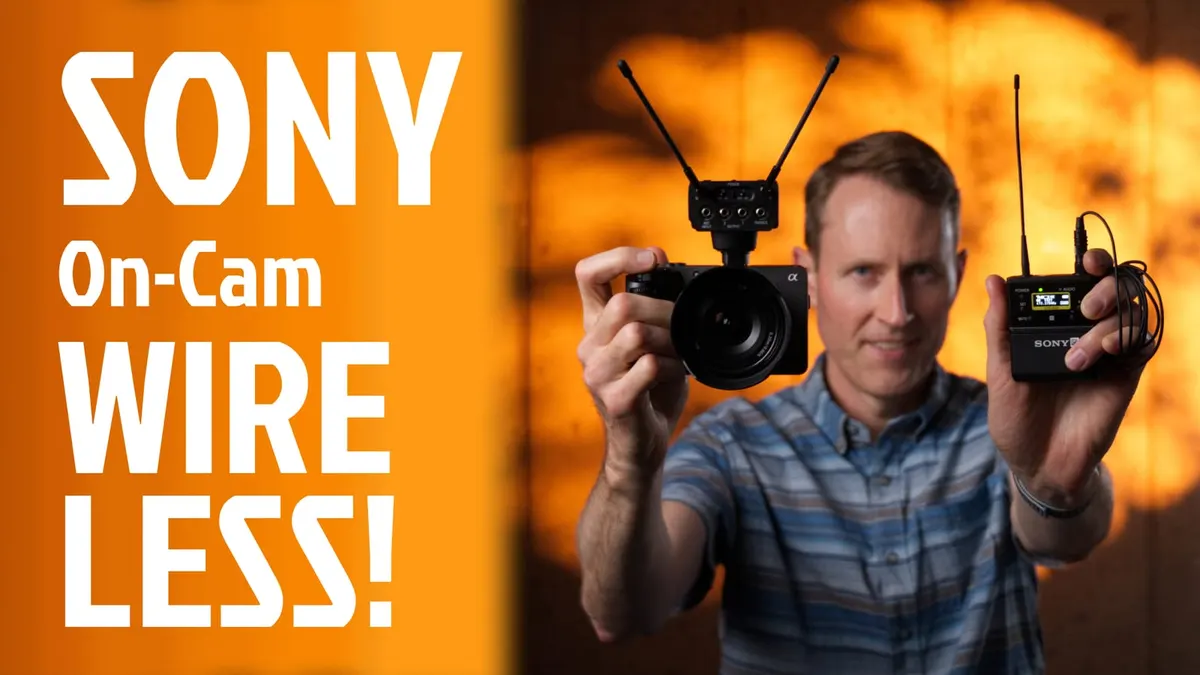
In this episode we have a look at and a listen to the SONY UWP-D wireless microphone system. This 2 channel kit includes a dual channel receiver and two transmitters with lavalier microphones. The system is a good fit for wedding videographers, news, and general video making, especially if you film with SONY cameras which have the MI shoe — which allows you to feed clean digital audio from the receiver, directly into the camera with no extra wires.
Gear used or mentioned
The links below are Amazon, B&H Photo, Sweetwater, or other affiliate links. As an affiliate, I earn from qualifying purchases.
- SONY UWP-D27 dual channel wireless microphone system — B&H, Trew Audio
- SONY FX30 cinema camera — B&H, Amazon
- SONY FX3 cinema camera — B&H, Amazon
- Impact Turtle-Base C-Stands — B&H, Amazon
- Amaran 200x S LED light — B&H, Amazon, Aputure
- Aputure Light Dome II soft box — Aputure, B&H, Amazon
- Aputure Spotlight Mount — Aputure, B&H, DVE Store, Amazon
- Rosco Prismatic Glass Gobo in Cool Lavender — B&H
- Canon C70 Cinema Camera — B&H
- Canon RF 24-70 f/2.8 lens — B&H, Amazon
- Panasonic GH5 camera — B&H, Amazon
- Panasonic 12-35mm f/2.8 II lens — B&H, Amazon
Read the transcript
A review of the Sony UWP-D27 wireless microphone system (fourth-generation UWP-D), tested here feeding a lavalier mic through a body-pack transmitter into the dual-channel receiver mounted on a Sony FX30, with an included plug-on XLR transmitter also covered as part of the broader UWP-D lineup. Audio samples are loudness-normalized to -23 LUFS (a standard broadcast loudness) with no other processing.
This is a UHF hybrid system, not a 2.4GHz consumer system like the Rode Wireless Go 2 or DJI Mic, which avoids the Wi-Fi-band congestion and dropout risk those consumer systems face. With a Sony camera featuring the multi-interface shoe (like the FX30 or FX3), audio passes to the camera already digital, with no analog conversion needed. Other advantages over 2.4GHz consumer systems: swappable AA batteries instead of fixed internal batteries requiring USB charging mid-shoot, generally longer range outdoors, and (on the Wireless Pro, though not the DJI Mic) locking plugs. Indoors, the system held signal through two floors and multiple doors with zero dropouts; outdoors, it held a strong signal at 50 meters out of line of sight (versus roughly 25-30 meters typical of consumer 2.4GHz systems).
Technically, it’s a hybrid analog/digital system: audio is converted to digital, compressed, converted back to analog for the modulated wireless transmission, then reconstructed to digital and expanded at the receiver (or converted to analog output via 3.5mm if not using the multi-interface shoe). This compand approach preserves transient detail better than a purely analog wireless system, giving a crisper sound. Conversion happens at 96kHz/24-bit. A practical noise-floor test (normalized to -23 LUFS) measured -70 dB RMS max on silence, with room tone around -75 dB — slightly cleaner than a Rode Wireless GO II and notably cleaner than a DJI Mic.
It’s a true-diversity receiver with a single transmitter (switching to antenna diversity with two transmitters), tunable across 2,772 available UHF frequencies, supporting up to 16 transmitters on one system. Setup is simple: scan for open frequencies with one button, then sync each transmitter to the receiver via NFC (or infrared on older transmitters) by holding them together. Powered by two AA batteries per unit; with Eneloop NiMH batteries, the transmitter ran 12 hours 46 minutes and the receiver 4 hours 31 minutes, with lithium primaries expected to run even longer. Gain can be set manually (preferred, since auto-gain can over-boost quiet pauses) or automatically. The transmitter accepts line-level input and 48V phantom power (for boom mics); the receiver has a headphone jack and a 3.5mm mic input, giving up to four audio channels into the receiver. Max transmitter output is 30 milliwatts (reducible to save battery). Latency is under one millisecond, keeping audio in sync with video, and a single-channel receiver can double as an IFB (interruptible foldback) for a director or script supervisor to monitor audio live.
Build is metal and plastic and feels solid. A two-transmitter, dual-channel receiver kit costs $1,230 USD; single-channel kits run around $600. One-year warranty.
Cons: menu labels for battery type use generic “Type 1/2/3” instead of naming alkaline/NiMH/lithium; the transmitters’ 3.5mm mic input uses Sony’s proprietary wiring, so third-party lavaliers (like the Sanken COS-11 used here) must be specifically terminated for Sony, available from suppliers like Trew Audio or Gotham Sound; there’s no true line-level output on the receiver (only mic level with a boost option), so it’s designed to feed a camera rather than a mixer; and the antennas aren’t user-replaceable (no SMA connectors), ruling out upgrades like a log-periodic or shark-fin antenna.
Versus the Sennheiser G4 (EW100): the Sony’s digital companding gives better audio quality, a wider tuning range, and (unlike the G4) a true dual-channel receiver option, making the Sony the clear pick. Versus the Sennheiser EW-DP (a fully digital system): the Sony still transmits farther outdoors and offers a genuine dual-channel receiver (versus stacking single-channel EW-DP receivers), while the EW-DP’s one advantage is that all gain control happens at the receiver rather than the transmitter — for Sony-camera shooters needing multi-interface-shoe integration and dual-channel reception, the Sony wins. Versus the not-yet-released Deity Theos (wider tuning range, built-in 32-bit float recording on the transmitter, though U.S. patent restrictions mean you can’t use the recorder and transmitter simultaneously): its real-world performance remains unproven since review units hadn’t shipped yet.
Overall: for Sony shooters with multi-interface-shoe cameras who need a dual-channel, more reliable-than-consumer wireless system, this fourth-generation UWP-D is a fantastic choice. Get out there and make something great, and we’ll talk to you again soon.