
Sound Devices A20 Mini — Why do pros use gear like this in the film and TV production world?
· Audio · Wireless systems · 9:59
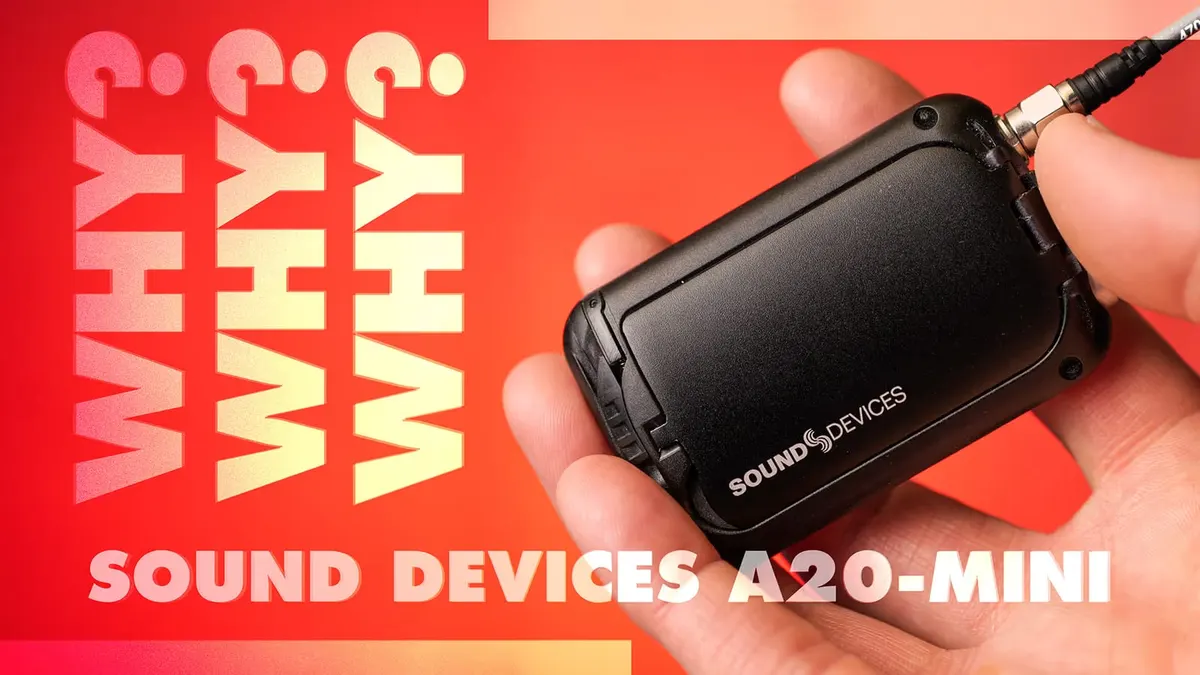
Sound Devices A20 Mini: Why Do Pros Use Gear Like This?
In this week’s episode, we discuss how and why the Sound Devices A20 Mini wireless transmitter is useful to audio professionals in the filmmaking and TV production world. This tiny transmitter includes several distinguishing features like GainForward and SpectraBand technologies, as well as ultra-long transmission range and a wide variety of tunable bands. In this video we walk through the A20 Mini’s new technologies and talk about why pros incorporate this kind of gear into their kits. Let’s take a closer look and listen!
GainForward — how does it work? Spectraband Technology
Gear used or mentioned
The links below are Amazon, B&H Photo, Sweetwater, or other affiliate links. As an affiliate, I earn from qualifying purchases.
- Sound Devices A20 Mini Digital Wireless Transmitter — Trew Audio, B&H
- Sound Devices A20 dual channel receiver — B&H
- SHURE Twinplex TL-48 Lavalier microphone — Trew Audio, B&H
- Sound Devices 888 recorder — Trew Audio, B&H, Sweetwater
- Sound Devices SL-2 slot system for wireless receivers — Trew Audio, B&H
Read the transcript
This is not a review. The difference between consumer and Pro Gear isn’t that Pro systems cost a lot more and sound a little bit better, although they do generally sound better. There are a lot of other features that professional sound mixers need, that consumers generally don’t need. And so they’re paying a lot more money (Laughs) for these features. This is a $2,200 USD transmitter alone. That does not include the dual channel receiver, which is another several thousand dollars. It does not include lavalier microphones. Typically you’re using professional grade lavalier microphones with a system like this. You’re looking at at least 300 to around $500 per microphone. So a lot more money.
Question that I think a lot of consumers have is, why so much more expensive and what do you get for all that additional expense? So please don’t leave a comment below. This says, “This is a complete waste of money.” And I don’t understand why anyone would ever buy these. This is really designed for people who earn their living recording sound professionally. And so they need these features that will allow them to get their clients for future jobs, period. That’s really what it’s about in the end. So not only does it produce great sound quality, but it also enables them to provide a very reliable experience so that they’re not costing retakes. Retakes are very expensive on sets. The most expensive thing is the time of the crew and the talent that are on camera. So if you have to do retakes and the filming session goes a lot longer than expected, that’s very, very expensive. So while this may seem like a very expensive transmitter, and indeed it is, if you’re self-funding and buying all your own gear, in the context of a bigger set where the biggest expense is the crew and the cast, this is a much more reasonable expense.
So let’s jump in and talk about some of the features. And this will just give you some ideas of what the professionals are looking for at this point and what the manufacturers that are producing these high-end professional wireless microphone systems are including in terms of new technology. First is what Sound Devices calls game forward.
Here’s a challenge that if you aren’t typically working on set maybe for and to you, but if you have say 12 people wired up with lavalier microphones, wireless systems, that’s a lot of people to manage and it’s a lot of wireless transmitters to manage. So if you were in a position where you’re like, “Oh no, the gain is set too high on this one.” To run up to that talent or send the utility or send the boom operator up to that talent, adjust the levels and then the mixer has to test again, especially if that costs a retake, that’s very expensive and it’s time consuming and it’s gets the, it potentially takes the actor or the talent out of their element and out of the right mindset, it’s very disturbing. What gain forward allows the mixer to do is the gain, the low cut filter and the limiter are all set at the receiver or if they’re using a Sound Devices 800 series recorder, it can be set directly on the recorder itself and this isn’t sort of a remote control kind of thing. This isn’t sending another wireless signal back from the receiver to the transmitter to change the settings on the transmitter. It’s actually settings that are on the receiver itself. So it’s not doing the amplification at the transmitter, it’s doing the amplification at the receiver and there’s a lot of really clever tech. If you’re interested in the details, we put a link down below with an article that explains exactly how all that works.
Incidentally, this entire episode is being recorded with a Twinplex TL48, which you see just right here into the A20 Mini transmitter, which is sitting on my back here, transmitting to my A10 receiver and that’s then feeding digitally into the Sound Devices 888 audio recorder. You’re hearing that right now. This is what it sounds like just so you get a sense for the audio quality.
Now, if you’re in an environment that is really bad from an RF perspective, in other words, you’ve got tons of interference and wireless just isn’t going to work or you’re working in extraordinary distances from the receiver, you can actually basically turn the A20 Mini into a recorder, a body pack recorder. So it can go into record only mode and it then becomes a 32-bit float audio recorder. All you have to do is plug in via USB, you can download the files in the end and you have this great recording. So it gives you a lot of versatility.
Now you’ll notice that the A20 Mini does not have any buttons on the outside of its body, nor does it have a screen. So how do you control it? You control it with an iOS or Android app. It runs on both iOS phones, Android phones, and also on tablets. So the nice thing is if you’re using a bunch of A20 Minis, you can control all of them in a group within the app as well. It’s not just a single transmitter that you control with the app, like a lot of consumer systems, it’s like you get to control one system. This actually can control full groups of them. And you can change settings to the entire group at the same time, or you can go into the individual transmitters and change just their settings. So that works very nicely as well.
Next up is what Sound Devices calls their SpectraBand Tech. And with this, you can tune the A20 Mini anywhere between 470 and 1,524 megahertz. That’s the widest supported range of frequencies on a single transmitter that I’ve ever seen. And that means that you can use this in any country in the world. So every country has a different set of frequency bands that are legal for use for unlicensed use and some that are legal for licensed use that are different in every country. So if you film in different countries, you may have to actually get or rent or buy a different wireless kit to work in that other country. With the A20 Mini and the A20 receiver, that issue is basically gone, which is really nice.
Now, to maintain compatibility with the previous A10 receivers, you still can use this with the A10 receivers, no problem whatsoever. They can be upgraded with their firmware for free, by the way, and then you are only limited in that case by what the receiver can support in terms of frequencies. So it’s great because this supports this new technology in this really wide range of frequencies that you can tune to, or you can still use it if you have an existing A10 receiver with the frequencies that it supports.
In addition, this includes brick wall surface, acoustic wave filters, saw filters. What does that mean? Well, that’s a huge discussion there, but it includes these to improve its wireless range. These are really very precise filters. So the big thing with RF is radio frequency is you have to filter things down to get clean transmission and reception. And on the A20 Mini and the A10 and A20 receivers, they’re using these really, really precise filters so that you can transmit farther. The A20 uses full digital RF modulation and transmission, so it’s not doing any sort of hybrid type of thing. And in addition to this, you can set it to two different transmission modes. There’s standard mode and there’s long range mode. So it uses different modulation techniques in each of those modes. And they claim that this has the largest transmission distance, I believe, of any digital system. That’s to be tested.
I’ve had very good luck with it so far, and it does indeed transmit farther than the A10 transmitters that I have. So it does definitely make a difference. You don’t have all the other wireless systems to test it against, but it does do a very nice job. And you do get plenty of distance here, especially depending on the type of antenna that you’re using on the receiving end. If you’re gonna use some shark fin antennas, that’ll take you farther as well.
Now, if you do use the A20 Mini as a body pack recorder, it also has an inbuilt temperature-compensated crystal oscillator, a very highly accurate timecode generator. So you can jam this to your recorder or mixer. And that way, when you’re using this as a body pack recorder in post, it’ll be very easy to sync it back up to picture along with everything else. So really great feature there.
And then finally, the form factor of the transmitter itself is very small. It has a rounded body. That makes it much easier to hide on talent, especially when you’re working with talent that are wearing form-fitting clothes. Hiding transmitter packs can be a real challenge. This makes it so much easier. Also water resistance. So not waterproof, but water resistant. So you’re not gonna have to worry a whole lot about sweat becoming a problem as well.
So I hope this gives you some ideas of how the higher-end wireless systems for professionals differentiate themselves from consumer-based systems, just so you get a sense for what some of those features are. Now, if you’re a content creator paying for your own gear and you’ve already got a consumer wireless microphone system, don’t let any of this hold you back. Get out there and make some great sound. You can make great things with the gear that you have. But in some future day, if you decide to become a professional sound mixer, this is just a glimpse of some of those features that you may see on those future wireless systems that you’ll use in that professional context. So I hope that was helpful for you. If you have any questions, go ahead and leave those down below. If you’ve not already subscribed, make sure you do that. And we’ll be sure to get you more great videos on how to improve your lighting and sound for video.