
Tiny Light, Cine Battery Power: Godox ML150Bi
· Lighting · 7:50
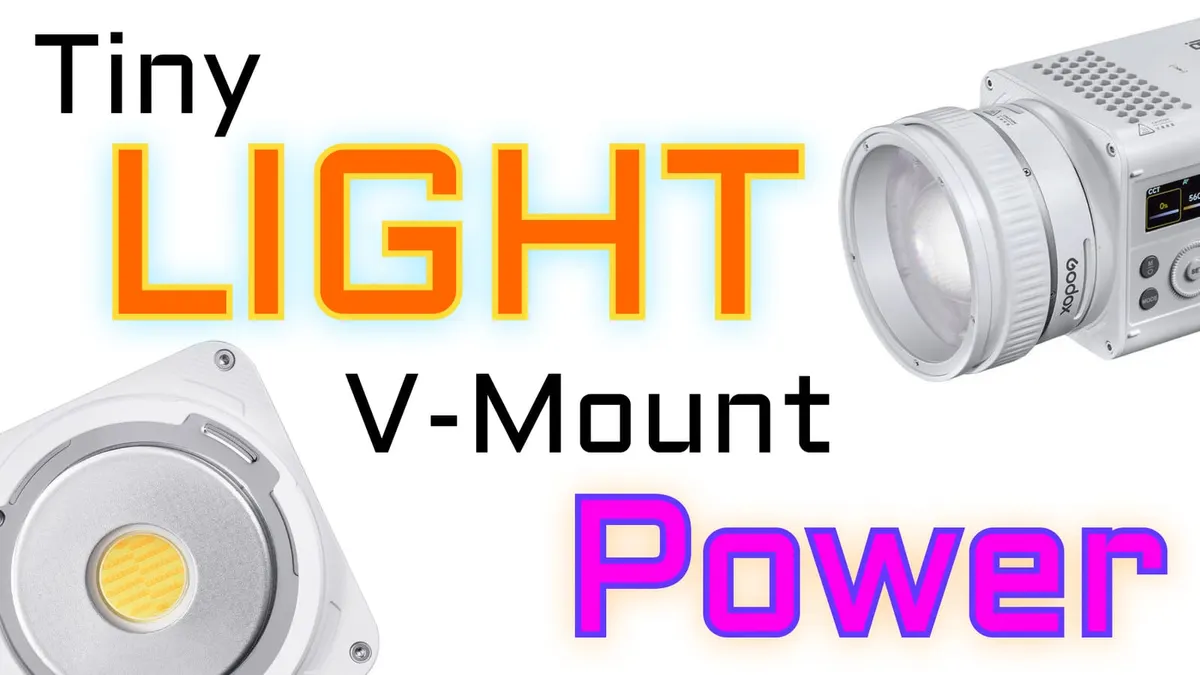
In this week’s video we check out the Godox ML150Bi, a small LED video light with big powering options. Included in this episode is a quick comparison to the Amaran Ray 120c, as well as various photometric tests and a brief overview of the feature set. Let’s take a closer look!
Gear used or mentioned
The links below are Amazon, B&H Photo, Sweetwater, or other affiliate links. As an affiliate, I earn from qualifying purchases.
- Godox ML150Bi — LED Video Light
- Barn Doors Modifier — Godox Magnetic
- Diffuser Set — Godox Magnetic
- Softbox — Godox ML
- Bowens Mount Adapter — ML to
Read the transcript
Today, let’s take a look at the Godox ML150 Bi, a tiny LED light with a trick up its sleeve, and see how it compares to the Amaran Ray 12C. It’s a compact, easy-to-use LED light with a color temperature range of 2800K to 6500K. You can power it via AC or a V-mount battery using the included plate adapter — a really nice feature. The fan can be set to off, medium, high, or auto (off locks you to 10% dimmer output). You control it via the Godox Light app on iOS or Android, which can group multiple Godox lights together, and it supports NFC pairing so you don’t have to fuss with Bluetooth pairing. It also supports wired DMX with an adapter.
It uses Godox’s proprietary ML mount rather than Bowens, but includes the MLZ zoom lens giving a 13° to 30° beam angle range, plus 11 built-in effects like TV, faulty bulb, lightning, and fire. The kit includes the light, the zoom lens, a metal yoke, a V-mount battery adapter plate, an AC power adapter with a locking connector, and a semi-hard case.
The standout feature compared to the Amaran Ray 120C is the V-mount battery adapter plate — you can run this off standard cine batteries, roughly an hour at full power on a 150Wh battery. I much prefer V-mount over USB power banks, since a lot of battery banks don’t supply enough power for a light this size and there are too many inconsistent USB PD standards. The light is priced at $259 US. Color quality is good enough for talking-head video.
Pros and cons: the ML mount is smaller than Bowens, which makes this light more convenient for tight spaces, though you can’t use existing Bowens accessories without an adapter (and you should be careful not to put heavy modifiers on it). The body is plastic with a metal internal frame and yoke, using a 1/4-20 thread, so keep accessory weight modest. In a flicker test at 59.94fps, 11.25° shutter angle, 10% dimmer, we did see some flicker — mainly a concern for high-speed flash photography, not an issue for video up to 60fps at 180° shutter angle.
Comparing to the Ray 12C: same price, $259 US. The Ray is full-color/RGB while the ML150 Bi is bicolor, so the ML150 Bi is mainly for lighting people while the Ray can double as an effects light. The Godox has slightly more output and I prefer its cine-battery powering, though the Ray does have its own proprietary battery ecosystem. Color quality is very slightly better on the Ray at 5600K, about equivalent at 2800-3200K. The ML150 Bi has a much wider native beam angle, which is nicer for softbox use since the Ray’s narrower beam needs Amaran’s specific dual-diffuser modifiers. It really comes down to which features matter most to you. Get out there, make some great lighting designs, and we’ll talk to you again soon.