
Trouble with Fan Noise? Dracast DRX2000RGB LED Light
· Lighting · 13:34
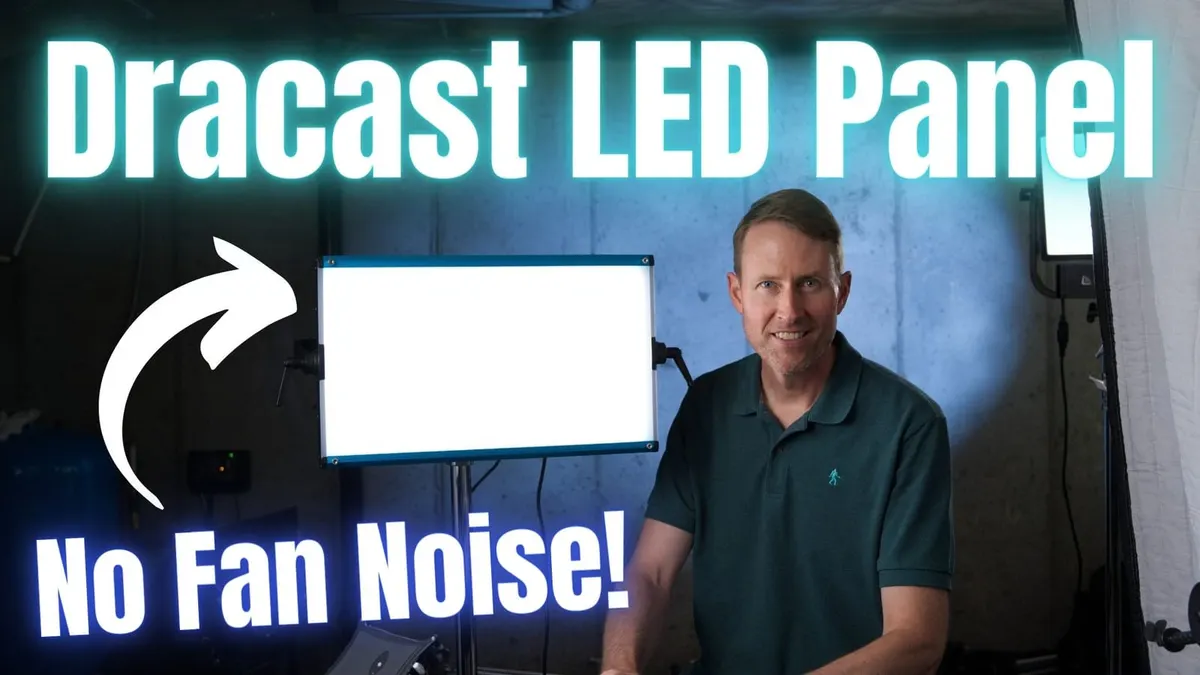
In this episode we try out the new X-Series LED2000 light panel from Dracast. This full RGB and bi-color LED panel is great for use as a key light, background light, effects light, and more. With high color quality and no cooling fans, this panel is also a great option for lighting your livestreams! In this video we walk through the LED2000’s well-rounded feature set, have a look at the remote control app, and examine the results of our color quality tests. Then we demonstrate all the great things this light is capable of! Let’s take a closer look!
Gear used or mentioned
The links below are Amazon, B&H Photo, Sweetwater, or other affiliate links. As an affiliate, I earn from qualifying purchases.
- Dracast X-Series LED2000 RGB/Bi-Color Light Panel — B&H, Amazon
- Aputure Nova P300C RGB LED Light Panel — Aputure, B&H
- Sennheiser MKH 8050 Low-Profile Supercardioid Condenser Microphone — Trew Audio, B&H, Amazon
- SoundDevices MixPre II Series Audio Recorders — B&H, Sweetwater, Trew Audio, Amazon
- Impact Turtle-Base C-Stands — B&H, Amazon
- Amaran 200x S LED light — B&H, Amazon, Aputure
- Aputure Light Dome II soft box — Aputure, B&H, Amazon
- Aputure Spotlight Mount — Aputure, B&H, DVE Store, Amazon
- Rosco Prismatic Glass Gobo in Cool Lavender — B&H
- Canon C70 Cinema Camera — B&H
- Canon RF 24-70 f/2.8 lens — B&H, Amazon
- Panasonic GH5 camera — B&H, Amazon
- Panasonic 12-35mm f/2.8 II lens — B&H, Amazon
Read the transcript
[Music] ‘But Curtis, you never review lights other than Aperture or Amaran lights!’
That is not true. I have- if you go to our channel, we’ve got reviews of a variety of different manufacturers.
But here is a new one for us, Dracast, a lighting company that makes largely LED panels.
In this case, we’re going to take a look at the X-Series LED 2000 RGB and Bi-Color LED panel. Now, this is a really interesting panel for a few reasons to me.
Number one, it’s about a 100 watt panel.
It does not have any sort of fan in it, which is beautiful.
That’s a wonderful thing because when you’re using it as a key light, especially for maybe live streaming, it produces beautiful soft light, but it does not introduce a bunch of noise into your audio, which is super, super helpful.
Let’s go ahead and put up the photometrics here. We used our Sekonic C800 to gather these, so this tells us a little bit about light output and color quality.
You can take a look at those if you really want to dig into the details- pause here and take a look. But overall output- we’ll just highlight a couple things- 3,790 lux or 352 foot candles at one meter when we had it at 5,600 Kelvin- or 5,500 Kelvin, excuse me, and 100% on the dimmer. In practical terms, right here we are actually using the Dracast as our key light right over here. We’re shooting it through a 4x4 silk, and right now I have the dimmer on at 37%.
We’re at ISO 800, f2.8, and our frame rate is 23.976, and our shutter angle is 180 degrees.
That’s roughly 1/48th of a second.
So just to give you an idea of how much light this is, we’re only at 1/3 power.
We have a lot of reserve here to do more with this, so if you wanted to use it for two person interviews, you could certainly get it to work for that.
And full body shots, whatever you’re aiming to do.
This has got plenty of punch. Surprising amount of punch, I would say, for a 100 watt light.
Color quality is also good. I’m not as concerned with CRI.
It’s not the most useful measure, but for those that are into CRI, we’ve got those metrics here. For me, the more interesting thing is SSI: Spectral Similarity Index, and that came in at 73 out of 100 for 5,500 Kelvin and 85 SSI at 3,200 Kelvin.
In essence, what that means, if you’re in the 80s or 90s, you’re very unlikely to experience color rendering errors. When you dip down into the 70s, you might start to experience some color rendering errors.
Here are the little graphs here that show the spectral output.
The short version is this: for a key light, this is excellent color quality.
You can definitely use this without hesitation as far as skin tones and just general color reproduction go. If you’re doing something super, super color critical, you might want to go to 3,200 Kelvin if you’re doing product photography or product videography, but 85 SSI is definitely enough there. The panel surface is 20.25 by 12.25 inches.
That’s roughly 51 by 31 centimeters.
It does have a diffusion panel on it, so by nature, panel LED lights are soft lights by their very nature. You cannot make them hard. That makes them a great option for key lights, for example, for rim lights, even for background lighting if you’re not needing a hard light source for your background.
Lots of uses there. It does have a metal and plastic build.
It’s mostly metal with a few plastic bits, and we’ll talk more about that later.
Overall, this is nice because not only does it help disperse the heat that’s generated by the LEDs, it’s also fairly durable.
You can tune the color temperature between 2,800 Kelvin to 8,000 Kelvin, so nice, very cool, down to very, very warm.
It also, of course, is a full RGB light as well.
You can control that, the RGB, with individual red, green, and blue settings, or you can control it in HSI mode where you actually specify the hue, in essence the color, how saturated it is, and its intensity, which is roughly similar to a dimmer.
I very much prefer the HSI mode.
It does have some built-in effects, common ones that you see on a lot of RGB lights like police car, fire, fireworks, strobe, etc.
We’ll talk a little bit more about those later.
It does come with a 15 volt AC adapter.
You plug into AC mains and it plugs onto the back of the light here.
And also you’ll notice on the back there are some DMX input and output ports, so that allows you to connect this to a DMX. If you’ve got this on a grid up in your studio, then you can control it via wired DMX.
Now if you want to go mobile, you can also power via battery, and it does come with either a V-mount or a gold mount battery plate on the back.
And again, it’s a 100 watt light, so you can kind of figure out how much or how long you can power the light. So if I’ve got a 150 watt hour battery at 100% on this light, I can probably power it for about an hour and a half. So that’s really nice with those big cine batteries.
The screen on the back that you use to control it is really quite easy to read.
It looks very nice, really quite impressed with that.
The controls are fairly intuitive and quick to learn, so everything worked out pretty nicely there. Now you can control it via app as well, on both iOS and Android.
And the app is actually pretty good. The main thing that I like about the app is that it’s a Bluetooth connection, but unlike some other poorly implemented apps where you have to go through this whole rigamorule every time you unlock your phone and you have to reconnect to the light, in this case you don’t have to do that. It’s beautiful. I open the app and I can change things very quickly.
So for example, I can go over here into gel mode very quickly and just like that… we are searing our eyes right now.
So we’re going to go back to the regular mode like this and get it dialed right back where
I need it. I can control one light or multiple lights at the same time, so we can control it- looks like a whole bunch of groups, but it looks like it has slots for 99 lights.
So if you’re doing a big lighting design, this app appears to have you covered.
You can also control various modes.
So there’s sort of a bi-color mode, there’s a single color mode, there is a wider color tuning mode, a color picker, where I can actually just choose an individual color.
So here we go, like this.
I can go closer to neutral. Whoa, it’s still- intensity is way up there.
There we go, bring that down. I’m just choosing a color on a color wheel here as an example.
There is also the effects mode. I can control the different effects here, so let’s go maybe to the fire effect and show you what that looks like. Here I am at the campfire.
So overall, I think the iOS app, I haven’t, I don’t have an Android device, but I assume the app is similar on Android.
Nicely implemented, not the most full featured, but it’s really easy to work with.
I think really convenient because it just connects and allows you to control the light very, very quickly in between sessions.
The yoke is nice, it is all metal, and you can position it either vertically or horizontally.
So if you need a little bit more of the ability to tilt the light a little bit more, you can go in that horizontal position.
Otherwise, you can go in a vertical position; just gives you a little bit more flexibility.
We did do a flicker test, and the way we did this is we dimmed it down to 20% on the dimmer and shot with a 1/782 of a second shutter speed just to see what we got there.
We did not experience any sort of flicker in our test.
It does come with a one year warranty.
And the price of the RGB version of the light is $699 USD at the time of this review.
There is also a daylight or bi color versions, the daylight version actually has more output.
And that comes in at $599 USD or the bi color version allows you to tune- probably- a little bit more output than the RGB version, is my guess- I don’t have that on hand here.
But not quite as much output as the daylight version.
If you just need a lot of output, go for the daylight version if that works for you in terms of color temperature. But if you need something that’s bi-color, you’re going to sacrifice a little bit of output. But you get more flexibility. So those are the pros; this is a fantastic light, and I especially like the fact that there is no fan. Did I say that already? I’m going to say it again: no fan!
That’s beautiful. All right, now there are a few things that I wanted to note, a couple of maybe cons or just notes. Number one, the dimmer control on the back of the unit… that’s an all plastic assembly where the control unit is, which is fine, you have to be able to have radio signal coming in and out of there for the Bluetooth connection for the app.
But the knob itself is really precise, which is nice.
But on the other hand, if you spin it fast, it doesn’t change faster.
It’s like you have to do a lot of spins to get- if you need to do a big change in terms of the overall dimmer settings or whatever you’re changing with the menus.
It’s not a huge deal, this is really nitpicky.
But it’d be really cool to see if there was a- if a fast spin could make bigger changes.
There are buttons that will get you to 20%, 50%, or 80% on the dimmer very quickly.
So they’ve provided that as another way to operate.
The handles that you use to adjust the tilt of the light itself are plastic.
So whereas most of the rest of the build, aside from the control box and the handles are metal, those handles are plastic.
They seem fine. I don’t know if you dropped this on the floor, on one of the handles, if it would hold up or not. Don’t know, but just to call that out.
The AC adapter cable that comes with it is nice.
It’s a nice long IEC cable that goes from the power adapter itself to the wall to the mains. But the cable for- on the other side of the adapter is a little bit on the short side.
So when you have the light raised up a fair bit, like on just a regular C stand, the AC adapter is lifted up off the floor and you have to kind of- you have to find a way to secure it to the stand. It does have this sort of elastic Velcro or hook and loop thing that it comes with you can use that to attach it to the stand.
So I’d like to see that cable just a little bit longer.
That’d be ideal. But it’s totally usable as it is.
And then let’s just talk about the effects.
The effects, they’re okay. They’re not super smooth. So for example, the color chase is not like a color fade.
So instead of like, very gently and smoothly fading from one color to the next, this is more of a quick fade to the next color, quick fade to the next color, quick fade.
So there’s that. And the fire effect was okay in terms of color, but it wasn’t super convincing in terms of the flicker. So if you- if you’re planning on really using, like you really need these effects to be amazing, this may not be the best choice. But overall, did I say it doesn’t have a fan?
I’m really excited about this light.
Even given its price, it seems like it puts out fantastic light quality.
It has the features that are probably most important to me.
The effects generally are not that important- maybe as a background light that some of the color effects are useful, but overall as a key light, especially if you’re going to be doing live streaming and things like that. I think this light has a great set of features.
The app is really effective, much more effective than most of the other systems that I’ve used.
Let me just talk about this in context to other lights here now.
So this is a basically a $700 light, the RGB version, or $600 light if you get the daylight or bi-color version. If you compare this to another panel light that a lot of people are aware of, for example, the Aputure P300C.
That is not totally comparable because of course, first of all, it’s about $1,000 more expensive. But they’re similar from the standpoint that they have similar color quality.
They both came in with CRI and TLCI ratings around 95, SSI was about the same on both of them. They both have similar beam angles, 120 degrees.
The light emitting surface on the Dracast is just a little bit bigger, I think.
They’re pretty similar, but maybe just a little bit bigger.
But there are some differences. There’s a wider color temperature range on the Aputure.
The build quality on the Aputure is a huge difference.
Dracast is super lightweight, which is nice.
The Aputure P300C is really heavy for its size.
It’s made for a different league, frankly.
And it’s also reflected in the price. It’s $1,000 more than the Dracast.
It includes a few more color modes for controlling those RGBs.
So you’ve got not only the RGB and HSI, you also have XY modes.
Oh, I also, I didn’t mention there are gel modes on this, although it’s not quite as extensive as you get on the Aputure as well.
So anyway, I hope that puts it in context.
I think if you’re not going to be using your light a ton on location, I think the Dracast is a really, really great fit.
If you’re going to be working constantly in the rough and tumble production location world,
I think that’s where you might want to invest in something a little bit more durable.
But this as a studio light, I think is a fantastic choice.
And I think you can take it on location if you’re careful, but overall, fantastic light.
Hope that was helpful. If you have any questions, go ahead and leave those down below.
Get out there and make something great, and we’ll talk to you again soon.