
USB microphones with the RODECaster Pro II & Duo
· Audio · Recorders · 4:12
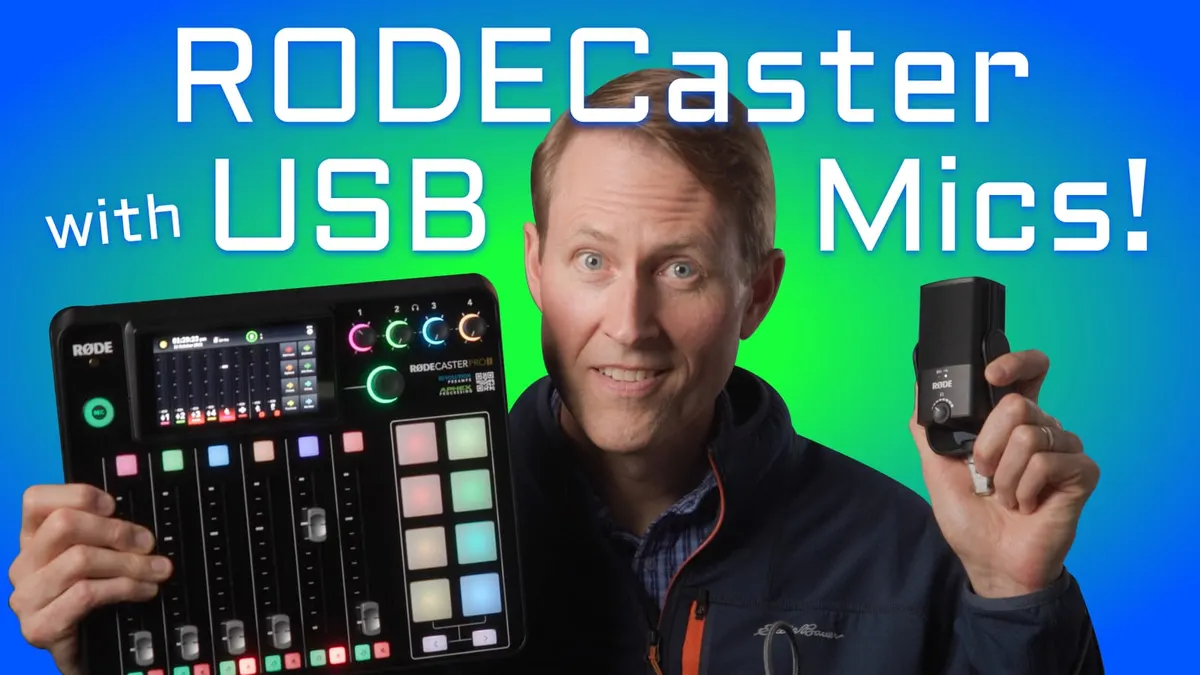
In this episode we try out RODE’s latest beta firmware update (1.3.2) for the RODECaster Pro II. This update adds a very exciting and much-requested capability: USB microphone support! What does this mean? The RCPII can now be used with most RODE USB mics via a direct USB-C connection, taking the RCPII’s capacity from 4 total mics to 5 and the Duo’s capacity from 2 total mics to 3. In this video we talk through the specifics, demonstrate how to connect your USB mics to the RODECaster, and listen to a sound quality sample compared to two standard XLR mic connections. Let’s take a closer look!
Gear used or mentioned
The links below are Amazon, B&H Photo, Sweetwater, or other affiliate links. As an affiliate, I earn from qualifying purchases.
- RODECaster Pro II All-In-One Production Studio — B&H, Sweetwater, Amazon
- RODE NT-USB Mini USB Microphone — B&H, Sweetwater, Amazon
- SHURE SM7B Cardioid Dynamic Microphone — B&H, Sweetwater, Amazon
- ElectroVoice RE20 Cardioid Dynamic Microphone — B&H, Sweetwater, Amazon
- Impact Turtle-Base C-Stands — B&H, Amazon
- Amaran 200x S LED light — B&H, Amazon, Aputure
- Aputure Light Dome II soft box — Aputure, B&H, Amazon
- Aputure Spotlight Mount — Aputure, B&H, DVE Store, Amazon
- Rosco Prismatic Glass Gobo in Cool Lavender — B&H
- Canon C70 Cinema Camera — B&H
- Canon RF 24-70 f/2.8 lens — B&H, Amazon
- Panasonic GH5 camera — B&H, Amazon
- Panasonic 12-35mm f/2.8 II lens — B&H, Amazon
Read the transcript
[MUSIC] In this episode, we’ll talk about a new beta firmware for the RODECaster Pro 2, which enables among other things using some RODE USB microphones directly into the RODECaster.
So you don’t need a computer, you can plug directly into the RODECaster Pro 2 with a variety of different RODE Mics. Now, I’ll go ahead and put up on the screen here the RODE Mics that are supported by this.
They have to be with some of the newer generation microphones.
But here, for example, we’re using my RODECaster Pro 2, which I bought with my own money.
We’re using a RODE NT-USB Mini, which RODE sent to me probably three years ago, right as it came out. And this is what it sounds like with no processing whatsoever.
Now, one of the magic things about some of the newer generation RODE Mics, in fact, I think all of the newer generation RODE Mics is that they have inbuilt processing.
And in fact, if I come in here, I can actually turn on a noise gate.
I can turn on a compressor. Here’s the compressor. And it also has the big bottom and aural exciter.
We’ll go ahead and turn those on as well, so you can hear what that sounds like.
So that’s with all of the processing turned on.
I can just turn it on and off right here from the RODECaster.
I don’t have to connect it to a computer to tune the settings or to turn them on or turn them off. In this case, the NT-USB Mini just has the ability to turn each of those features on or off. But go back to no processing whatsoever, and that’s what that sounds like as well.
So one thing you need to keep in mind is that if you want to make sure that you’re not hearing a lot of latency while you’re monitoring, especially yourself, you do need to plug your headphones directly into the microphone’s headphone jack, as opposed to the headphone jack on the RODECaster itself. So that’s just going to reduce the latency.
And then when we listen back to when I put my headphones on monitoring on this microphone, and I have other participants plugged in, so Dani and Emma as well, to XLR inputs on the RODECaster Pro 2, I’m not noticing any sort of distracting latency or anything like that, so I’m able to monitor all of that, hear all of that, and it works great.
So no issues with latency. Just remember to plug your headphones into the microphone itself if you’re the one using that microphone, and then everyone else that’s using XLR mics can use the headphone jacks on the RODECaster. This allows you to use up to five microphones simultaneously, and record five simultaneously, on the RODECaster Pro. Fantastic feature. Now, as I mentioned, all the processors work.
You can access them directly from the RODECaster.
The thing that’s unique about this is that there is no other recorder on the market, of which I’m aware, that you can plug a USB mic in directly.
Maybe I’ve missed one out there. I don’t know. RODE claims, this is the first in the market.
In any case, this is a unique feature, and a pretty handy one for those needing an additional microphone, or who already have one of the RODE USB microphones and want to be able to use it with their RODECaster Pro 2 or the RODECaster Duo.
Now, let’s get you a quick sample where we actually did kind of a podcast.
I had a Shure SM7B for myself, an ElectroVoice RE20 for Emma, and Dani was on the RODE NT-USB
Mini. I like to be able to hold it in my hands.
I think Spotify also removes a little bit of the interest besides just hearing the music, because you don’t have the liner notes, and you don’t have the album art, and that sort of thing. Oh, great deal, yes. Liner notes are important, because then you discover cool studio musicians.
That’s right. Yeah. Also, inner sleeves have proved to be a lot of fun.
There’s usually funky photos on there. [laughs] So is it really about the analog experience in terms of the album cover, the liner notes? Is that it? So there are some other features in this firmware update. We’ll come back and potentially cover those in a future episode.
In the meantime, nice job, RODE.
Get out there and make some great sound, and we’ll talk to you soon. [MUSIC]