
Video light reviews are boring, but the Godox PaletteLab SL300RF is good
· Lighting · 6:10
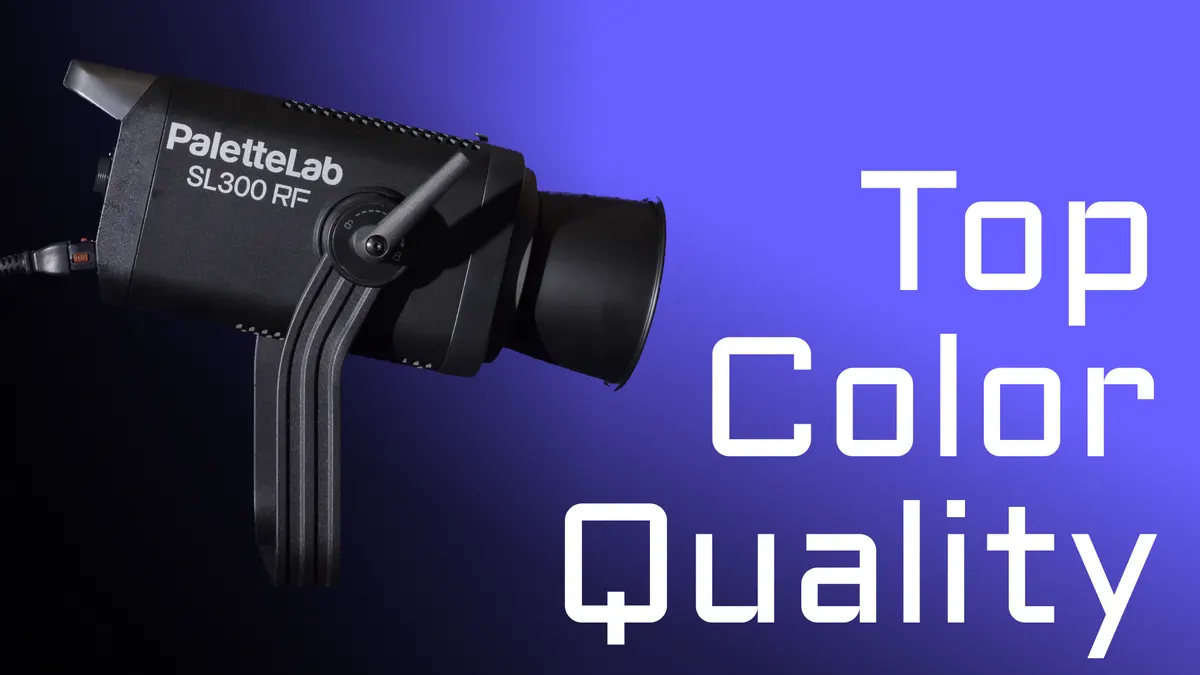
The Godox PaletteLab SL300RF LED light represents a more budget oriented option for sophisticated color engine LED lights. We compare it to its closest competitors, the amazon RAY series of lights. And overall, for my money, I’d opt for the Godox PaletteLab SL300RF.
Gear used or mentioned
The links below are Amazon, B&H Photo, Sweetwater, or other affiliate links. As an affiliate, I earn from qualifying purchases.
Read the transcript
LED light review videos are pretty boring. So we’re gonna go fast. This is the PaletteLab SL300RF from Godox. I’m saying Godox because that’s what I heard them say on their videos — like I would never sure whether it was Godox or Godox. We’re going with Godox. LED lights keep evolving, and one thing we’ve seen in the higher-end lights more recently is color engines, where they’re using multiple different colored LEDs to produce a smoother spectral output, so better color quality, so that when you get into post-production you’re not finding weird color responses on some of your things.
And that’s not just a camera thing. Cameras are expecting a specific kind of spectral output from lights, whether it’s the sun, a tungsten old-school tungsten light, or new LED lights. And the problem with LED lights, traditionally, has been that their spectral output is kind of all over the place.
We’re getting a lot better, especially on the high-end lights.
But here is a light that’s less than a thousand dollars, just over $700 — the PaletteLab SL300. It’s a 330 watt light. So it has a Bowens mount so you can use any Bowens mount accessories, light modifiers with it. Obviously, it’s going to be optimized for the Godox, you know, specific things when it comes to ellipsoidal lenses and things like that, but pretty much any softbox will work.
So what’s unique about the color engine here? The PaletteLab LED color engine has five different blue colored LEDs, three reds, one green, one cyan, and one amber.
So they’re taking a slightly different approach than some of the others like Aputure and Amaran and lots of others.
So when you combine these different colors, the idea is that you can get a smoother spectral output. And let’s go ahead and put the metrics up on the screen.
So I think the biggest competitor to this is going to be the Amaran Ray lights. I did not have the Amaran Ray 360, which would be the closest to this particular light. But I did have the 660, and this is putting out basically half of the light output of the 660 on the Ray side, and that tracks, so it’s pretty much the same light output color quality wise.
However, the PaletteLab from Godox is doing better than the Amaran Ray lights in terms of spectral similarity index. Now, those are just individual numbers. But if you look at the spectral output, this — you can see, especially for tungsten, this tracks traditional tungsten lights really, really well.
Like, you should not expect any color rendering issues with this. If you do have any issues, it’s going to be the color science of your camera most likely.
So that’s the first thing.
If you go to daylight — and daylight is always harder for LED lights to reproduce, because they tend to have this massive blue spike. And indeed, there is a blue spike here, but overall it tracks closer to daylight than the Amaran Ray does. And in fact, it is even really close to the Aputure Storm 400x I reviewed a while back.
So again, sells for $719 US. You can get a 230 watt version for $639.
And we scored an 85 SSI at daylight, 5,500 Kelvin, and 91 at 3,200 Kelvin, so tungsten.
That’s better than almost any RGB warm and cool white LED light that I’ve seen out there. Those are kind of the first generation RGB lights.
It’s better than the Amaran Ray in terms of color quality with equal output, basically, and it’s really quite close to the Aputure Storm 400x with its BLAIR light engine, which is one of the very good light engines out there. It actually did better by four points when it comes to tungsten, and it was just two points behind the Storm 400x when it comes to daylight, so…
That’s like basically — and it’s basically half the price. Yeah, about half the price, so that’s really impressive.
Now, I’m not saying that the Storm 400 is not worth it. The Storm has other production features that are going to be really important for those working on higher budget films and other productions where you need a super super rugged build, you’re gonna be putting massive modifiers on it, and you need that really tough Bowens mount.
But otherwise, for those of us doing really smaller, you know, smaller budget productions, PaletteLab is fantastic. So if I were buying today, I would probably look at the PaletteLab SL300RF over the Amaran Ray 360. That’s my experience.
So bonus here. There is one unique thing on the PaletteLab SL300RF, and the 200 as well. And that is that you can set the light curve that allows you to tune the light output. So this allows you to fine tune the output so you can match traditional sources or looks. You can experiment with these to see which you prefer for your particular situation.
There are three different settings. There’s the Godox curve, which is a proprietary balance optimized for modern CMOS camera sensors, to give you better skin tones and cinematic color response. Well here, we’ll put it up on the screen. Here.
You can do a blackbody curve, which follows the Planckian locus of traditional tungsten radiation, which is useful when matching your light to older incandescent sources. So if you’re going to mix and match with some tungsten lighting.
And then there’s daylight TM-30 curve, which skews slightly green to mimic natural sunlight passing through the atmosphere. And it prioritizes strict measurable color fidelity depending on the specific standard you’re using.
So here’s my wrap-up. We’re seeing more affordable lights that produce very good color quality at lower prices. I wouldn’t say super budget prices, but $719 for a 330 watt light with this kind of color quality is actually quite good. The Godox PaletteLab lights demonstrate that this technology is definitely coming into the more affordable lights.
Hope that was helpful! Get out there and make some great lighting designs. Talk to you again soon.