
Zoom F6: Is it time to upgrade your recorder?
· Audio · Recorders · 8:33
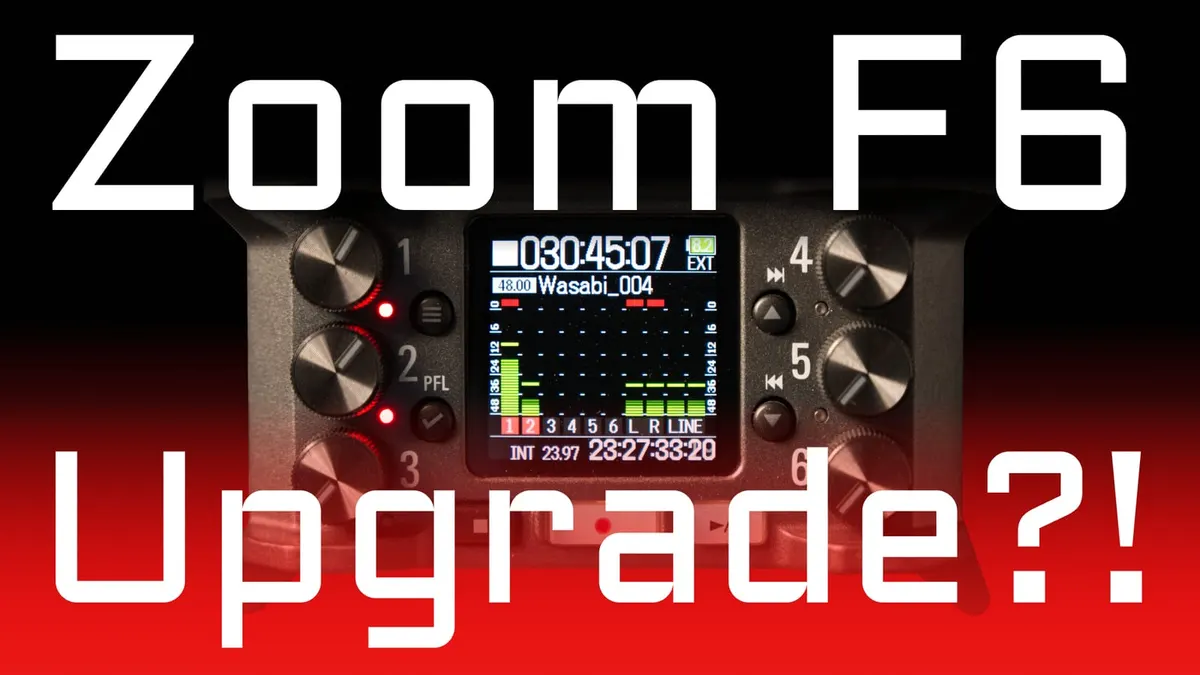
In this episode we discuss whether or not you should upgrade to a new recorder from your ZOOM F6. We cover things to consider when choosing a potential new recorder– and when to pass on shiny new tech. In this episode we examine what’s available on the market in late 2023, show you how to determine whether recorder features will be useful to your workflow, and give you some opinions on and examples of when it’s best to upgrade versus not. Let’s take a closer look!
Gear used or mentioned
The links below are Amazon, B&H Photo, Sweetwater, or other affiliate links. As an affiliate, I earn from qualifying purchases.
- Zoom F6 Field Recorder/Mixer — B&H, Sweetwater, Amazon
- Zoom F8n Pro Field Recorder/Mixer — B&H, Sweetwater, Amazon
- Sound Devices MixPre II Series — B&H, Sweetwater, Amazon
- Sound Devices 888 Field Recorder/Mixer — B&H, Sweetwater
- Sennheiser MKH 50 Supercardioid Condenser Microphone— B&H, Sweetwater, Amazon
- Sennheiser MKH 416 Supercardioid Shotgun Microphone — B&H, Sweetwater, Amazon
- Sennheiser MKH 8050 Supercardioid Condenser Microphone — B&H, Amazon
- Mogami XLR cables — B&H
- Canare XLR cables — B&H
- Impact Turtle-Base C-Stands — B&H, Amazon
- Amaran 200x S LED light — B&H, Amazon, Aputure
- Aputure Light Dome II soft box — Aputure, B&H, Amazon
- Aputure Spotlight Mount — Aputure, B&H, DVE Store, Amazon
- Rosco Prismatic Glass Gobo in Cool Lavender — B&H
- Canon C70 Cinema Camera — B&H
- Canon RF 24-70 f/2.8 lens — B&H, Amazon
- Panasonic GH5 camera — B&H, Amazon
- Panasonic 12-35mm f/2.8 II lens — B&H, Amazon
Read the transcript
[Music] Should you upgrade your Zoom F6? It’s late 2023- I’m not sure, but do me this favor: down in the comments below, go ahead and tell me what’s not working well with your Zoom F6, and then I can go and actually answer each of those individually. So in short, it depends, and to a large extent probably the answer is no- it probably is not going to do you a lot of good to upgrade your Zoom F6 in most circumstances. There are some circumstances where I think it will. This entire episode is being recorded with a Zoom F6 right here, and we’re just actually recording in 24-bit, 48 kHz- we’re not even using 32-bit float, more on that later. So I’ll wait here while you put your answer down below: what’s not working well with your Zoom F6.
Let’s talk first about some reasons for upgrading that I don’t think are probably valid and probably won’t get you your money’s worth if you do upgrade, and the first one would be “I want better audio quality.” If you’re not getting good audio quality with your Zoom F6, it’s probably not the recorder, it’s probably something else, it’s probably your microphone, the cable, or your technique. So if you’re still putting your microphone on top of your camera, you’ve got to change that if you want better audio quality- if you don’t care, or if it’s good enough on the camera, fine- but a new audio recorder is probably not going to get you better audio quality, so just be aware of that. The kind of fundamental thing here is that the microphone is going to impart the biggest impact in terms of your audio quality, along with where you position that microphone. In our case here we’re using a Sennheiser MKH50, it’s right here, just barely out of the frame- that’s the reality. So if you think you’re going to get better audio quality by upgrading to a MixPre-10 II, probably not; Zoom F8n Pro, probably not; Sound Devices 833, probably not- it’s probably more to do with your microphone and where you place it. Sorry to break that to you, because if you’ve got money burning a hole in your pocket, it’s just probably not going to make that big of a difference.
“I just feel like I’ve grown out of the F6.” Well if that’s one of your reasons as well, I would say get more specific than that- is there something about the Zoom F6 that’s not working for you? Does it take too long to set up? Are you finding it difficult to use because of where the buttons are laid out? That could be legitimate. Now if you were trying to use this in a sound bag, say you’re a dedicated sound person on some of your projects and you’re trying to operate this from a sound bag, I think that’s actually a legitimate reason to say, you know what, maybe the Zoom F6 is not the best fit for us- maybe it would be fine for those situations where I need to, for example, mic up the interior of a car and send them off, that’s actually a really good use case for a Zoom F6- but if you are booming a microphone and you’ve got the recorder in a sound bag all day long, I find that the ergonomics of the F6 are not that great, and that might be a legitimate reason, for example, to go with a Zoom F8n Pro. Is it going to change the sound quality directly? No, it’s the same preamps, pretty much everything, except the ergonomics of the knobs and buttons and how you control it are better, so what that’s going to mean and how it’s going to translate into better audio quality is it’s going to be easier for you to get things where you need them to capture good audio.
So it’s really important to understand that most people assume if I spend more money it will sound better- it’s actually, once you get past like $600 on a recorder, you might get tiny incremental gains in terms of audio quality, but the bigger things are going to be more ergonomics, inputs and outputs, and things like that. There are a variety of other legitimate reasons for upgrading, and that might be if you’re working more and more in production sound, you’re getting hired for little gigs, little commercial pieces or whatever, and you find yourself on a set where you need to actually feed wireless audio to a director or a producer or a script supervisor or whatever- that might be a valid reason to go with something more like a Zoom F8n Pro.
There’s also the question of, if you did upgrade, what would you upgrade to? A lot of people are like, well, if I upgraded to a MixPre-10 II, would that be a better recorder? Well, it depends on what you’re doing, and I don’t think it’s going to sound a whole lot different- tiny, tiny bit, you get a tiny tiniest bit more bass response in the MixPre, but 99.9% of your audience is not going to notice that, so I don’t think that in of itself is a reason to spend almost $2,000 on an upgraded recorder from a Zoom F6, so I don’t really think that’s it. Just to illustrate this point, at some point in this video we switched from recording with the Zoom F6 to a Sound Devices 888- can you tell where? Put the time in the comment down below, I’ll let you know if you got it right.
My point is this: quit letting money burn a hole in your pocket. A few pieces of advice, some great ideas from my friend Bandrew over at the Podcastage YouTube channel- also, Bandrew says Podcast- he had some advice which was, if you are thinking about buying something, write it down on a list and wait at least 30 days, and if at the end of the 30 days you still think it would be useful for you, go ahead- that’ll help eliminate the kind of impulsiveness from the purchase and give your mind some time to think about it actually logically, in a cool, rational fashion, instead of an “oh, I just need this” reaction. That’s a really good piece of advice. If you’re running a business and you need to solve a specific problem, do your research and buy if it’s going to solve a problem; if you’re not sure, hire someone you can consult with who has experience in that area and let them make the mistakes for you, or let their experience help prevent you from making the same mistakes.
So a lot of things to think about- I just want you all to have the benefit of experience from my mistakes, buying things that I didn’t need, and I actually feel like at this point, now, with all of the equipment that I have here, I feel very little need to upgrade. Obviously if you have an 888, why would you need to upgrade? But it’s similar to- if you’re running a YouTube channel, why do you need an Arri Alexa LF Mini? You don’t, you do not, you can get great video without that, and nobody’s going to notice and nobody’s going to care- it’s going to be just an ego or a vanity thing for you.
So another thing I’d like to talk about just quickly is 32-bit float- frankly I almost never use 32-bit float, it just doesn’t solve any problems for me, and if you think that upgrading to a recorder from something else that doesn’t do 32-bit float is going to answer all of your problems, you can stick your microphone on top of your camera and you don’t have to care and you’re going to get perfect Hollywood sound every single time- you are deluded, and you need to stop thinking that way. 32-bit float does not solve all the problems- in fact it solves very few problems- and there are still going to be audio engineers out there, there’s still going to be production sound mixers and boom operators out there- 32-bit float does not take away their jobs, it just doesn’t solve any of those problems. So I just don’t see 32-bit float as the end-all. I’ve also got- I can’t tell you how many notes I’ve gotten from people saying, oh, I recorded this whole thing in 32-bit float, then I delivered it to my client and their post team says they want it in 24-bit, what do I do? It’s another example- why did you record it in 32-bit float, what advantage was there?
And yeah, I understand if you’re a solo operator, and you know, you’re operating the camera, the lighting, you’re doing the interview, you’re also operating sound- okay, it could help if you manage to set the gain incorrectly, but why are you not listening with headphones if you’re doing that- you would know right away if there was a problem with that. So it’s just not worth the upgrade from my point of view- it doesn’t sound better in and of itself. So this was just a little bit of tough love, because I love you- get out there and make some great sound.